
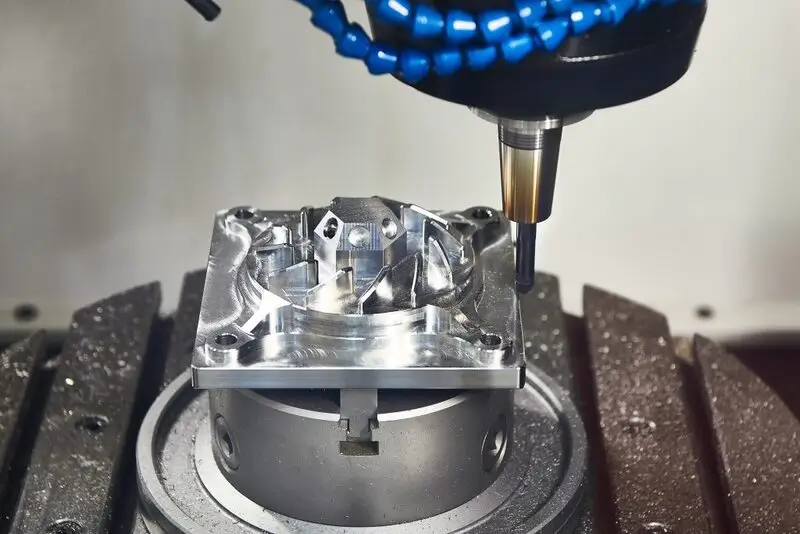
1. What is CNC Prototyping?
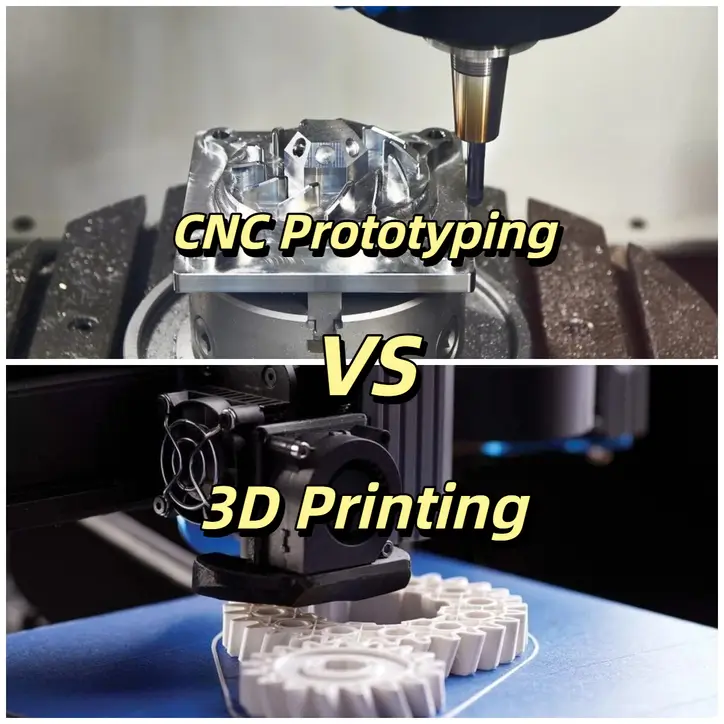
CNC prototyping is a subtractive manufacturing process that uses computer-controlled milling and turning machines to machine parts from solid material blocks. It delivers high dimensional accuracy and repeatability, with tolerances commonly reaching ±0.05 mm or better, making it ideal for precision and functional prototypes.
At ZH Precision, we use 3-axis to 5-axis CNC machining to produce complex prototype parts with consistent quality. CNC prototyping supports a wide range of production-grade materials, including aluminum, stainless steel, engineering plastics, and other alloys, allowing prototypes to be tested under real working conditions.
This makes CNC prototyping the preferred choice for functional testing, structural validation, and assembly verification, where strength, durability, and precision are critical.
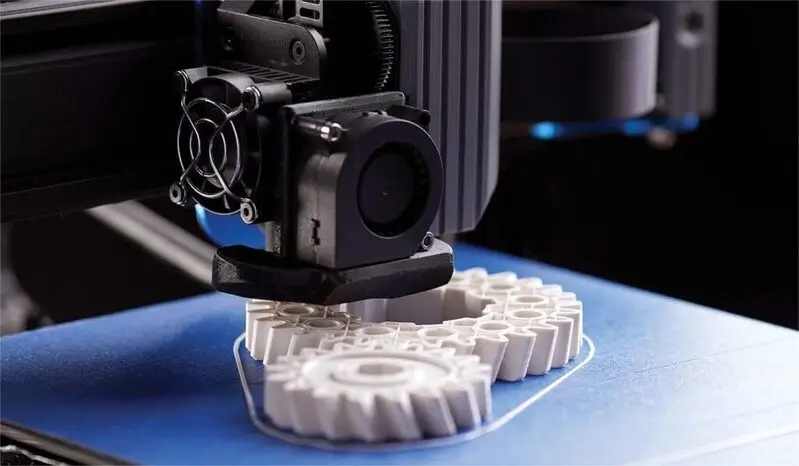
2. What is 3D Printing?
3D printing is an additive manufacturing process that builds parts layer by layer directly from a digital model. Unlike CNC prototyping, which removes material from a solid block, 3D printing deposits material only where needed, enabling the creation of complex internal structures and lightweight geometries that are difficult or impossible to machine.
Common technologies include FDM, SLA, SLS, and DMLS, supporting a range of plastics and metals. 3D printing is widely used for early-stage concept validation, design iteration, and complex geometry evaluation.
Typical tolerances range from ±0.2 to ±0.3 mm, depending on the process and material. While this is sufficient for visual models and fit checks, it is generally not suitable for high-precision functional parts or tight assembly requirements.
3. CNC Prototyping vs 3D Printing: Detailed Comparison
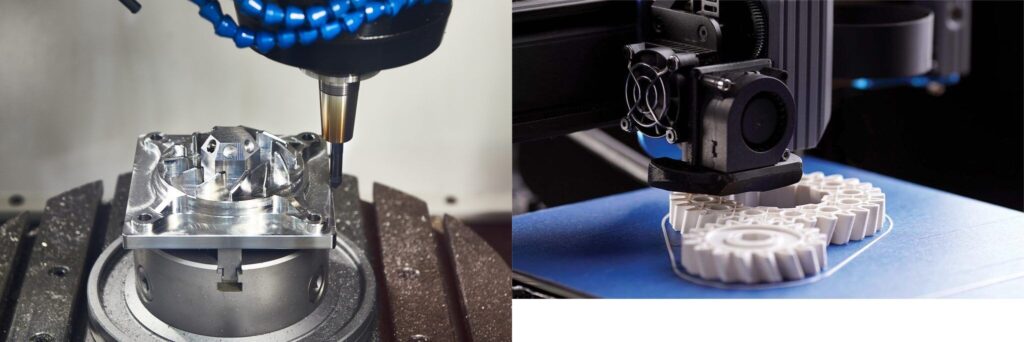
Choosing between CNC prototyping and 3D printing depends on several engineering factors, including material performance, dimensional tolerance, geometric complexity, production speed, and cost efficiency.
CNC prototyping is best suited for functional parts that require tight tolerances, production-grade materials, and consistent mechanical performance. 3D printing, on the other hand, is ideal for early-stage concept validation and complex geometries where design flexibility and rapid iteration are more important than precision or material strength.
Material Options
CNC prototyping supports a wide range of production-grade metals and engineering plastics, including aluminum, stainless steel, steel alloys, brass, ABS, PC, and nylon. Because the material properties match those used in mass production, CNC prototypes can be used for functional testing, structural validation, and assembly verification.
3D printing primarily uses thermoplastics and photopolymer resins, such as PLA, ABS, nylon, and resin materials, with limited metal options through processes like DMLS. While this provides good design flexibility, most 3D printing materials do not match the mechanical strength, heat resistance, or durability of CNC machined materials, making them less suitable for functional and load-bearing parts.
Tip: If your project requires high-strength metals or engineering plastics, CNC prototyping is often the best choice. ZH Precision specializes in machining challenging materials with consistent quality.
Precision and Tolerance
CNC prototyping delivers high dimensional accuracy and repeatability, with typical tolerances of ±0.01 to ±0.05 mm, making it suitable for tight assemblies, functional testing, and precision mechanical components. Parts can be directly used for fit verification and performance validation.
3D printing usually achieves tolerances between ±0.2 and ±0.3 mm, depending on the process, material, and build orientation. While this is sufficient for concept models and visual prototypes, it is not ideal for parts that require strict dimensional control or reliable mechanical performance.
Note: For tight tolerances and fine details, CNC prototyping delivers superior results. ZH Precision’s advanced equipment ensures your parts meet strict accuracy requirements.
Design Complexity and Geometry
CNC prototyping is limited by cutting tools and fixturing, which means extremely complex internal channels or undercuts may require multiple setups or special tooling. However, it produces highly accurate and structurally reliable parts suitable for functional testing.
3D printing excels at producing complex geometries, including internal channels, lattice structures, and lightweight designs that are difficult or impossible to machine. This makes it ideal for early-stage design validation and geometry optimization.
Production Speed and Lead Time
CNC prototyping requires programming, tooling, and setup, but once prepared, it delivers consistent parts quickly and is highly efficient for small to medium batches. Lead times typically range from a few days to one week, depending on complexity.
3D printing has minimal setup requirements and can produce parts within 24–48 hours, making it ideal for rapid concept iteration and early design testing.
Cost and Scalability
CNC prototyping has higher initial setup costs due to programming and fixturing, but the per-part cost decreases significantly for small to medium batch production. It is the most cost-effective solution for functional prototypes and production-ready parts.
3D printing has low startup cost for single pieces, but the cost per part increases rapidly with quantity, making it less suitable for batch production or production-intent parts.
Volume & Scalability
CNC prototyping scales from one-off prototypes to small-batch production. At ZH Precision, we support single prototypes through low-volume runs using production-grade materials. As batch size grows, costs drop thanks to reusable fixtures and optimized machining, allowing smooth transition from prototype to production with reliable accuracy.
3D printing works best for single prototypes and very small batches, offering fast iteration and minimal setup. Costs per part stay relatively high as volume increases, and material strength may not match production-grade parts, making it less suitable for functional or load-bearing applications.
4. When to Choose CNC Prototyping
High-Precision Applications
Choose CNC prototyping when your project requires high precision, functional performance, and production-grade materials. It is ideal for industries like aerospace, automotive, and medical, where parts must meet strict tolerances and regulatory standards. CNC prototyping can achieve tolerances as tight as ±0.05mm, ensuring every detail matches specifications. At ZH Precision, we use advanced CNC equipment and experienced technicians to deliver accurate and reliable parts for applications such as aircraft brackets, engine prototypes, and surgical instruments, providing a seamless path from prototype to small-batch testing.
Get Your CNC Prototype Quote Now
ZH Precision provides professional CNC prototyping from single prototypes to on-demand small batch production. We ensure precise tolerances, fast delivery, and consistent high-quality results for every part.
Get QuoteFunctional Testing
CNC prototyping is the preferred method when prototypes must perform like final products during functional testing. By using production-grade metals and engineering plastics, parts accurately reflect real mechanical strength, durability, and fit. At ZH Precision, our advanced CNC equipment and experienced technicians ensure prototypes withstand stress tests, assembly trials, and operational simulations. This approach allows iterative design improvements, enabling engineers to validate and refine products before moving to full-scale production.
On-Demand Production
ZH Precision offers CNC prototyping and manufacturing on demand, supporting projects from a single prototype to small- or medium-batch production. No matter the quantity, we ensure consistent quality, tight tolerances, and reliable performance. Our optimized CNC workflows, automated machining, and rigorous quality control allow rapid turnaround and repeatable accuracy for every part, providing a seamless path from initial prototype to low-volume production.
5. When to Choose 3D Printing
Complex Geometries
Choose 3D printing when your design includes intricate or organic shapes that are difficult or impossible to produce with CNC prototyping. This technology allows you to create parts with internal channels, lattice structures, or complex curves in a single build without multiple setups or tool changes. With minimal design-for-manufacturing constraints, 3D printing enables rapid innovation and concept validation, making it ideal for prototypes that prioritize geometry complexity and early-stage design testing.
Rapid Prototyping
3D printing offers a major speed advantage for early-stage prototypes. Digital models can be transformed into physical parts within hours, allowing engineers to quickly validate concepts, test fit, and refine designs without waiting days or weeks. Unlike CNC prototyping, which requires tooling, programming, and setup, 3D printing enables rapid iteration and fast design feedback, making it ideal for concept validation and small-scale experimentation.
6. How to Pick the Right Process Between CNC Machining vs. 3D Printing
1. Project Purpose
If you need a functional prototype that must perform like the final part, withstand stress, or be used in assembly testing, CNC prototyping is the better choice. For visual models, concept validation, or design iteration, 3D printing provides speed and flexibility.
2. Material & Strength Requirements
Choose CNC prototyping when your parts require production-grade metals or engineering plastics with high durability. 3D printing works well for less demanding materials and designs that prioritize geometry or rapid iterations.
3. Precision & Complexity
CNC prototyping delivers tight tolerances (±0.05mm) and high repeatability, ideal for precise, functional parts. 3D printing allows complex geometries and internal structures that may be impossible or costly to machine but with lower precision (±0.2–0.3mm).
4. Volume & Turnaround
For single prototypes or very small batches needing fast feedback, 3D printing is ideal. CNC prototyping supports single parts up to low-volume production with consistent quality, and scales efficiently as quantity grows.
7. Conclusion
Choosing the right prototyping approach depends on your project’s goals, required materials, precision, and production volume. CNC prototyping is ideal for functional, high-precision parts and supports on-demand production, from a single prototype to low-volume production. At ZH Precision, we specialize in delivering consistent quality, tight tolerances, and fast turnaround for each project. By understanding your requirements and leveraging CNC prototyping, you can confidently move from design to functional prototype and small-batch production with reliable results.
8. FAQ
You gain superior precision and material strength with CNC prototyping. ZH Precision delivers tight tolerances and excellent surface finishes, making this method ideal for functional testing and end-use parts.
Yes. You can combine 3D printing for complex shapes and CNC machining for high-precision features. ZH Precision often recommends this hybrid approach to maximize performance and efficiency.
You should consider your part’s function, required strength, and operating environment. ZH Precision helps you select the best engineering metals or plastics for CNC prototyping, ensuring your prototype meets all specifications.
You see the greatest impact in aerospace, automotive, and medical fields. ZH Precision supports these industries with reliable, high-precision CNC prototypes that meet strict quality standards.