
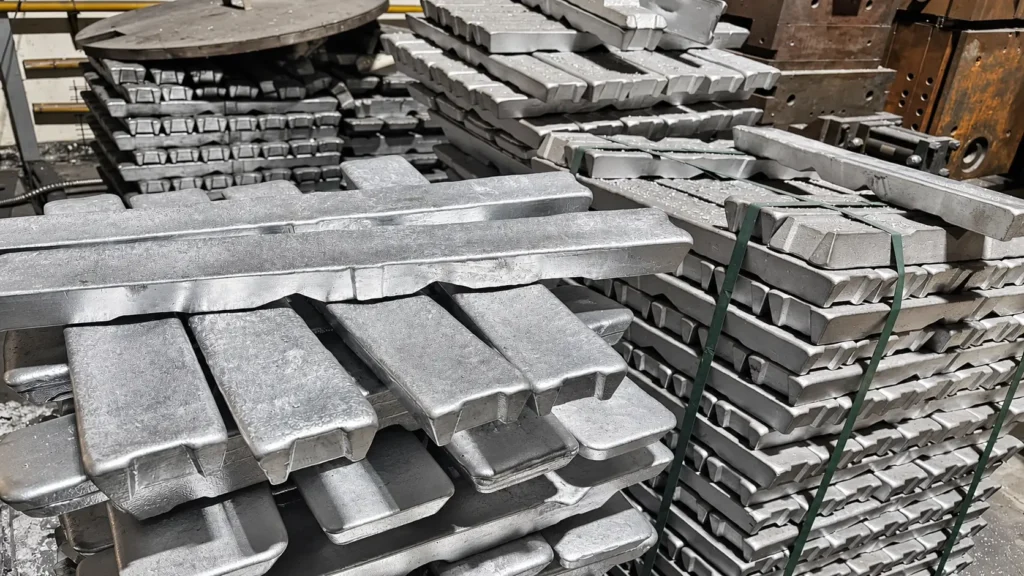
A380 Aluminum Alloy
A380 is an aluminum-silicon-copper alloy widely used in high-pressure die casting. It offers a practical balance of castability, strength, and machinability for housings, covers, brackets, and other custom components.
Explore its composition, properties, typical applications, and cost factors to assess whether A380 suits your part’s design and manufacturing requirements.
Home » Services » Aluminum Die Casting » A380 Aluminum Alloy
A380 Aluminum Chemical Composition
A380 is an aluminum-silicon-copper casting alloy, with aluminum forming the balance of its composition. Silicon and copper are the main alloying additions, while other elements are controlled within specified limits.
The table below lists published composition limits for A380 die castings. Values are percentages by weight; maximum limits should not be interpreted as fixed amounts present in every batch.
| Element | Content (% by Weight) |
|---|---|
| Aluminum (Al) | Balance |
| Silicon (Si) | 7.5–9.5 |
| Copper (Cu) | 3.0–4.0 |
| Iron (Fe) | 1.3 max |
| Manganese (Mn) | 0.50 max |
| Magnesium (Mg) | 0.10 max |
| Nickel (Ni) | 0.50 max |
| Zinc (Zn) | 3.0 max |
| Tin (Sn) | 0.35 max |
| Other Elements, Total | 0.50 max |
A380 Aluminum Physical Properties
A380’s physical properties help assess part weight, heat transfer, and dimensional changes with temperature. The table below summarizes typical reference values for the alloy.
| Property | Typical Value |
|---|---|
| Density | 2.71 g/cm³ |
| Melting Range | 540–595°C |
| Electrical Conductivity | 23% IACS |
| Thermal Conductivity | 96.2 W/(m·K) |
| Coefficient of Thermal Expansion | 21.8 µm/(m·K) |
| Specific Heat Capacity | 963 J/(kg·K) |
A380 Aluminum Mechanical Properties
Mechanical properties describe how A380 responds to loading and deformation. The values below are typical reference data, rather than guaranteed properties for every casting. Actual performance depends on casting quality, section thickness, and test conditions.
| Property | Typical Value |
|---|---|
| Ultimate Tensile Strength | 324 MPa |
| Impact Energy | 4 J |
| Yield Strength | 160 MPa |
| Elongation (50 mm Gauge Length) | 3.5% |
| Shear Strength | 190 MPa |
| Brinell Hardness | 80 HB |
A380 Aluminum vs 6061 Aluminum
A380 and 6061 are designed for different manufacturing routes. A380 is primarily used for die casting, while 6061 is commonly supplied as plate, bar, and extruded profiles. The choice depends on part geometry, production quantity, and the properties required in the finished component.
| Comparison | A380 Aluminum | 6061 Aluminum |
|---|---|---|
| Alloy Type | Aluminum-silicon-copper casting alloy | Aluminum-magnesium-silicon wrought alloy |
| Common Product Form | Die cast components | Plate, sheet, bar, and extruded profiles |
| Typical Manufacturing Route | Die casting followed by machining where required | Machining, extrusion, forming, or fabrication |
| Strength Comparison | Depends on casting quality and test conditions | Depends on temper, product form, and thickness |
| Heat Treatment | Solution heat treatment requires assessment of blistering risk | Available in heat-treated tempers, including T6 |
| Typical Selection Reason | Complex cast shapes with integrated features | Machined parts, structural profiles, and fabricated components |
| Cost Considerations | Tooling investment, casting quantity, and secondary operations | Stock size, material removal, machining time, and fabrication |
Advantages of A380 Aluminum
A practical balance of castability, mechanical performance, and cost.
- Good castability
Supports detailed shapes, ribs, and bosses, allowing multiple features to be incorporated into one casting.
- Strength at low weight
Combines relatively low density with useful as-cast strength for components where weight matters.
- Economical material choice
Widespread use and established supply make A380 a practical option for general-purpose die cast parts.
- Useful thermal conductivity
Transfers heat through the component, making it an option for housings and other parts with thermal requirements.
Disadvantages of A380 Aluminum
Material limitations to consider alongside its advantages.
- Limited ductility
Relatively modest elongation makes it less suitable for applications requiring substantial bending or deformation.
- Corrosion protection may be needed
Exposure to moisture, salts, or chemicals may require a protective finish rather than relying on the bare alloy.
- Heat-treatment restrictions
Entrapped gas can cause blistering during solution heat treatment of conventional high-pressure die castings.
- Sensitivity to casting defects
Porosity and other defects can affect local strength and pressure tightness. Alloy data alone does not establish finished-part performance.
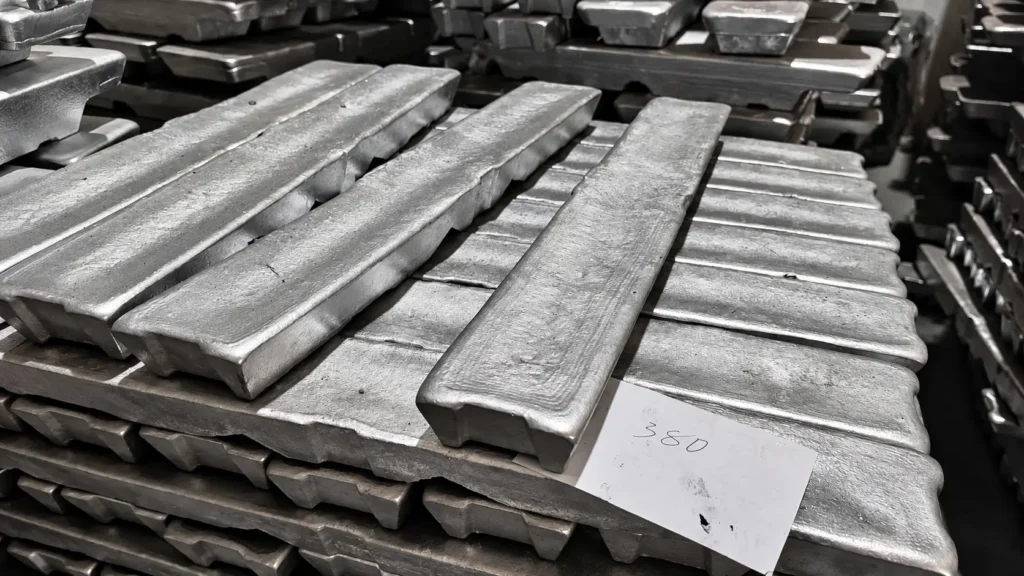
Manufacturing Processes for A380 Aluminum
A380 is primarily used in cold-chamber high-pressure die casting, where molten alloy is injected into a reusable steel mold. This process produces near-net-shape components with integrated ribs, bosses, and other detailed features.
After casting, CNC milling, drilling, and tapping can be used to finish holes, threads, and mating surfaces.
Surface treatments may then be selected according to appearance, corrosion protection, and functional requirements.
What Is A380 Aluminum?
A380 is an aluminum-silicon-copper alloy primarily used in high-pressure die casting. Aluminum forms the base, with silicon and copper as the main alloying additions. It belongs to the casting alloy family, unlike wrought grades such as 6061, which are commonly supplied as plate, bar, or extrusions.
The designation identifies a material composition—not a finished-part specification. Casting conditions, wall thickness, and internal soundness also influence component performance, so drawing requirements and inspection criteria must be considered alongside the alloy grade.
Applications of A380 Aluminum Alloy
A380 aluminum is commonly used for die cast parts that combine complex shapes with moderate weight and functional strength. Typical applications include:
Automotive components: Transmission cases, covers, and brackets with cast features and machined mounting interfaces.
Electrical and electronic enclosures: Protective housings with integrated ribs, fixing points, and openings for connectors.
Industrial equipment: Machinery housings, end covers, and support components requiring repeatable shapes for batch production.
Power tools and appliances: Tool bodies, motor housings, and equipment frames that combine structural support with compact designs.
Suitability depends on the component’s loads, operating temperature, exposure conditions, and finishing requirements.
Frequently Asked Questions
A380 is commonly used as a shortened name for A380.0. In the Aluminum Association designation system, the decimal suffix “.0” identifies the alloy in casting form. Purchase specifications should state the complete designation and applicable standard.
A380 and ADC12 are different alloy grades with different composition requirements. They should not be treated as interchangeable without reviewing the specified standard, part requirements, and customer approval.
Heat treatment requires careful assessment. Conventional high-pressure die castings can contain entrapped gas that causes blistering during solution treatment. Any proposed treatment must account for the casting process, material condition, and required properties.
Yes, but its silicon and copper content can affect coating appearance and color uniformity. For decorative applications, confirm the required finish using representative samples before approving production.
A380 provides corrosion resistance for many general applications, but it is not corrosion-proof. Exposure to salts, chemicals, or persistent moisture may require a protective coating or a different alloy.
No. Published values generally represent specified test conditions or typical reference data. Finished-part properties depend on casting quality, section thickness, and material condition. Required acceptance values and test methods should be agreed before production.