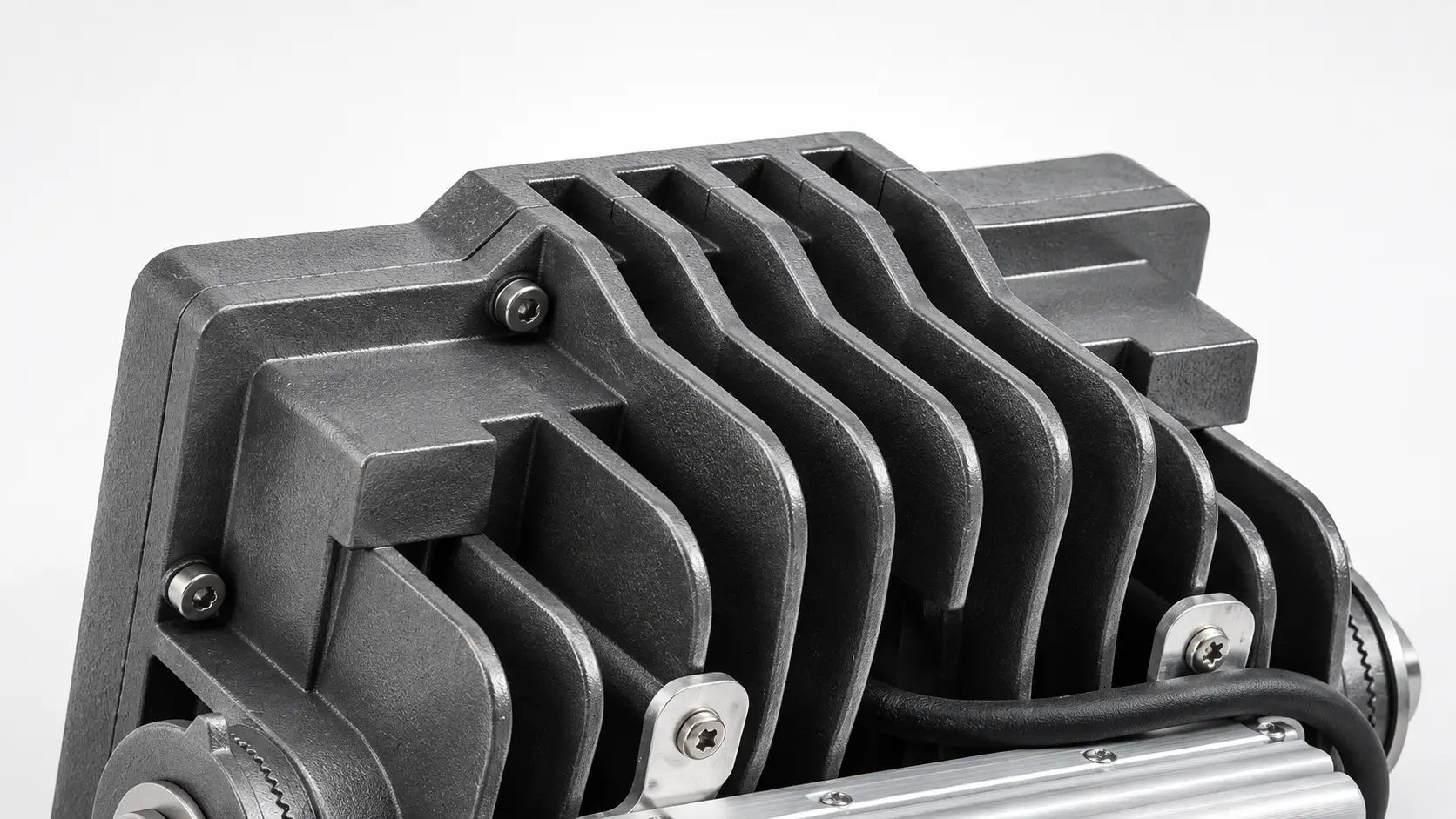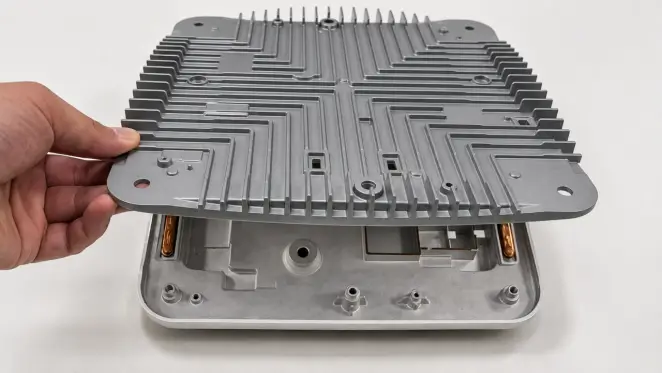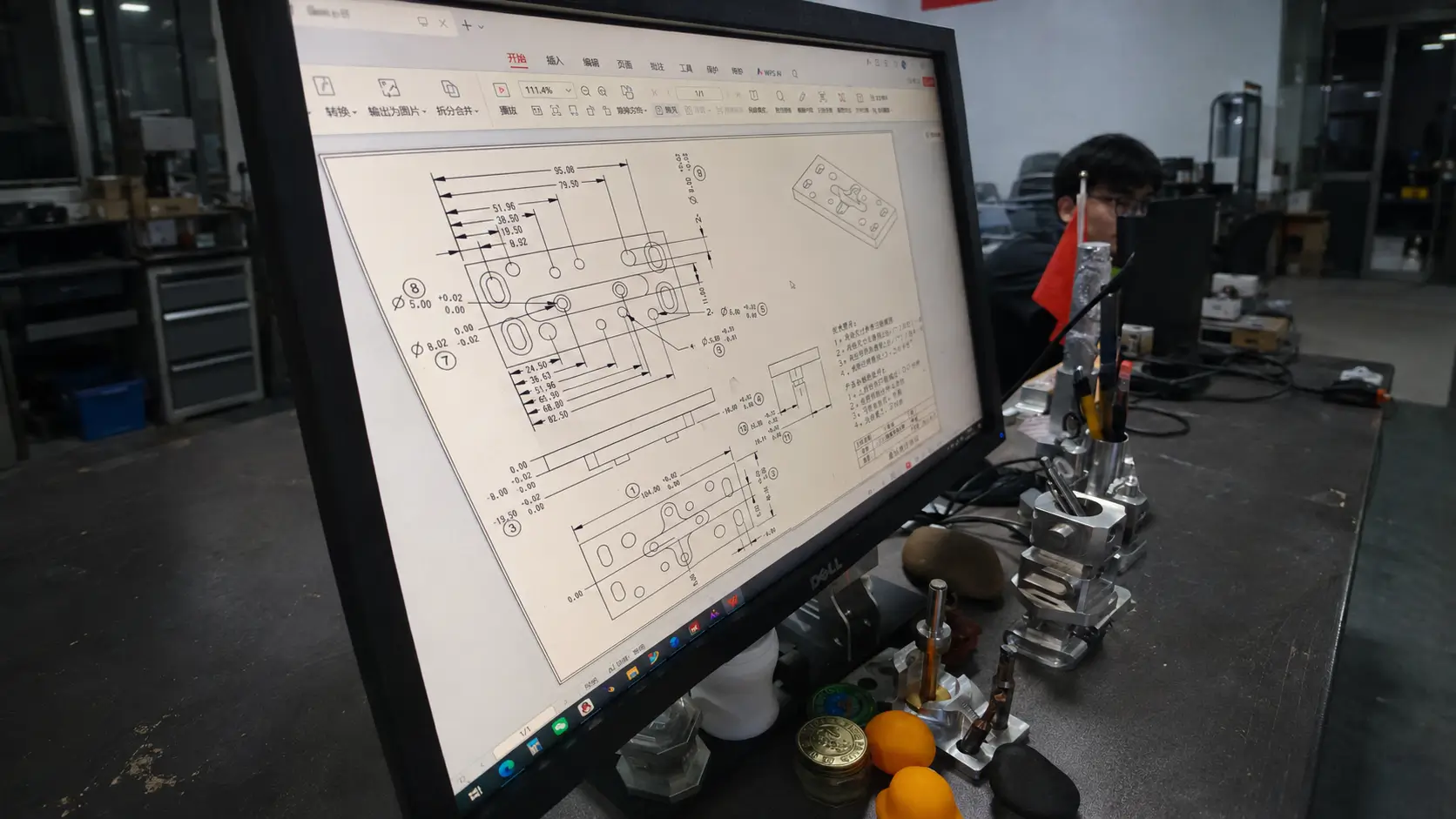

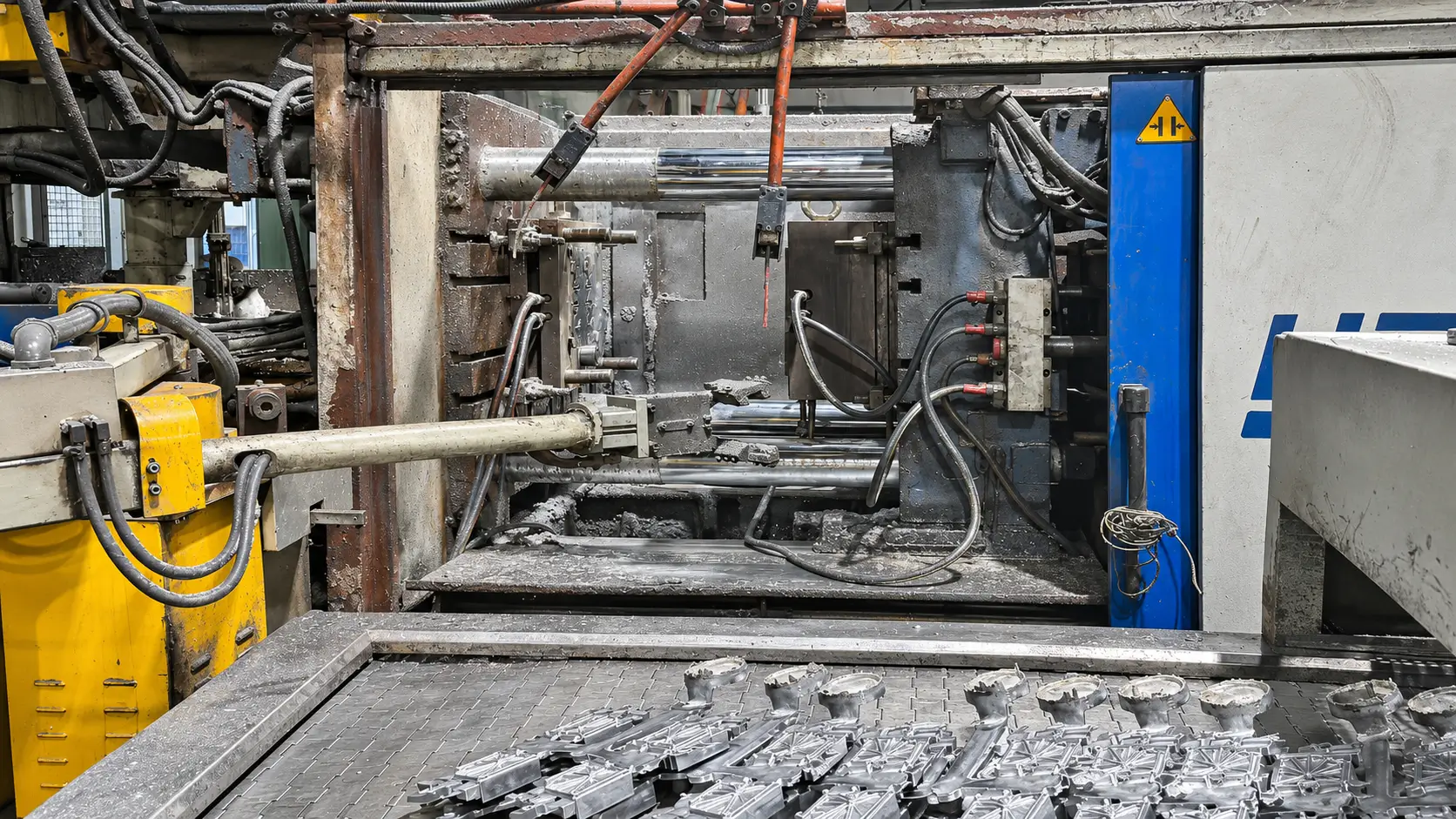
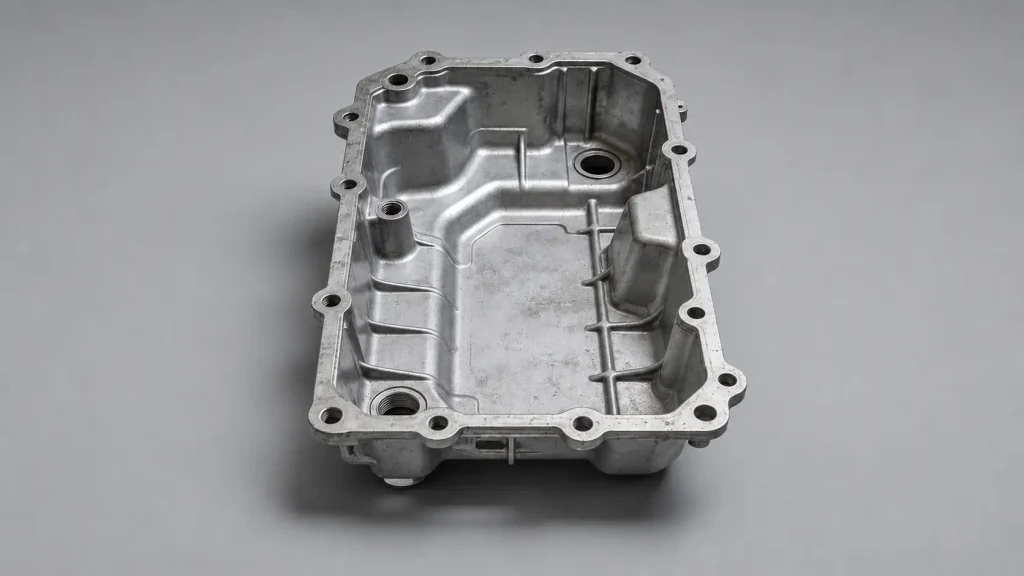
Die casting is useful for making complex metal parts in repeat production. Thin walls, reinforcing ribs, and mounting bosses can often be formed together in one piece, reducing the need for separate parts or assembly steps. Using the same die helps keep part geometry consistent from one production cycle to the next.
Before investing in tooling, start with the part drawing and expected production volume. Identify which features can be formed in the die and which critical surfaces may still need machining. This gives you a practical starting point for deciding whether die casting suits the part and whether the expected volume can justify the cost of the die.
How Does Die Casting Work?
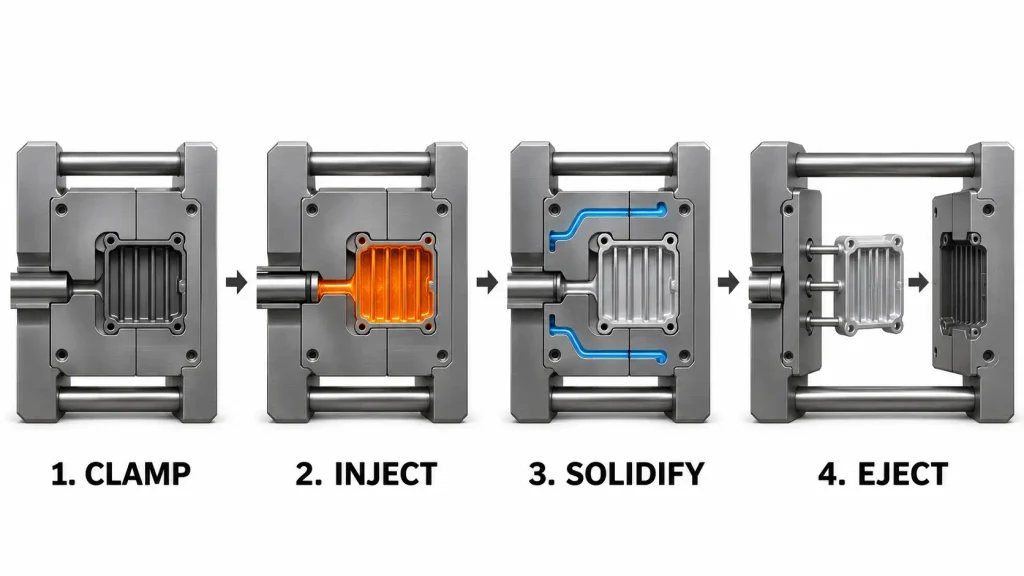
A die casting machine clamps a steel die shut, injects molten metal into it, and opens the die once the casting is solid enough to remove. One injection is called a shot. After the casting is ejected, the machine can close the die for the next shot.
- Close and clamp the die. The machine holds the two die halves together against the force generated during injection.
- Inject the molten metal. The metal fills the cavity under pressure. It must reach thin sections and fine details before solidification restricts the flow.
- Let the metal solidify. The steel die draws heat from the metal. The die stays closed until the casting can hold its shape during removal.
- Open the die and eject the casting. Ejector pins push the casting out. Any attached runner or overflow metal can then be trimmed away.
For a step-by-step explanation of the full production sequence, see the die casting process guide.
What Does a Die Casting Mold Do?
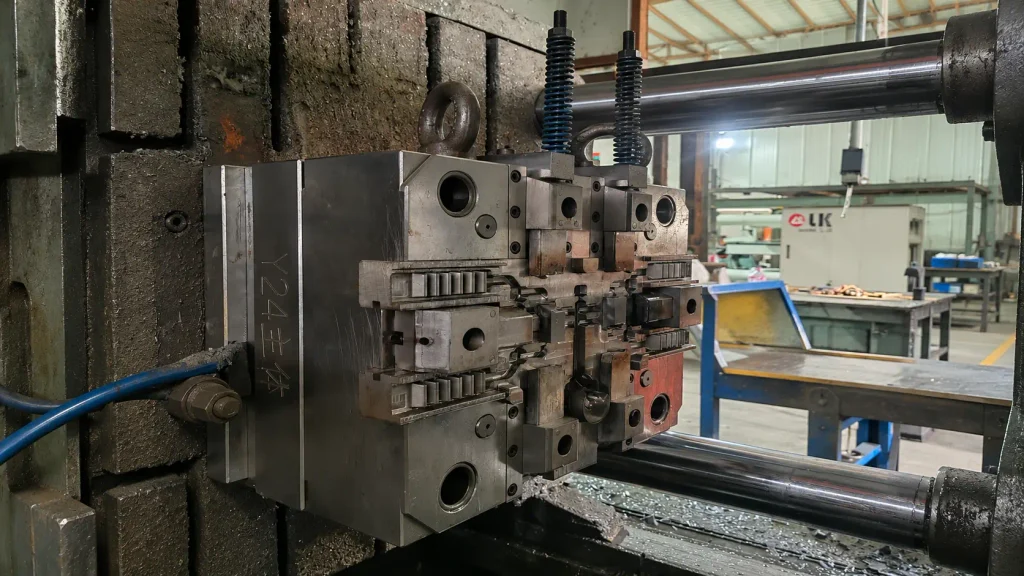
The cavity and cores give the casting its shape. The rest of the die helps produce that shape consistently from shot to shot. Runners and gates carry molten metal into the cavity, vents let displaced air escape, and cooling channels help control die temperature. After the die opens, ejector pins push the casting out.
Where these features sit matters. Trimming a gate can leave a mark, and ejector pins can leave small impressions. A mark on a hidden face may be acceptable. On a visible cover, it can affect appearance. On a gasket seating face, it may interfere with the seal if it falls in the gasket’s contact path.
Before the die layout is finalized, mark visible faces, sealing surfaces, and areas that will be machined on the drawing. Ask the die caster where the gates, ejector pins, and parting line will leave traces. That review helps determine which surfaces can stay as cast and which need trimming, machining, or a change to the die layout.
What Are the Main Types of High-Pressure Die Casting?
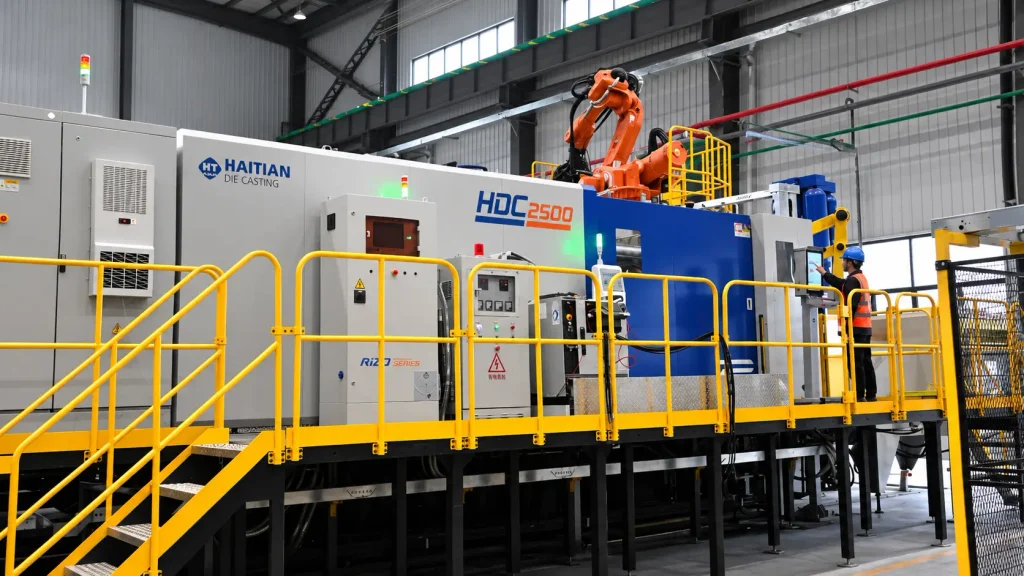
High-pressure die casting uses two main injection systems: hot chamber and cold chamber. They differ in how molten metal is supplied to the injection mechanism, which determines alloy compatibility, part size limitations, and production cycle times.
In hot-chamber die casting, the injection mechanism is connected directly to the molten metal bath. A plunger forces metal through a gooseneck and into the die, allowing the injection system to refill between shots without a separate ladling step. This supports relatively short cycle times and is commonly used for zinc alloy parts with fine details, such as connector housings and lock hardware.
In cold-chamber die casting, a separate furnace holds the molten metal. For each shot, a measured amount is ladled into the shot sleeve, where a plunger injects it into the die. This arrangement is suitable for alloys with higher melting temperatures, particularly aluminum, and is widely used for parts such as automotive housings and telecommunications enclosures.
Hot-Chamber vs. Cold-Chamber Die Casting
| Hot-Chamber Die Casting | Cold-Chamber Die Casting |
|---|---|
| Injection mechanism is immersed in the molten metal bath. | Molten metal is transferred from a separate furnace into the shot sleeve. |
| Commonly used for zinc alloys and selected magnesium alloys. | Commonly used for aluminum alloys and also suitable for magnesium alloys. |
| Uses a gooseneck and plunger for metal injection. | Uses a shot sleeve and plunger for metal injection. |
| Generally offers shorter cycle times because metal feeding is integrated into the machine. | Requires a separate metal dosing step for each injection cycle. |
| Commonly suited to small and intricate parts, especially high-volume zinc castings. | Suitable for a wider range of part sizes, including larger aluminum castings. |
Hot-chamber die casting is generally preferred for high-volume zinc parts where short cycle times and detailed features are important. Cold-chamber die casting is the primary choice for aluminum parts and larger castings. The final selection depends on alloy, part geometry, casting size, and production requirements.
For more on the production cycle, alloy selection, and part design, see our high-pressure die casting guide.
What Materials Are Used in Die Casting?
Die casting primarily uses nonferrous alloys. Aluminum, zinc, and magnesium are the most common choices. Each alloy family offers different advantages in weight, mechanical properties, castability, and finishing compatibility. Material selection depends on the part’s structural requirements, geometry, and operating environment.
Common Die Casting Alloys
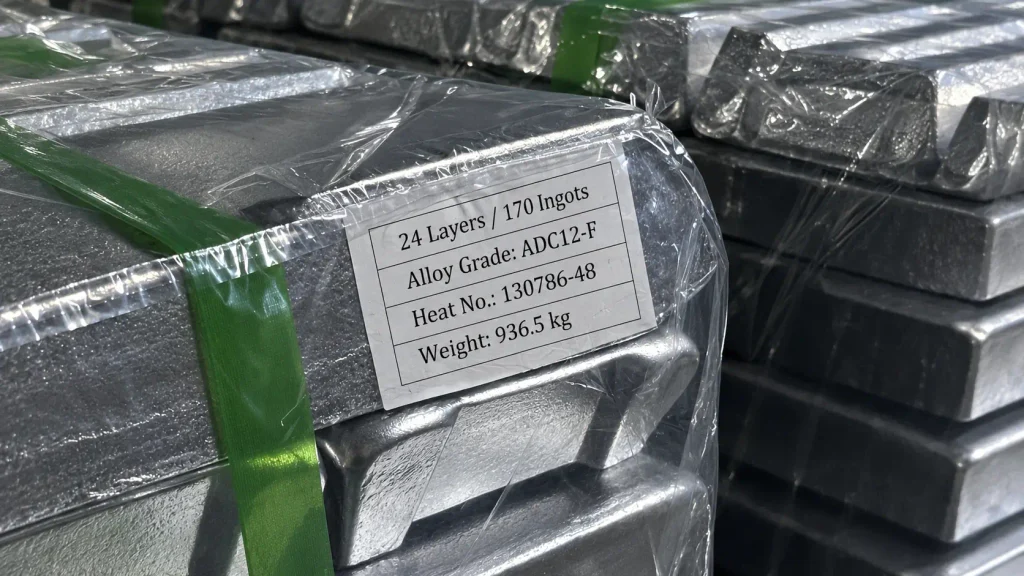
Aluminum alloys include A380, A360, ADC12, and 383.0. They offer a balance of strength, weight, thermal conductivity, and castability. The specific grade should be selected according to structural loads, wall thickness, corrosion exposure, and any pressure-tightness requirements.
Zinc alloys include Zamak 3, Zamak 5, and ZA-8. Their good fluidity supports intricate details, thin sections, and relatively tight as-cast tolerances. Grade selection depends on the required strength, ductility, dimensional stability, and finishing process.
Magnesium alloys include AZ91D and AM60B. AZ91D is commonly selected for its strength and castability, while AM60B offers greater ductility and energy absorption. The choice depends on weight targets, impact requirements, and the part’s structural loading.
For detailed comparisons of die casting alloy properties, including tensile strength, yield strength, elongation, density, and thermal conductivity, refer to the NADCA die casting alloy data.
Key Factors in Die Casting Material Selection
Mechanical loads and deformation. Evaluate the actual loading conditions rather than relying on tensile strength alone. Brackets and mounting structures may require sufficient stiffness to limit deflection, while impact-exposed parts may need greater ductility and energy absorption.
Weight and thermal performance. Compare alloy density against the required part geometry and target weight. For housings and heat-dissipating structures, also consider thermal conductivity, wall thickness, and the contact area between the casting and other assembly parts.
Casting geometry and wall thickness. Review minimum wall sections, ribs, bosses, transitions, and the distance molten metal must travel during filling. These features affect filling behavior, shrinkage, and the risk of porosity. Alloy fluidity and the proposed die layout should be evaluated together.
Operating environment and surface finishing. Consider exposure to moisture, chemicals, temperature changes, and outdoor conditions. The alloy, surface preparation, and coating must be compatible. Decorative plating, anodizing, and powder coating have different material requirements, so confirm process compatibility before finalizing the grade.
Machining requirements and total part cost. Identify critical features that require secondary machining, including precision bores, threads, mating surfaces, and sealing faces. Consider machining allowance, material machinability, and the risk of distortion. Compare grades based on the combined cost of casting, machining, finishing, and inspection at the expected production volume.
Before finalizing the mold design, confirm the alloy grade and applicable material specification on the drawing. Define acceptance criteria for critical dimensions, mechanical properties, and functional requirements. For pressure-tight parts, specify the leak-testing method and acceptance limits for finished castings, including the effects of any required CNC machining or surface treatment.
What Buyers Should Confirm Before Ordering
Before placing a die casting order, buyers should make sure the material, quotation, and inspection requirements are clearly defined.
Exact alloy grade and specification. Ask the supplier to confirm the alloy designation and applicable material standard in the quotation and technical documents. If an alternative grade is proposed, have engineering review its mechanical properties, casting suitability, and finishing compatibility before approval.
Comparable quotation scope. Compare quotations using the same drawing revision, alloy grade, and order quantity. Confirm whether tooling, trimming, CNC machining, surface finishing, inspection, and packaging are included or quoted separately.
Quality requirements and documentation. Agree on the required inspection scope, material certificates, batch traceability, and first-article inspection reports. For critical features, define the measurement method and acceptance criteria before production.
A material decision is ready for tooling when engineering has approved the alloy and technical requirements, while purchasing has confirmed the quotation scope, tooling costs, and inspection deliverables.
Common Die Casting Applications
Die casting serves high-demand sectors including telecommunications, electric vehicle automotive, LED lighting, and general industrial equipment. These industries rely on the process for parts requiring stable dimensional repeatability, EMI shielding, thermal management, structural strength and outdoor environmental resistance.
Typical finished components cover 4G/5G base station and RF filter enclosures, EV motor housings, transmission and pump covers, LED heat sinks, valve bodies, and instrument casings. Our focus within telecommunications extends to small cell and gateway housings, where we regularly address thin-wall casting and precision sealing requirements.
Advantages and Limitations of Die Casting
Die casting offers high production efficiency, good dimensional consistency, and relatively smooth surface finishes, making it suitable for manufacturing complex metal parts in medium- to high-volume production. Thin walls, ribs, bosses, and mounting features can be integrated into the mold, reducing material waste and secondary machining.
However, die casting requires significant upfront tooling investment and is less economical for low-volume production or frequently changing designs. Part geometry must also account for wall thickness, draft angles, and metal flow. Internal porosity, material limitations, and machine capacity can further affect part quality and design flexibility.
Is Die Casting the Right Process for Your Project?
| Die casting is a good fit when | Consider other processes when |
|---|---|
| The part design is stable and ready for dedicated tooling. | The design is still undergoing frequent changes. |
| Repeat orders are expected over several production cycles. | Demand is one-off or future orders are uncertain. |
| Annual demand can justify the initial tooling investment. | The expected lifetime quantity is too low to recover tooling costs. |
| The geometry includes thin walls, ribs, bosses, or integrated features that benefit from casting. | The part has relatively simple geometry that can be made more economically by machining or fabrication. |
| Aluminum, zinc, or magnesium alloys meet the part’s strength, weight, thermal, or corrosion requirements. | The required material properties cannot be achieved with suitable die casting alloys. |
| Most features can be formed in the casting, with machining limited to critical dimensions and interfaces. | Extensive machining is required to produce most of the final geometry. |
For customers with recurring annual demand, Zhonghui Precision can develop a long-term tooling and production plan to reduce overall costs. For example, projects requiring several thousand parts each year can be planned around one initial tooling investment, with production arranged in batches for annual delivery. This helps spread tooling costs across multiple years while reducing inventory pressure and upfront purchasing costs.
Die Casting vs. CNC Machining, Sand Casting, and Sheet Metal Fabrication
Die casting is suited to repeat production of metal parts with complex geometries, thin walls, and integrated features. Once the mold is developed, it supports consistent production across recurring orders. However, the initial tooling investment makes it more suitable for projects with a stable design and an established production plan.
CNC machining is useful for prototypes, low-volume orders, and parts requiring precise machined features. It avoids dedicated casting tooling and allows design changes with greater flexibility. For recurring production, however, machining complex parts from solid material can involve longer cycle times and more material removal than die casting.
Sand casting is an option for larger metal parts, thicker sections, and projects with relatively low production volumes. It can accommodate casting sizes and geometries that may be impractical for some die casting setups, but generally produces rougher surfaces and wider dimensional variations than high-pressure die casting.
Sheet metal fabrication suits enclosures, brackets, panels, and other parts made by cutting, bending, and joining sheet materials. It can be economical for relatively simple structures, while die casting may be more suitable when a design requires complex three-dimensional features, integrated ribs, bosses, or a one-piece metal housing.
What Affects Die Casting Cost?
Die casting cost mainly consists of upfront tooling investment and recurring production costs. Tooling expenses may include mold design, manufacturing, assembly, and trial runs. Production costs cover alloy materials, casting operations, trimming, secondary machining, surface finishing, inspection, and packaging, depending on the agreed manufacturing scope.
Several factors influence the cost of a die casting project. Part size, geometry, wall thickness, and casting complexity affect mold structure and material consumption. Alloy selection, required production volume, cycle time, and the number of cavities also influence the cost per part. Additional CNC machining, surface treatments, and tighter dimensional requirements can further increase production expenses.
Production volume plays an important role in overall project economics. Although a higher initial tooling investment may increase upfront costs, recurring production can spread that investment across more parts. For customers with predictable annual demand, planned production and scheduled deliveries over multiple years can help reduce inventory pressure and optimize total purchasing costs.
When comparing die casting quotations, check whether tooling, mold trials, casting, machining, surface finishing, inspection, packaging, and freight are included. Different suppliers may quote different manufacturing scopes, so comparing unit prices alone may not reflect the actual project cost.
Design Considerations for Die Casting
Successful die casting design requires balancing part performance, manufacturability, dimensional requirements, and tooling cost. The NADCA Product Specification Standards for Die Castings provide industry guidance on casting design, dimensional tolerances, and tooling considerations. Key design factors include wall thickness, draft angles, corner radii, dimensional tolerances, and machining allowances. These features influence metal flow, solidification, mold release, and the dimensional consistency of finished parts. Early Design for Manufacturing (DFM) reviews help identify potential issues before tooling begins, reducing costly mold modifications and production delays.
In practice, keep wall thickness as uniform as practical and avoid abrupt transitions or excessive material buildup that can increase shrinkage porosity. Apply sufficient draft to surfaces parallel to the die opening direction, and use appropriate radii at internal corners and section transitions. Design ribs and bosses to provide structural support without creating unnecessarily thick sections. Gate, overflow, and vent locations should also be evaluated during mold design. For precision bores, threads, and critical sealing or mating surfaces, specify machining requirements and allowances in advance, as these features may require secondary CNC machining to meet tighter tolerances.
These design considerations need to be evaluated against actual tooling and production capabilities. Through our die casting services, Zhonghui Precision provides DFM reviews, mold development, casting production, and secondary CNC machining. Our engineering team reviews part geometry, critical dimensions, and machining requirements before tooling begins, helping identify potential manufacturing issues and avoid unnecessary mold modifications.
FAQ
Porosity is mainly caused by trapped gas during metal filling or shrinkage during solidification. Manufacturers can reduce these defects by optimizing gate and vent locations, controlling injection parameters, and avoiding excessive wall thickness or abrupt section changes. For parts requiring CNC machining or pressure tightness, internal porosity should be evaluated through appropriate inspection, such as X-ray testing when specified.
Yes. Die cast parts can meet air-tightness and water-tightness requirements when casting quality, part design, and leakage limits are properly controlled. Sealing surfaces, wall thickness, and machining locations should be reviewed before tooling. Buyers should also specify the test pressure, test method, and acceptable leakage rate.
The manufacturer should first identify whether the problem comes from the mold, casting process, part design, or secondary machining. Dimensional deviations may require mold or machining adjustments, while porosity, flash, and incomplete filling may require changes to mold design or process parameters. Corrective actions should be followed by new samples and re-inspection before mass production approval.
Yes, but the feasibility depends on the type and location of the change. Minor dimensional corrections may be possible through machining, welding, or insert replacement. Changes to the parting line, cavity structure, or side actions may require extensive rework or new tooling. Reviewing critical dimensions before mold production helps reduce modification costs and delays.
Start by defining critical dimensions, material specifications, process controls, inspection frequency, and acceptance criteria before production. Depending on the part requirements, inspection may include first article inspection, CMM measurement, X-ray testing, or leak testing. Production inspection records and batch traceability also help identify process variations and maintain consistency between lots.