
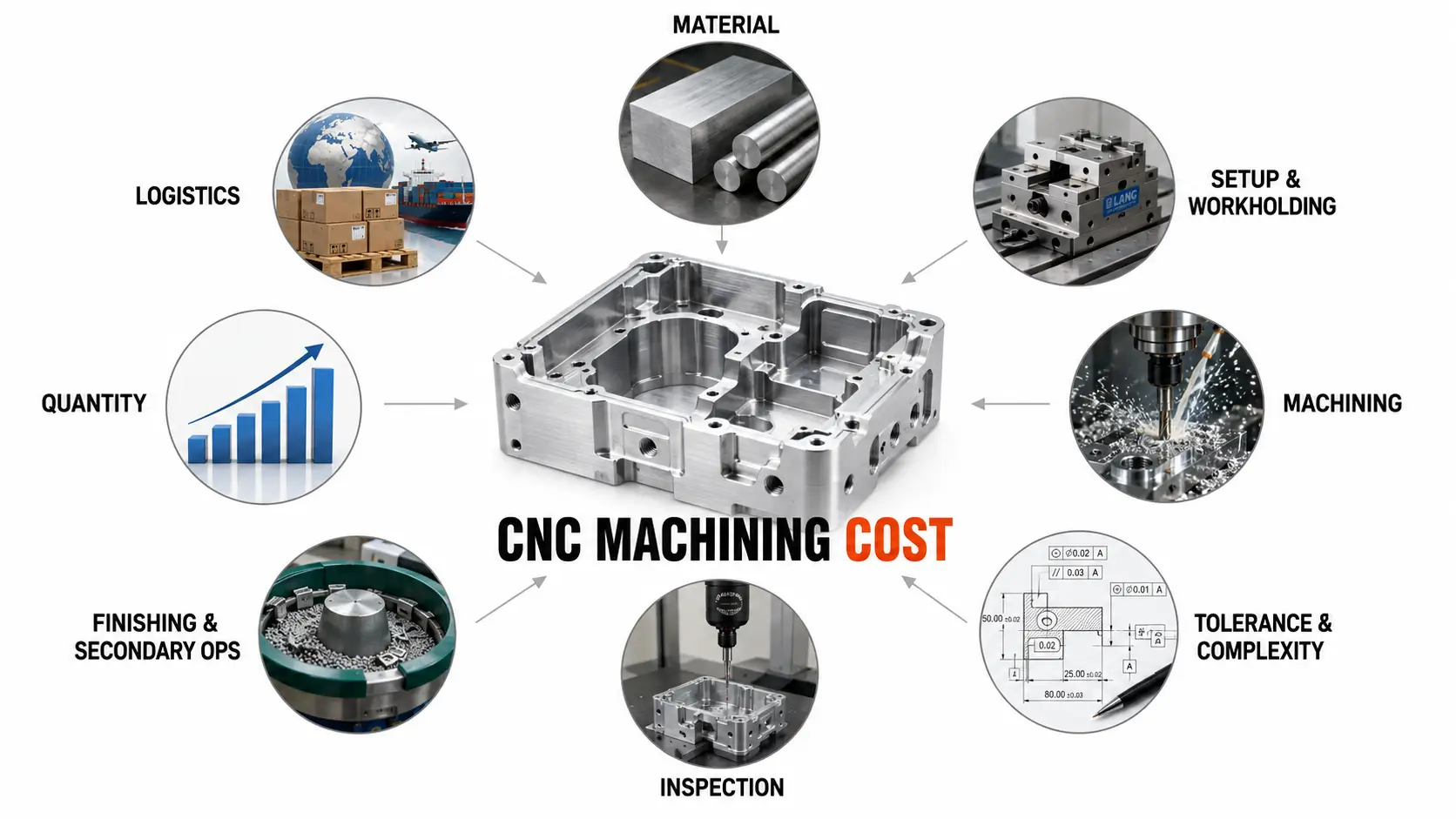
This guide explains how CNC machining cost is calculated, which factors determine it, and how design and quotation decisions affect the final price. The goal is to give engineers and buyers a framework to estimate cost before quoting, identify over-design before it reaches a bill of materials, and evaluate supplier quotes on a consistent basis.
How Is CNC Machining Cost Calculated?
Every CNC Machining Quote follows the same underlying structure:
Quoted Manufacturing Cost = Material and Stock Preparation + Engineering, Programming, and Setup + Machining and Tooling + Secondary Operations + Inspection and Documentation + Production Packaging
The formula itself is simple. The difficulty lies in estimating each term accurately.
A supplier that underestimates cycle time or setup count either loses margin or issues a change order later. A supplier that overstates cost on every line produces an inflated quote. Understanding the buildup allows a buyer to identify both cases.
Fixed, Variable, and Mixed Costs
Cost items fall into three categories, and each behaves differently as order quantity changes.
| Cost Type | Examples | Behavior with Volume |
|---|---|---|
| Fixed (one-time) | Programming, workholding setup, first-article inspection | Cost per part decreases as quantity increases |
| Variable (per-part) | Raw material stock, cycle time, per-part inspection, packaging | Cost per part remains approximately constant |
| Mixed | Tooling wear, secondary-operation minimum charges | Partially fixed, partially scales with volume |
Fixed costs explain why a 5-piece prototype order and a 500-piece production order from the same drawing produce different per-part prices. The fixed cost is identical in both cases; it is divided across a different number of parts.
Machine Hourly Rate Is Not Total Part Cost
A quoted machine hourly rate covers machine time only. It does not include programming and CAM preparation, setup and workholding time, tool changes and tool wear, or operator monitoring during multi-axis or unattended cycles.
On low-volume orders, setup time frequently exceeds cycle time per part. A quote that separates setup time from cycle time allows a more accurate cost comparison than a single blended hourly figure.
What Are the Main CNC Machining Cost Drivers?
Material and Stock Utilization
Material cost depends on raw material price per unit mass, stock form, and stock utilization. Stock utilization is the proportion of purchased stock that becomes finished part volume rather than chips.
| Material | Relative Cost Index | Machinability | Typical Application |
| Aluminum 6061 | 1.0 (baseline) | High | General structural components, enclosures |
| Aluminum 7075 | 1.4 | Moderate-high | High-strength structural components |
| Carbon Steel 1045 | 1.2 | Moderate-high | Shafts, structural components |
| Stainless Steel 304/316 | 1.8–2.2 | Moderate (work-hardens) | Corrosion-resistant, medical, food-contact parts |
| Titanium Ti-6Al-4V | 6–9 | Low (low thermal conductivity) | Aerospace, high strength-to-weight applications |
| Brass C360 | 1.5 | High | Fittings, electrical connectors |
Low stock utilization increases both material cost and cycle time because more material must be removed to reach the finished geometry.
When a part’s bounding box significantly exceeds its finished volume, a near-net stock form, such as an extrusion profile or pre-cut plate, reduces the volume of material removed and lowers cost accordingly.
Geometry, Feature Access, and Setup Count
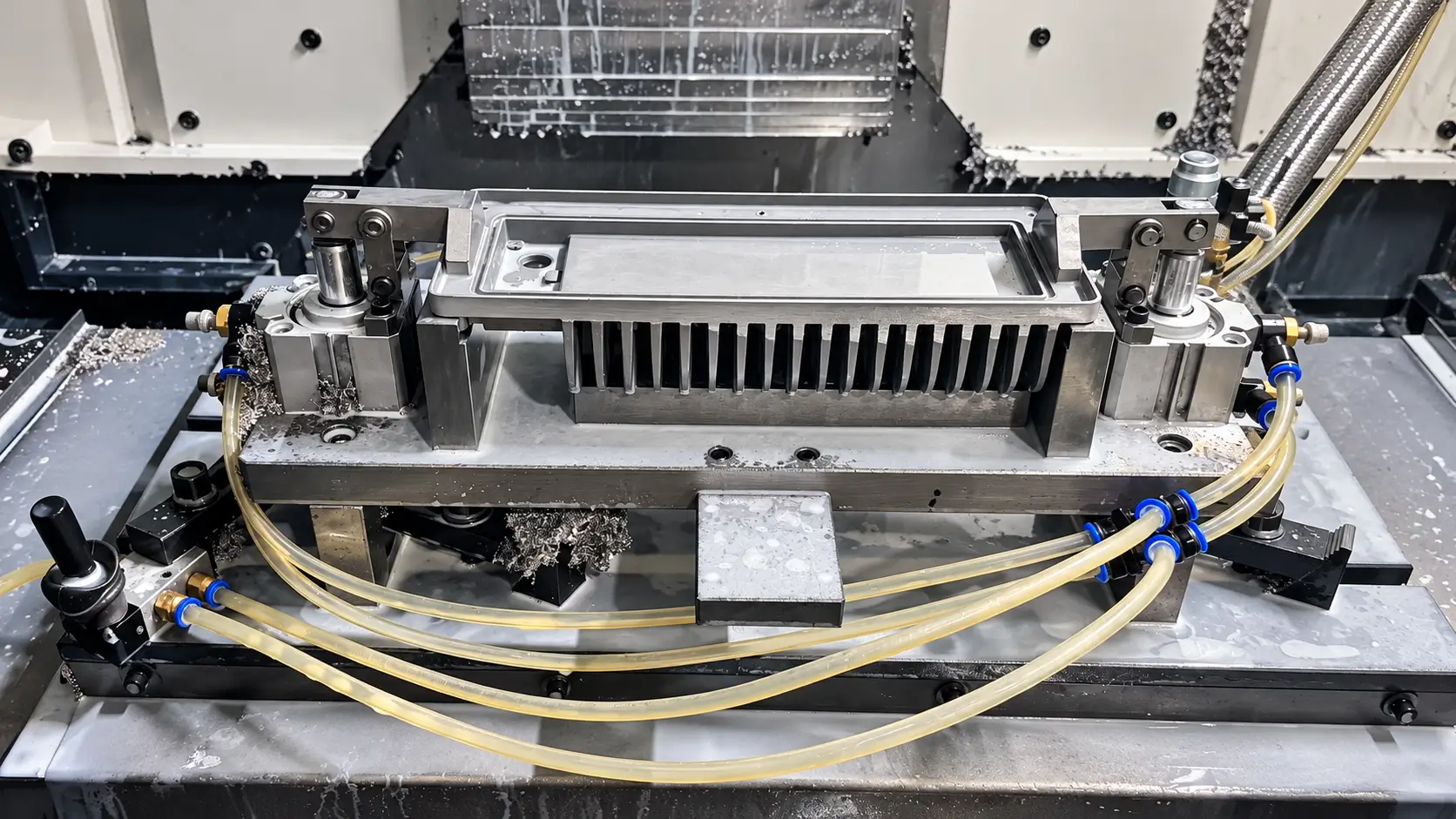
Setup count is determined by part geometry and is one of the most controllable cost drivers. Each setup requires re-fixturing, re-establishing datums, re-zeroing the machine, and, in many cases, a dimensional check before the next operation proceeds.
A part machined in a single setup requires less total time than a part requiring multiple setups, even when total cycle time is similar.
Setup count typically increases when a part has features on opposite faces, deep pockets or tall bosses requiring extended-reach tooling, undercuts not accessible from a single approach direction, or tolerances referenced to a datum accessible only from a different orientation.
For example, a bracket with mounting holes on one face and a threaded boss on the opposite face requires a minimum of two setups on a three-axis mill. Reducing the number of faces containing functional features reduces the number of required setups and lowers setup cost accordingly.
Tolerances, GD&T, and Inspection
Tolerance specification affects cost through three mechanisms.
Tighter tolerances require reduced feed rates and additional finishing passes, which increases cycle time. Tolerances below approximately ±0.05 mm often require higher-rigidity machines and more frequent tool changes, which increases machine cost. Every toleranced dimension requiring formal verification, such as coordinate measuring machine (CMM) inspection, adds direct labor and documentation cost.
| Tolerance Band | Relative Machining Cost | Typical Process | Application |
| ±0.13 mm (±0.005 in) | 1.0 (baseline) | Standard three-axis milling | Non-mating features |
| ±0.05 mm (±0.002 in) | 1.3–1.6 | Additional finish pass, reduced feed rate | Bearing bores, mating fits |
| ±0.02 mm (±0.0008 in) | 2.0–3.0 | Precision milling or turning, CMM verification | Critical mating dimensions |
| ±0.005 mm (±0.0002 in) | 4.0 or higher | Grinding, jig boring, full CMM report | Metrology and optical applications |
Tolerance should be assigned according to the function of each feature rather than applied uniformly across a drawing. A clearance hole for a fastener does not require the same tolerance as a bearing bore.
GD&T, applied per ASME Y14.5, allows a limited set of features that control fit and function to carry tighter position or profile tolerances, while other features carry the drawing’s general tolerance. This reduces both machining time and inspection scope relative to a drawing with uniform tight tolerances on every dimension.
Surface Finishing and Secondary Operations
Secondary operations occur after machining is complete, and each one adds separate setup time, minimum order charges, and lead time.
Common secondary operations include anodizing, bead blasting or tumbling, passivation, heat treatment, coating, plating, tapping, and marking. Most finishing vendors apply a minimum lot charge independent of part count, so a small order incurs a similar finishing charge to a larger order.
Combining secondary operations across multiple part numbers, or increasing order quantity, reduces the per-part impact of these minimum charges.
How Process Selection Changes CNC Machining Cost
CNC Turning Versus CNC Milling
| Factor | CNC Turning | CNC Milling |
| Suited geometry | Rotationally symmetric parts (shafts, bushings, fittings) | Prismatic parts, pockets, non-symmetric geometry |
| Cycle time for simple parts | Lower | Higher |
| Stock form | Bar stock, higher material utilization | Block or plate, lower material utilization |
| Setup complexity | Typically single setup | Frequently multiple setups for complex geometry |
A rotationally symmetric part machined by turning generally requires less material and less cycle time than the equivalent part machined by milling.
Indexed and Simultaneous 4-Axis Machining
Four-axis machining adds a rotary table around a three-axis machine.
Indexed four-axis rotates the part to a fixed angular position, then machines using three-axis motion. This replaces a manual re-fixturing setup with an automated rotation and adds limited cost.
Simultaneous four-axis machines while the part rotates continuously. It is used for helical or contoured features on cylindrical parts and requires more complex programming, which increases cost.
3-Axis, 3+2, and Simultaneous 5-Axis Machining
Three-axis machining uses linear motion along X, Y, and Z only and is limited to features accessible from a single direction.
Three-plus-two machining tilts the part to a fixed angle, then machines using three-axis motion. This reduces setup count on parts with angled features without the programming cost of full five-axis machining.
Simultaneous five-axis machining moves all five axes together during cutting and is used for contoured surfaces such as impellers or turbine blades. It carries the highest machine rate and programming cost among the three methods.
Specifying simultaneous five-axis machining for a part that requires only angled holes or a single tilted face increases cost without a corresponding benefit. Three-plus-two machining achieves the same result at lower cost.
When Combined Turning and Milling Makes Sense
Mill-turn machines combine turning and milling operations in a single setup. This method applies to parts that are primarily rotational but include off-axis features such as cross-holes, flats, or slots.
Mill-turn carries a higher machine hourly rate than a standalone lathe, but it removes the setup cost and alignment error associated with transferring a part between a lathe and a mill. For turned parts with secondary milled features, this often results in a lower total cost than two separate operations.
Prototype Versus Production CNC Pricing
| Prototype (1–20 pcs) | Low-Volume Production (50–500 pcs) | High-Volume Production (500+ pcs) | |
| Dominant cost driver | Setup and programming (fixed cost) | Setup and cycle time, balanced | Cycle time and material (variable cost) |
| Fixturing | Standard vise or chuck, minimal non-recurring engineering | Simple dedicated fixtures may be justified | Dedicated fixtures, possibly multi-part fixtures |
| Per-part price trend | Highest | Decreasing | Lowest, approaching material and cycle time floor |
| Tolerance sensitivity | High relative impact | Moderate | Lower relative impact |
Prototype and production pricing should be evaluated separately.
Fixed setup cost is divided across a small quantity in a prototype order and across a large quantity in a production order. This produces a substantially different per-part price for the same drawing.
How to Reduce CNC Machining Cost
Reduce Avoidable Setups
Features should be accessible from as few orientations as possible. Where a second setup is unavoidable, grouping all features requiring that orientation together reduces the number of times the part is re-fixtured.
Use Standard Stock and Tooling
Hole diameters, corner radii, and thread sizes should match standard tooling sizes.
A hole diameter matching a standard drill size requires no additional operation. A non-standard diameter may require boring, which increases cycle time and tooling cost.
Internal corner radii should match available end mill radii. A sharp internal corner not required by function forces the use of a smaller, slower tool or a secondary operation such as EDM.
Improve Stock Utilization
Part dimensions should align with standard bar, plate, or extrusion sizes where geometry permits. This reduces both the material purchased and the volume of material removed during machining.
Apply Tolerances and Inspection Selectively
Each toleranced dimension should be evaluated against its function. A tolerance that does not control fit, function, or interchangeability should be relaxed to the shop’s standard tolerance.
Reserving tight tolerances and CMM inspection for dimensions that control fit reduces cycle time and inspection cost simultaneously. It also represents one of the higher-impact cost reductions available at the drawing stage.
How to Compare CNC Machining Supplier Quotes
A lower total price alone does not indicate a more accurate or more favorable quote. Supplier quotes should be compared using a consistent line-item breakdown.
| Line Item | Comparison Point |
| Material cost | Material grade and certification match specification |
| Setup count and cost | Number of setups matches expected part geometry |
| Cycle time / machine cost | Time estimate is consistent with part complexity |
| Tolerance-driven cost | Precision rates applied only to features that require them |
| Secondary operations | Itemized separately rather than bundled into a single finishing charge |
| Tooling / NRE | One-time fixture or programming charge disclosed, including reorder terms |
| MOQ and lead time | Lead time reflects setup and secondary-operation requirements |
| Landed cost | Freight, duty, and import handling included or stated separately |
Landed cost, rather than unit price, determines the actual cost of a part.
A lower unit price from an overseas supplier can result in a higher landed cost once freight, duty, customs brokerage, and potential rework are included. This is particularly important at lower order quantities, where fixed shipping cost is not distributed across many parts.
A supplier that itemizes each cost component allows a more accurate comparison than one that provides a single total figure.
For CNC projects that require a detailed quotation, ZH Precision can review CAD files, engineering drawings, material, quantity, tolerances, surface finishing, and inspection requirements before pricing. This helps clarify the expected machining process and quotation scope so buyers can evaluate the actual manufacturing requirements rather than comparing unit price alone.
Conclusion
CNC machining cost is determined by a defined set of factors: material and stock utilization, setup count, cycle time, tolerance and inspection requirements, and secondary operations, all divided across batch quantity.
The largest cost reductions typically result from design decisions made before a part is quoted, including setup minimization, function-based tolerancing, and stock form selection.
The same cost breakdown used to estimate a part’s cost should be applied when evaluating supplier quotes, using landed cost as the basis for comparison.
FAQ
Cost depends on part size, material, tolerance, setup count, complexity, and quantity. Simple aluminum brackets at low volume typically range from $20 to $60 per part, while complex tight-tolerance stainless steel or titanium components can cost several hundred dollars per part. General price ranges are useful only as a starting point.
Estimate material and stock cost first, then add programming, setup, machine cycle time, tooling, inspection, secondary operations, and packaging. Fixed costs such as programming and setup should then be distributed across the required batch quantity before margin is added.
Typical shop rates range from approximately $35 to $60 per hour for 3-axis milling, $50 to $90 per hour for turning centers, and $75 to $150 or more for 5-axis or mill-turn equipment. These figures represent machine time and do not necessarily include programming, setup, tooling, or inspection.
No. A 5-axis machine has a higher hourly rate, but it can reduce total cost on complex parts by eliminating setups that would otherwise require manual repositioning. It becomes unnecessarily expensive when the geometry does not benefit from the additional axes.
Suppliers may assume different setup counts, machine types, cycle times, tolerance requirements, inspection methods, secondary operations, or margins. Some quotations also bundle finishing and documentation into the unit price while others list them separately. Comparing the detailed scope is more useful than comparing the total price alone.