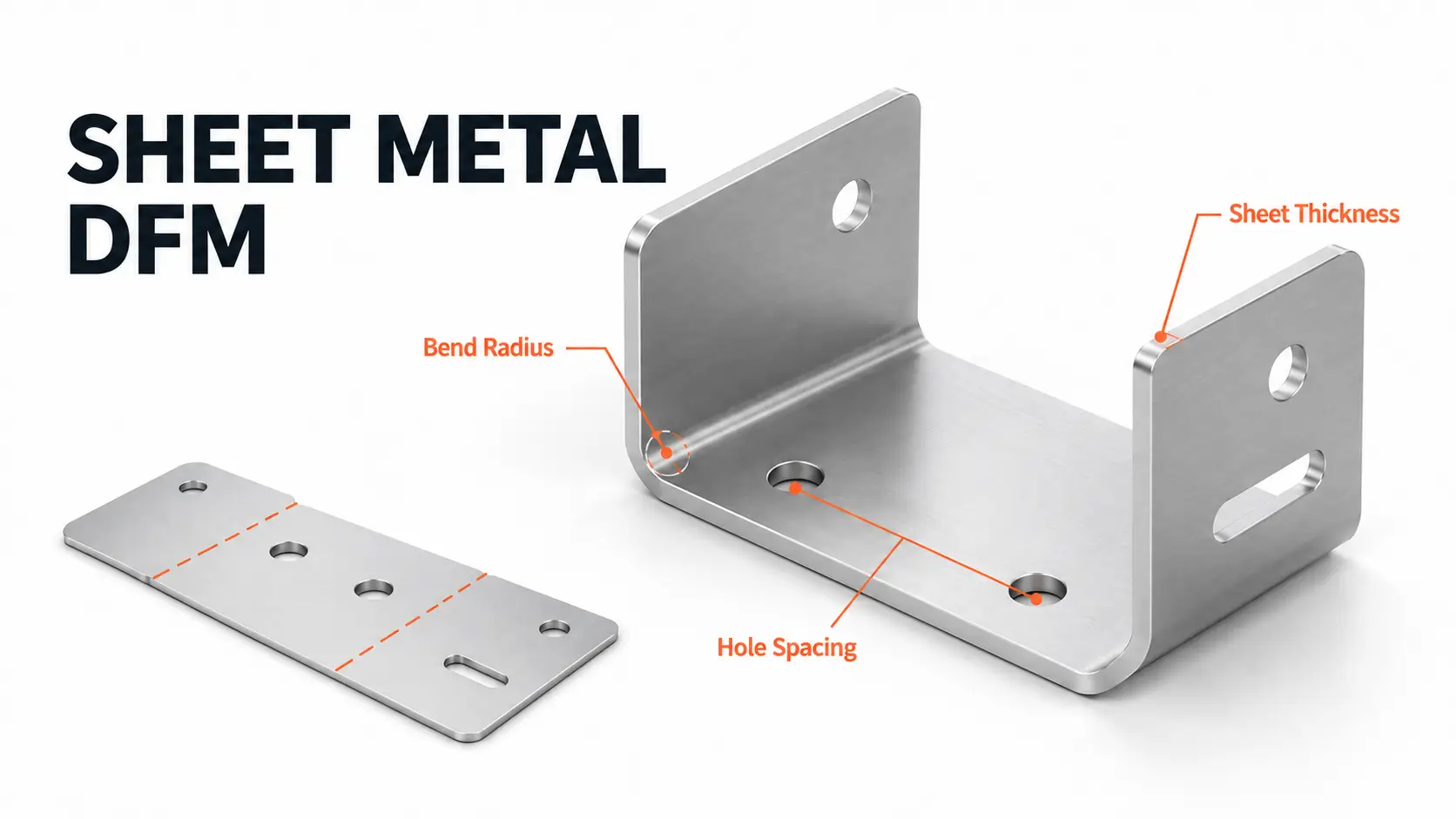

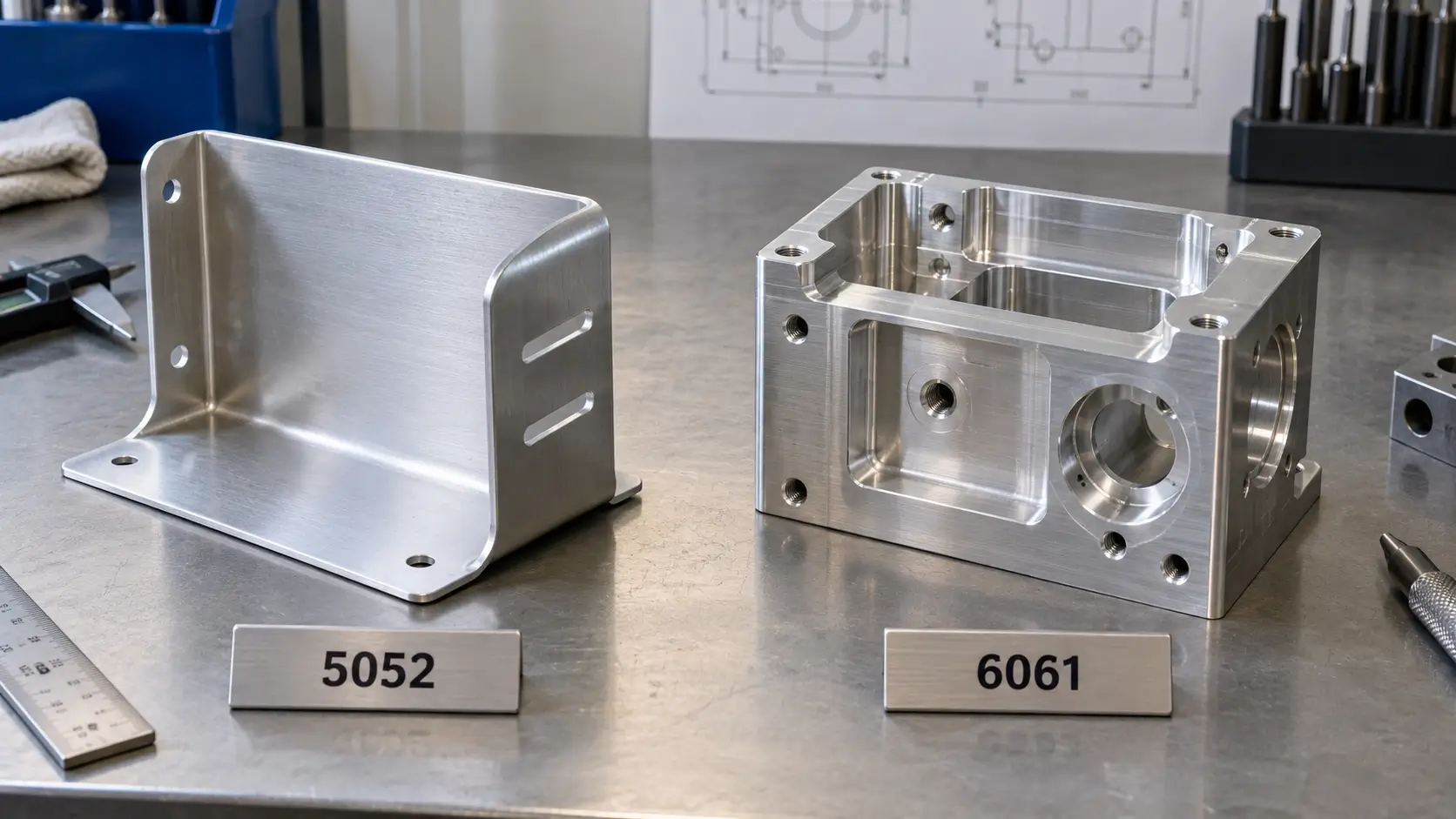
In practice, the comparison is often between 5052-H32 and 6061-T6 rather than the alloy numbers alone. The right choice depends on how the part will be manufactured, how much load it must carry, whether it needs to be welded or formed, and the environment in which it will operate.
5052 vs 6061 Aluminum at a Glance
The table below summarizes the differences that usually matter most when choosing between the two alloys.
| Property | 5052-H32 | 6061-T6 |
|---|---|---|
| Aluminum series | 5xxx | 6xxx |
| Main alloying elements | Magnesium | Magnesium and silicon |
| Heat treatable | No | Yes |
| Density | About 2.68 g/cm³ | About 2.70 g/cm³ |
| Typical tensile strength | About 230 MPa | About 310 MPa |
| Typical yield strength | About 195 MPa | About 276 MPa |
| Elastic modulus | About 70 GPa | About 69 GPa |
| Formability | Very good | More limited in T6 |
| Machinability | Fair | Good |
| Weldability | Very good | Good |
| Corrosion resistance | Excellent | Very good |
| Common use | Formed and welded parts | Machined and structural parts |
These values are useful for general comparison, but mechanical properties can vary with temper, product form, thickness, and the applicable material specification.
The broad distinction is simple: 5052-H32 is usually easier to form, while 6061-T6 provides higher strength and better machining behavior.
If the Part Needs Bending, 5052 Usually Has the Advantage
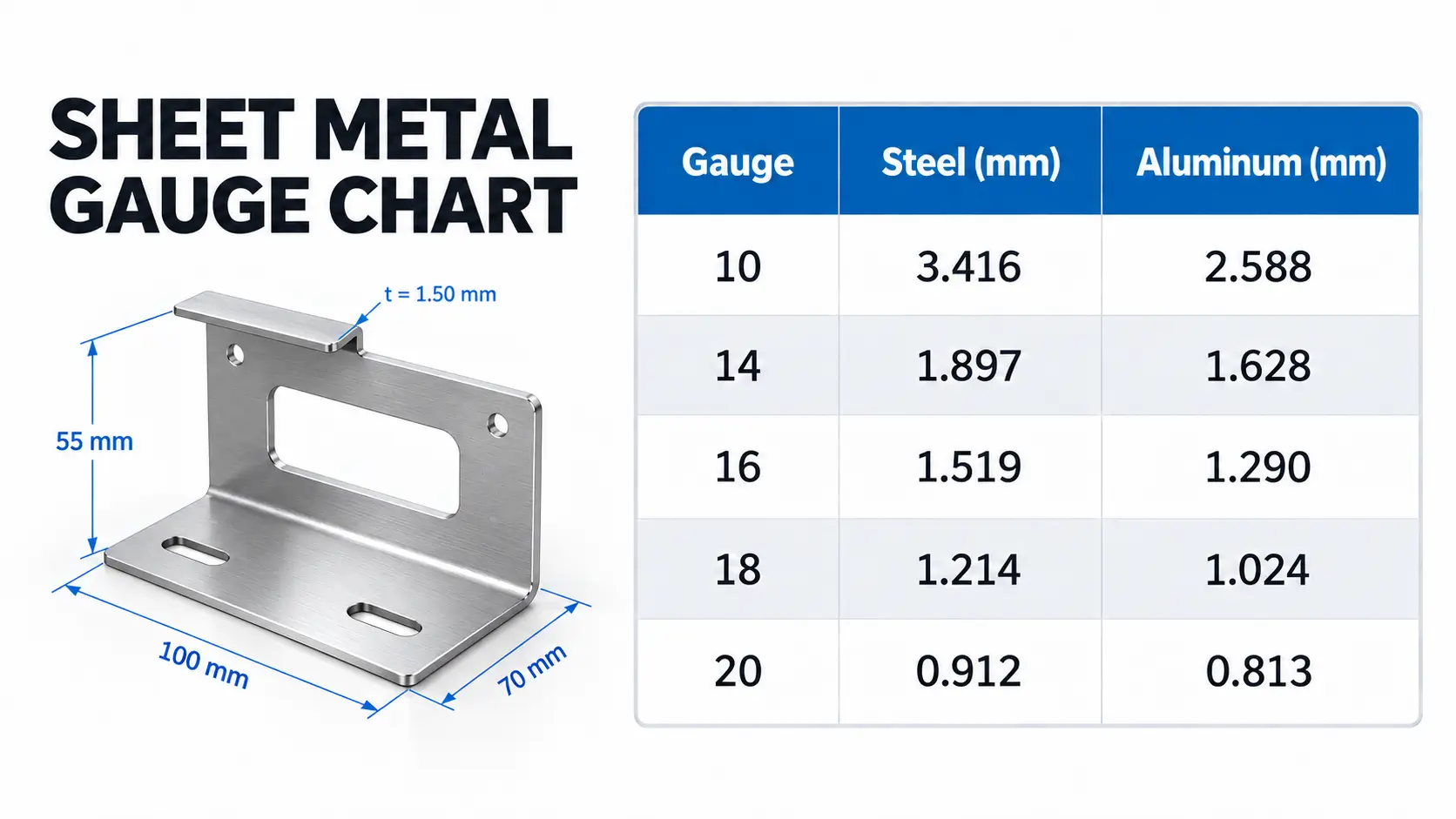
5052-H32 is commonly used for parts that begin as sheet and require significant forming before they become finished components.
Typical examples include electronic enclosures, covers, trays, cabinets, formed panels, and bent brackets. For these parts, the ability to produce bends reliably can matter more than having the highest possible yield strength.
5052-H32 combines useful mechanical strength with good cold-forming behavior. It can generally tolerate tighter and more demanding bends than 6061-T6 without the same risk of cracking.
6061 can also be bent, but the temper matters. T6 material has been heat treated to achieve higher strength, which also makes it less forgiving during forming. Bend radius, thickness, grain direction, and part geometry therefore require more attention.
This does not mean 6061 is inherently unsuitable for bending. Softer conditions such as 6061-O and 6061-T4 behave differently from 6061-T6. For a finished part specified as T6, however, forming requirements should be considered early rather than assuming the alloy can be processed in the same way as 5052-H32.
If the component is mainly a formed sheet-metal part with several bends, 5052-H32 is usually the more natural starting point.
If the Part Is Mainly CNC Machined, 6061 Usually Makes More Sense
The balance changes when most of the geometry is created by machining instead of forming.
CNC-machined housings, structural brackets, motor mounts, fixture plates, frames, and mechanical components often contain features such as pockets, bores, threads, counterbores, slots, and controlled mounting surfaces. In these parts, machinability and final mechanical strength become more important than cold-forming capability.
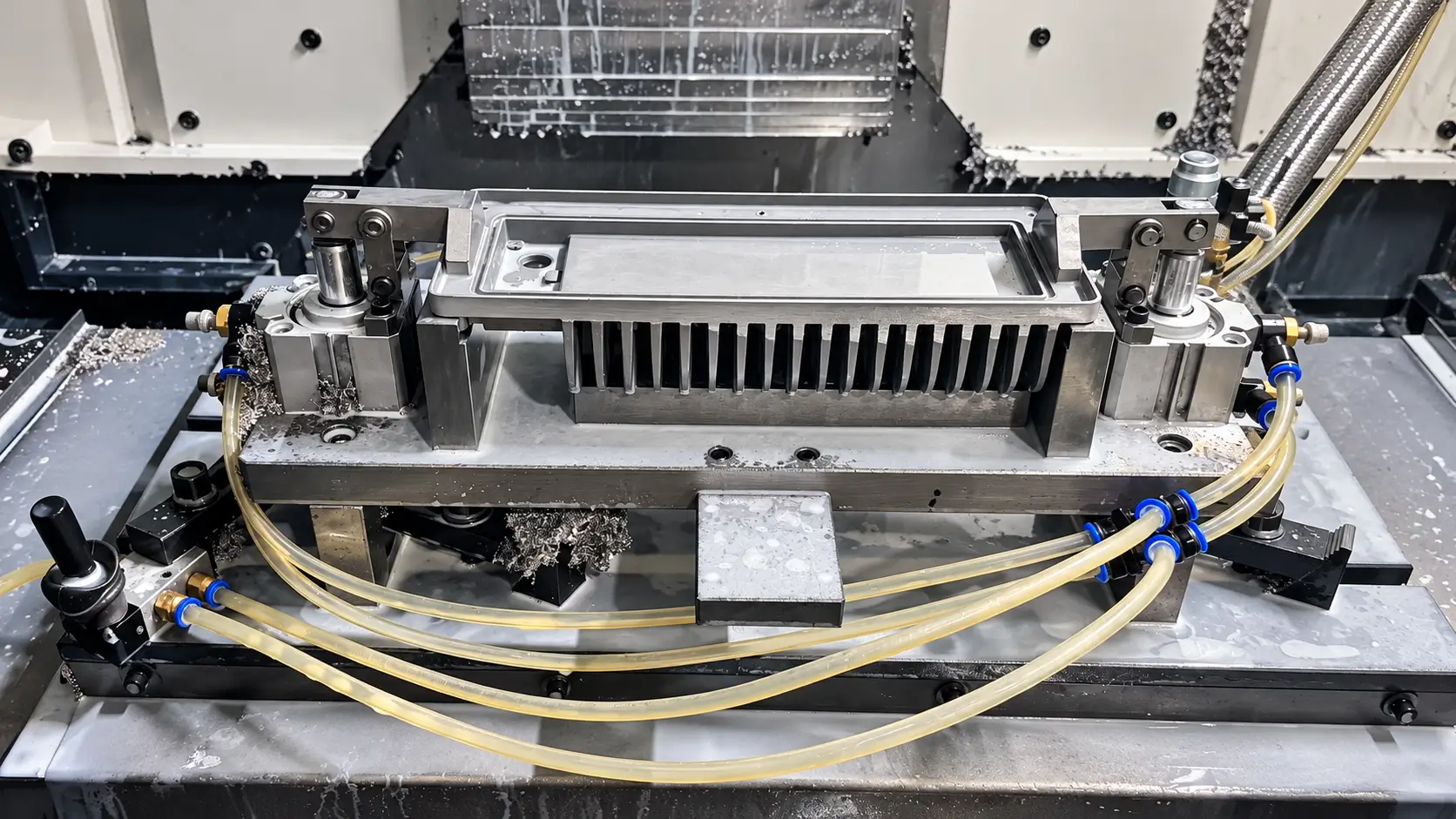
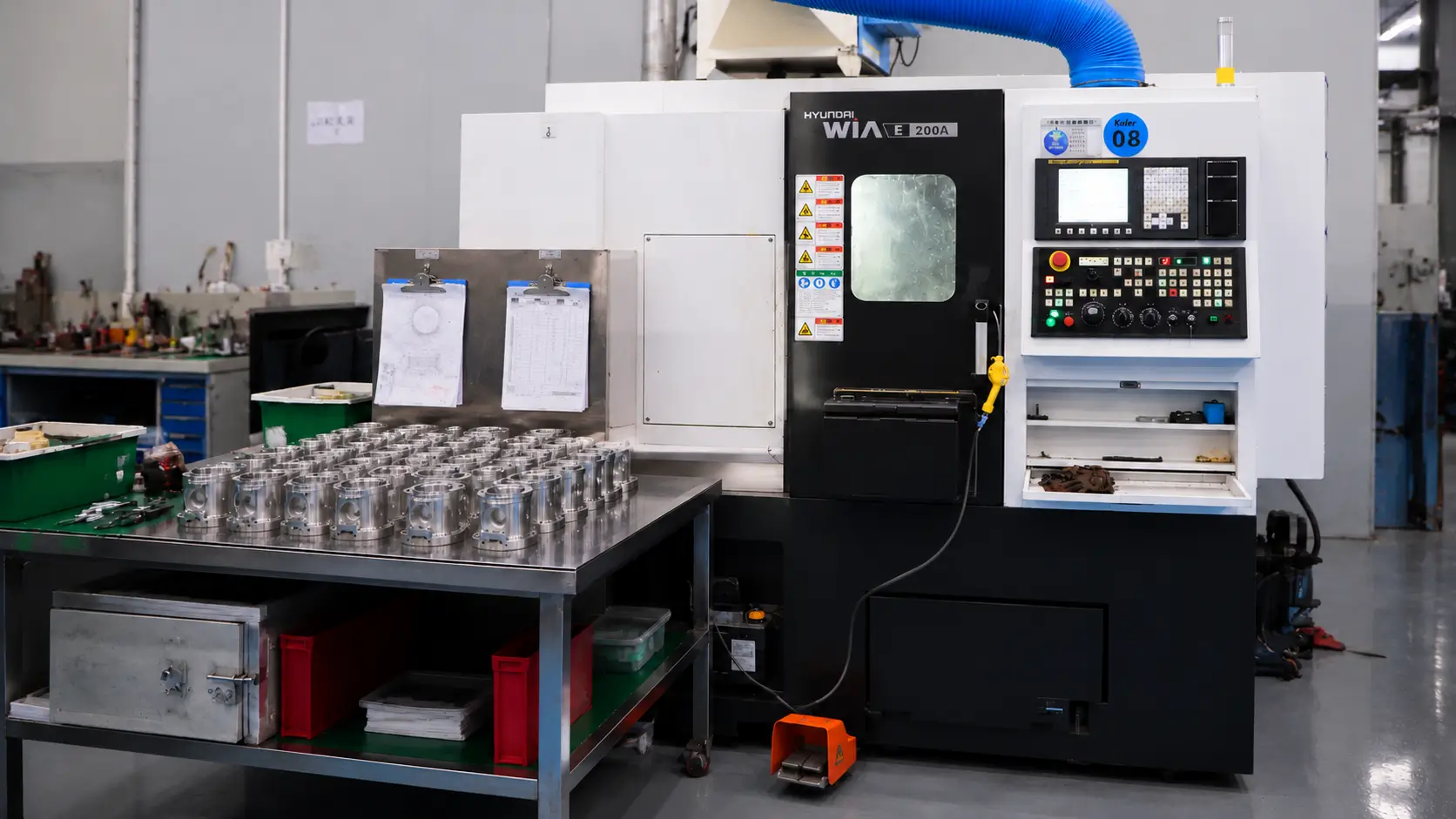
6061-T6 is widely used for this type of work because it generally cuts more predictably than 5052-H32. Chip formation is easier to control, edge quality is usually better, and the material is well suited to repeated milling, drilling, boring, and threading operations.
5052 can still be CNC machined. It is frequently machined for secondary features on fabricated parts. Its softer and more ductile behavior, however, can make long chips, burrs, or material smearing more noticeable, particularly when a large amount of material must be removed.
The difference becomes more important as machining becomes a larger part of the manufacturing process.
For example, a sheet-metal enclosure produced by cutting and bending may favor 5052-H32. If the design changes to a solid aluminum housing with machined pockets, threads, and precision interfaces, 6061-T6 may become the more practical choice even though the finished component serves a similar function.
6061 Is Stronger, but That Does Not Make It Better for Every Part
When 5052-H32 and 6061-T6 are compared directly, 6061-T6 has the higher tensile and yield strength.
Typical yield strength is around 195 MPa for 5052-H32 and about 276 MPa for 6061-T6. This gives 6061-T6 more resistance to permanent deformation when a component is subjected to higher stress.
That advantage matters in structural brackets, mounting components, machine parts, housings, and other applications where the finished part must carry significant load.
Higher strength, however, should not be confused with higher stiffness.
The elastic modulus of 5052 and 6061 is very similar, both being close to 70 GPa. If two parts have the same geometry and remain within the elastic range, changing from 5052 to 6061 will not reduce deflection in proportion to the difference in yield strength.
If excessive flex is the problem, increasing wall thickness, changing the cross-section, adding ribs, or shortening an unsupported span may have a greater effect than changing the alloy.
If the concern is permanent deformation under higher stress, the higher yield strength of 6061-T6 becomes much more important.
This distinction is useful because choosing the material with the larger strength number does not automatically produce the better part.
Welding or Corrosive Service Can Change the Choice
5052 is particularly useful when welding and corrosion resistance are important parts of the design.
Its resistance to general corrosion makes it common in marine components, tanks, exterior panels, outdoor equipment, enclosures, and other fabricated products exposed to moisture or salt-containing environments.
6061 also provides good corrosion resistance and works well in many outdoor and industrial applications. For most mechanical components, corrosion alone is not a reason to avoid 6061.
Welding introduces another difference.
5052 has good weldability and is widely used in welded sheet and fabricated assemblies. It is therefore well suited to products where forming and welding are both major parts of the manufacturing route.
6061 can also be welded successfully, but additional attention is required when the design depends on the properties of the T6 temper. Heat from welding changes the material condition around the weld, so the heat-affected area does not retain the same strength as the original unwelded T6 material.
For lightly loaded fabrications this may not control the design. For highly loaded welded structures, it can become an important engineering consideration.
A component exposed to a wet environment and produced mainly by bending and welding may therefore favor 5052 even though 6061-T6 is stronger before welding.
Does 5052 or 6061 Cost More?
There is no fixed rule that one alloy is always cheaper than the other.
Aluminum pricing changes with product form, thickness, quantity, supplier, market conditions, and region. Sheet, plate, bar, extrusion, and billet can also have very different pricing even when the alloy designation is the same.
Raw material price is only one part of the finished component cost.
For a sheet-metal part, forming difficulty, bend operations, welding, scrap rate, and secondary finishing can matter more than a small difference in material price.
For a heavily machined part, machining time, chip control, tool wear, deburring, and material removal can have a larger effect on cost than the price difference between 5052 and 6061 stock.
Consider two simple cases.
A multi-bend enclosure may be economical in 5052-H32 because the material is well suited to forming. Choosing a stronger material that is less forgiving during bending could increase fabrication difficulty or scrap without adding useful value to the finished part.
A machined housing may favor 6061-T6 because the material behaves more conveniently during machining and provides higher finished strength. Even if another alloy is slightly cheaper as raw stock, longer machining or deburring can erase that saving.
The useful cost question is therefore not simply which alloy costs less per kilogram. It is which alloy allows the part to be manufactured efficiently while still meeting its functional requirements.
So, Should You Choose 5052 or 6061?
The decision becomes easier when the part requirement is considered before the alloy.
| Part or Requirement | Common Starting Choice |
|---|---|
| Bent sheet enclosure | 5052-H32 |
| Formed cover or tray | 5052-H32 |
| Welded sheet assembly | 5052-H32 |
| Marine or wet environment | 5052-H32 |
| CNC-machined housing | 6061-T6 or T651 |
| Structural bracket | 6061-T6 |
| Part with extensive bores, threads, and pockets | 6061-T6 |
| Higher yield strength requirement | 6061-T6 |
5052-H32 is usually the stronger candidate when bending, forming, welding, or corrosion resistance controls the part.
6061-T6 is usually the stronger candidate when the component is mainly machined or when higher yield strength is required.
Some parts fall between these categories. A fabricated component may require bending first and then machining of mounting holes or locating surfaces. A machined component may need only a small formed feature. In these situations, the alloy should be selected around the operation or requirement that is most difficult to satisfy.
A few secondary machined features do not automatically make 6061 the better choice. Likewise, a small amount of forming does not automatically make 5052 preferable.
The final decision should follow the actual geometry and manufacturing sequence.
Conclusion
5052 and 6061 are both versatile aluminum alloys, but they suit different manufacturing requirements.
5052-H32 generally offers better formability, excellent corrosion resistance, and very good weldability, making it well suited to formed sheet components and welded assemblies. 6061-T6 provides higher strength and better machining behavior, which makes it a common choice for CNC-machined parts and structural components.
For most designs, the choice becomes straightforward once the manufacturing method and the requirement that controls the part are clear.
FAQ
When commonly used 5052-H32 and 6061-T6 are compared, 6061-T6 is stronger. It has higher tensile and yield strength, making it better suited to components that must resist higher mechanical loads or permanent deformation.
5052-H32 is generally better for bending and cold forming. 6061-T6 can be bent, but it usually requires larger bend radii and more attention to material condition and geometry.
Yes. 6061-T6 generally provides more predictable machining behavior and is widely used for CNC parts with pockets, threads, bores, and precision interfaces. 5052 can still be machined, especially for secondary features on fabricated parts.
Both alloys provide good corrosion resistance, but 5052 generally performs better in marine, wet, and salt-containing environments.
Yes. 5052 can be milled, drilled, turned, and machined using conventional CNC processes. It is simply less commonly chosen than 6061 for parts requiring extensive machining because its softer and more ductile behavior can make chip control and burr formation more difficult.