
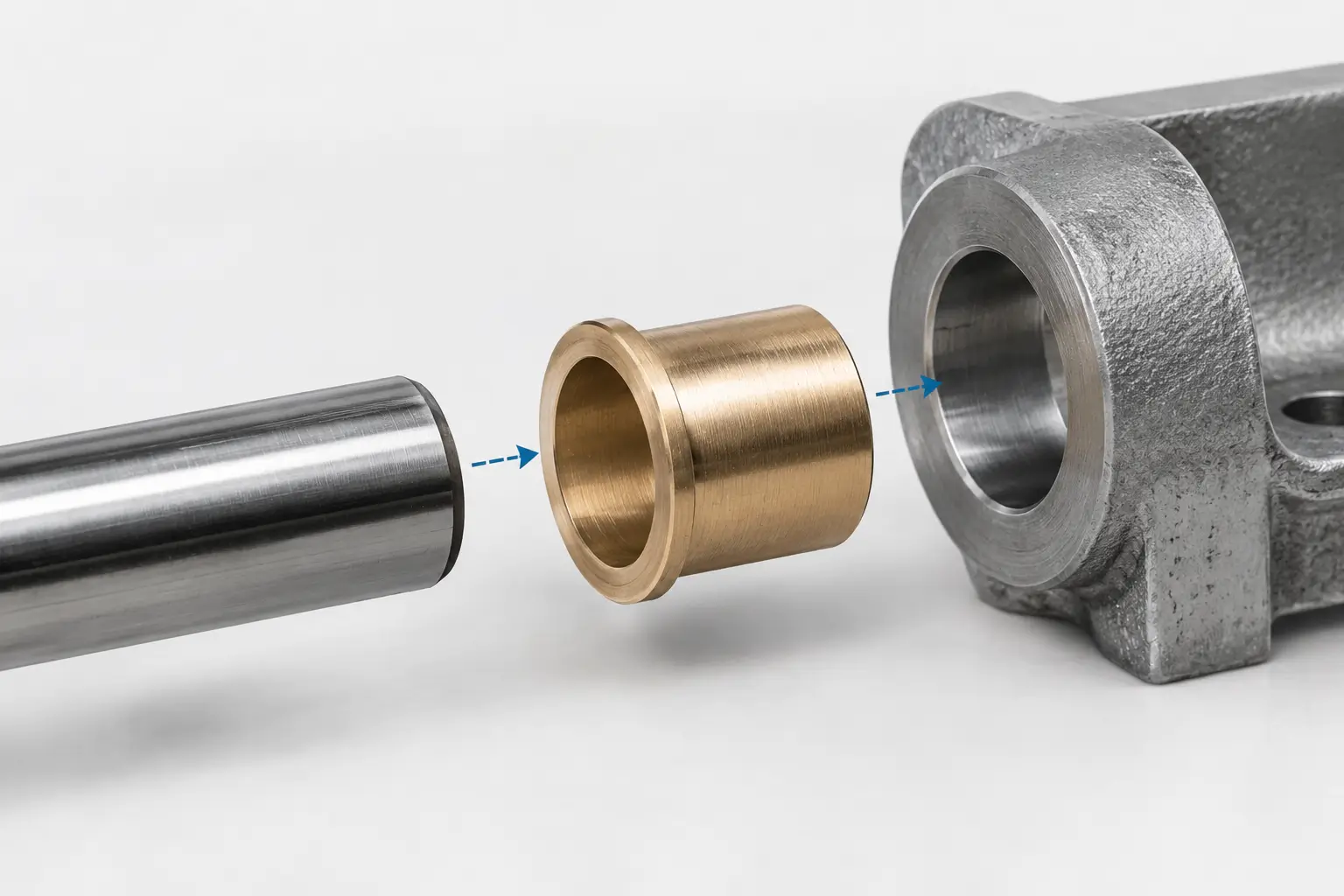
This simple arrangement is used in pivots, linkages, shafts, hinges, rollers, and many other mechanical assemblies. This article focuses on mechanical bushings used as plain bearings, including how they work, the common types and materials, how they are made, and where they are used.
What Is a Bushing and What Does It Do?
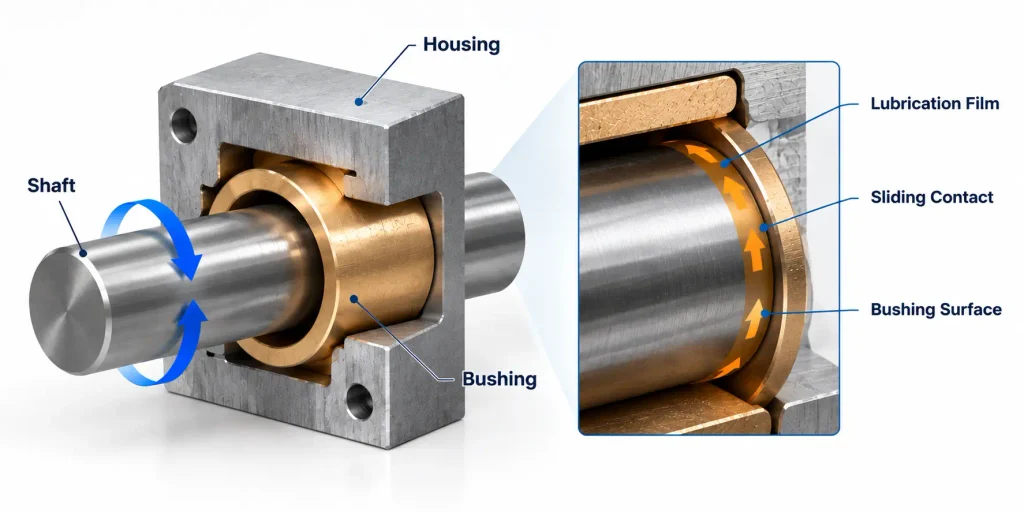
A bushing provides a bearing surface between a moving shaft or pin and the part that supports it. The outside of the bushing is held by the housing, while the shaft moves inside the bore.
Consider a steel pivot pin fitted into an aluminum housing. If the pin runs directly against the aluminum bore, wear occurs on the housing itself. Installing a bushing gives the pin a separate surface to run against. When that surface eventually wears, the bushing can be replaced without replacing the entire housing.
Bushings are not limited to continuously rotating shafts. The same basic arrangement can be used for a pin that moves back and forth through a small angle or a shaft that slides through the bore.
How Does a Bushing Work?
Most mechanical bushings are plain bearings. Unlike ball or roller bearings, there are no rolling elements between the shaft and the bearing surface. Movement takes place directly between the shaft and the inside of the bushing.
That sliding contact creates friction and wear, so the material at the bearing surface matters. Some metal bushings use oil or grease, while certain polymer and composite bushings are designed for dry or minimally lubricated operation.
The shaft also needs room to move inside the bore. Too little clearance can increase friction or cause binding; excessive clearance leaves unwanted play in the joint. The goal is not the smallest possible gap, but enough running clearance for the intended movement and operating conditions.
Common Types of Bushings
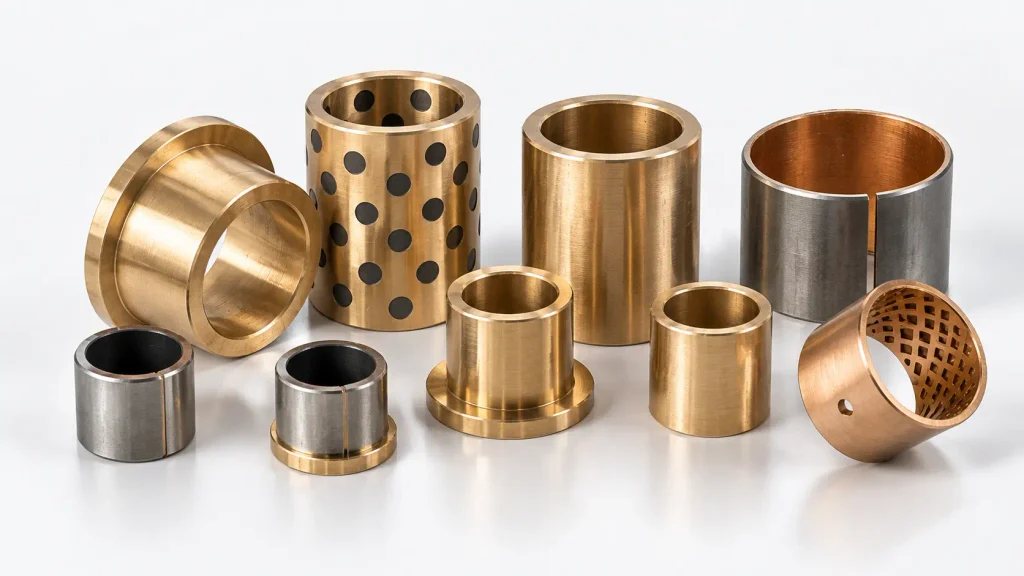
Not every bushing has the same construction. Some are machined from solid material, while others are formed from layered bearing strip. The shape also changes depending on how the bushing needs to sit in the assembly.
Sleeve Bushings
The basic form is a cylindrical sleeve with a shaft or pin running through the center. Sleeve bushings are common in pivots, hinges, linkages, rollers, and other applications where a compact bearing surface is needed around a shaft.
They can be made from solid metal, polymer, or composite bearing materials, so the familiar cylindrical shape does not tell you how the bushing was manufactured.
Flanged Bushings
A flanged bushing has a wider rim at one end. The cylindrical section supports the shaft, while the flange provides an axial locating surface and can also serve as a thrust bearing surface in suitable applications.
This makes the design useful when the assembly needs more than a simple cylindrical sleeve but does not justify adding another separate bearing component.
Split and Wrapped Bushings
A wrapped bushing starts as a strip of bearing material that is formed into a cylinder, leaving a visible split along its length. Metal-polymer bushings are commonly available in this construction.
The construction makes it possible to combine different materials within a thin wall. For example, one layer can provide structural support while the surface facing the shaft provides the required sliding properties.
What Materials Are Bushings Made From?
Bronze is one of the traditional materials for machined bushings. It is widely used where a durable metallic bearing surface is required and can work with oil or grease depending on the bearing design.
Steel is also used, but not every steel-backed bushing has a bare steel surface running directly against the shaft. Some designs use steel for structural support and a separate material at the sliding surface. Other bushings use hardened steel as the bearing material for lubricated, high-load, low-speed applications.
Polymer bushings provide another option where low weight, corrosion resistance, or dry operation is useful. Composite designs go a step further by combining a supporting structure with a bearing layer selected specifically for sliding contact. GGB, for example, offers both engineered plastic and fiber-reinforced composite plain-bearing systems designed for dry operation.
There is no need for every application to use the same material. A greased machinery pivot and a lightly loaded mechanism that must operate without lubrication place very different demands on the bearing surface.
How Are Bushings Made?
The cylindrical shape can make bushings look like variations of the same part, but they are produced in several different ways.
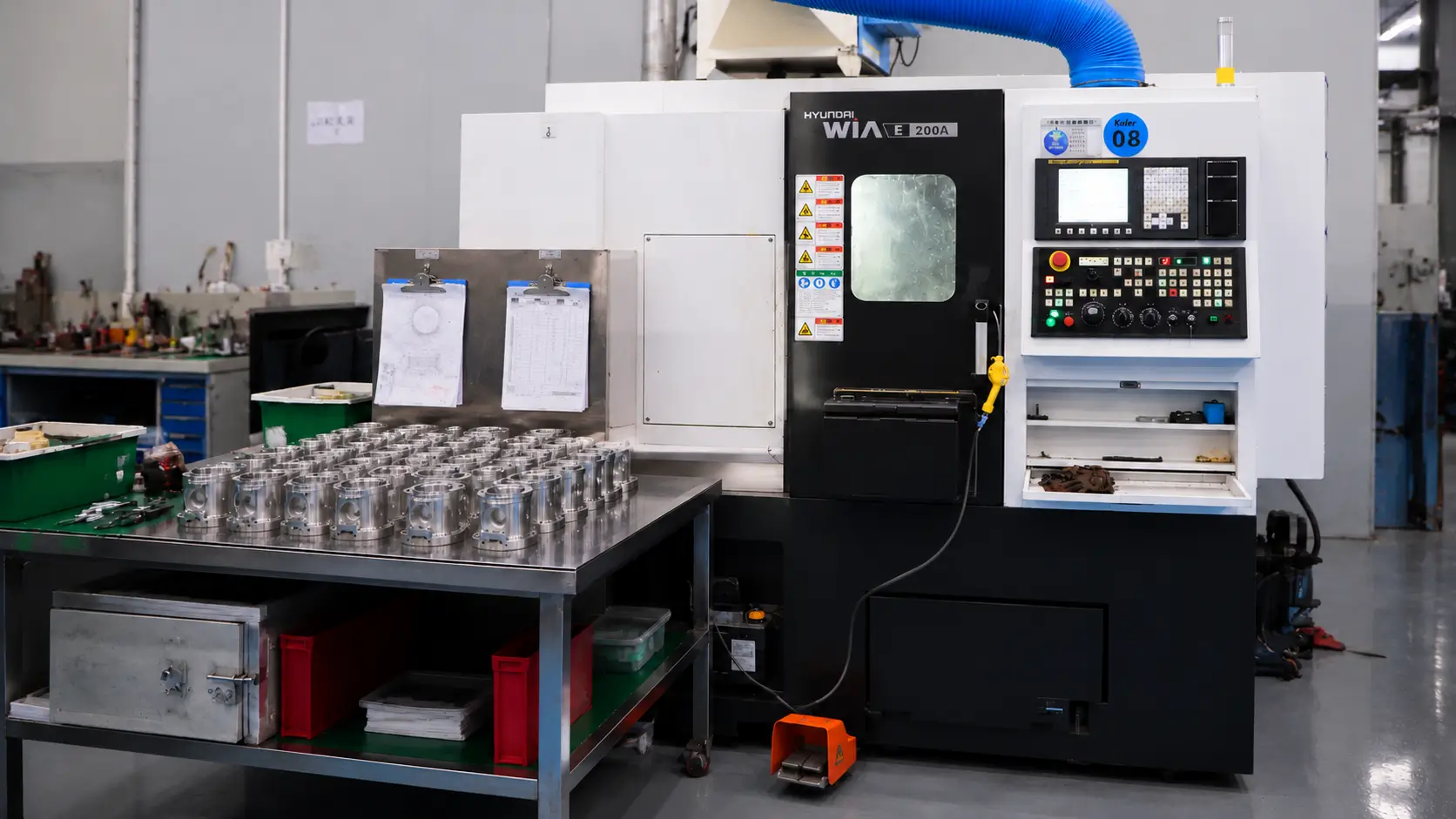
A custom solid-metal bushing can be machined from bar or tube stock. CNC turning is well suited to this type of part because the outside diameter, bore, faces, chamfers, and flange are largely rotational features. Drilling and boring can form the bore, with reaming, grinding, or honing used when the design calls for additional bore control or a particular surface condition.
A wrapped bushing is made differently. Instead of removing material from a solid blank, bearing strip is cut and formed into a cylindrical shape. This is common with layered metal-polymer bearing materials and produces the characteristic longitudinal split. GGB lists cylindrical and flanged split bushings among the standard forms for its metal-polymer bearing materials.
Sintered metal bushings follow another route. Metal powder is compacted and heated to bond the particles into the required shape. Polymer bushings can also be machined for custom requirements, while molded production is possible for suitable designs and volumes.
So a bushing should not automatically be thought of as a CNC-turned part. Machining is one manufacturing route, particularly for custom solid-metal bushings, but the construction and material determine how the part is actually made.
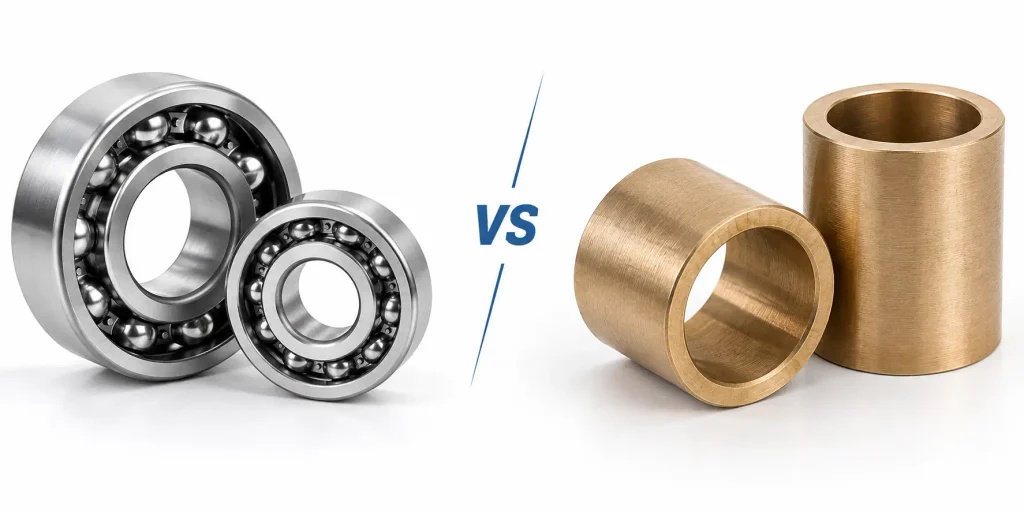
Bushing vs Bearing: What Is the Difference?
A bushing is a type of bearing. The confusion usually comes from using the word bearing to mean only ball or roller bearings.
The important difference is what happens between the moving surfaces. A plain bushing uses sliding contact. A ball or roller bearing places rolling elements between its races.
| Bushing | Ball or Roller Bearing |
|---|---|
| Uses sliding contact | Uses rolling contact |
| No balls or rollers | Contains rolling elements |
| Simple, compact construction | More components |
| Common in pivots and oscillating joints | Common on continuously rotating shafts |
| Can suit relatively slow movement | Often better suited to higher-speed rotation |
This does not mean one design is universally better. A pivoting linkage that only moves through a limited angle has different bearing requirements from a motor shaft rotating continuously at high speed. The type of movement, load, available space, lubrication, and operating environment all affect the choice.
Where Are Bushings Used?
Bushings are used in many places where connected parts need to move without wearing directly against each other. They are commonly found in hinges, mechanical linkages, actuator joints, hydraulic cylinder pivots, rollers, and other moving assemblies. Some support a rotating or oscillating pin, while others guide a shaft or rod that slides back and forth.
Bushings are also common in vehicle suspension systems, although these are often rubber or polyurethane parts rather than conventional plain bearings. They flex as the suspension moves, helping control movement and reduce vibration between connected components.
How Do You Choose a Bushing?
Start with the movement the bushing has to support. A slowly oscillating pivot, a sliding guide, and a continuously rotating shaft do not place the same demands on a bearing.
Then consider what the bearing surface will experience. Load, speed, lubrication, temperature, contamination, and exposure to moisture can all influence whether a bronze, polymer, composite, or another bearing material is appropriate.
The shaft and housing dimensions have to suit the selected bushing as well. Standard bearing manufacturers normally specify suitable shaft and housing requirements for their products. A custom bushing becomes relevant when the assembly needs a non-standard diameter, length, flange, material, lubrication groove, or other feature.
For an actual bearing design, these factors should be checked against the technical data for the specific bushing material rather than selecting a bushing from dimensions alone.
Conclusion
A mechanical bushing is a simple way to provide a bearing surface between a shaft or pin and its housing. Depending on the application, that movement may be rotation, oscillation, or sliding.
The familiar bronze sleeve is only one form. Bushings can be flanged, wrapped, sintered, polymer-based, or made from layered materials, and those differences affect both how they perform and how they are manufactured.
Understanding the basic relationship is the useful starting point: the housing holds the bushing, and the bushing provides the surface against which the shaft or pin moves.
FAQ
There is no fixed service life for a bushing. Wear depends on the load, movement, lubrication, shaft condition, bushing material, temperature, and contamination. Increasing clearance, noise, vibration, or movement in the joint can indicate that a bushing is wearing.
Some do and some do not. Bronze and other metal bushings are often designed to operate with oil or grease, while certain polymer and composite bushings can run dry. Lubrication requirements should be based on the specific bushing material and operating conditions.
Yes. Many bushings are designed as replaceable wear components. A worn bushing can often be removed from the housing and replaced without replacing the shaft, housing, or complete assembly, provided those components remain within acceptable condition.
Normal sliding contact gradually wears the bearing surface, but poor lubrication, contamination, misalignment, excessive load, insufficient clearance, or a damaged shaft can accelerate wear. The wear pattern can sometimes help identify what is happening elsewhere in the assembly.
Yes. Custom metal and engineering-plastic bushings can be machined when standard sizes or configurations do not fit the assembly. CNC turning is particularly suitable for custom cylindrical and flanged bushings, with additional machining used for features such as lubrication grooves, holes, or slots.