
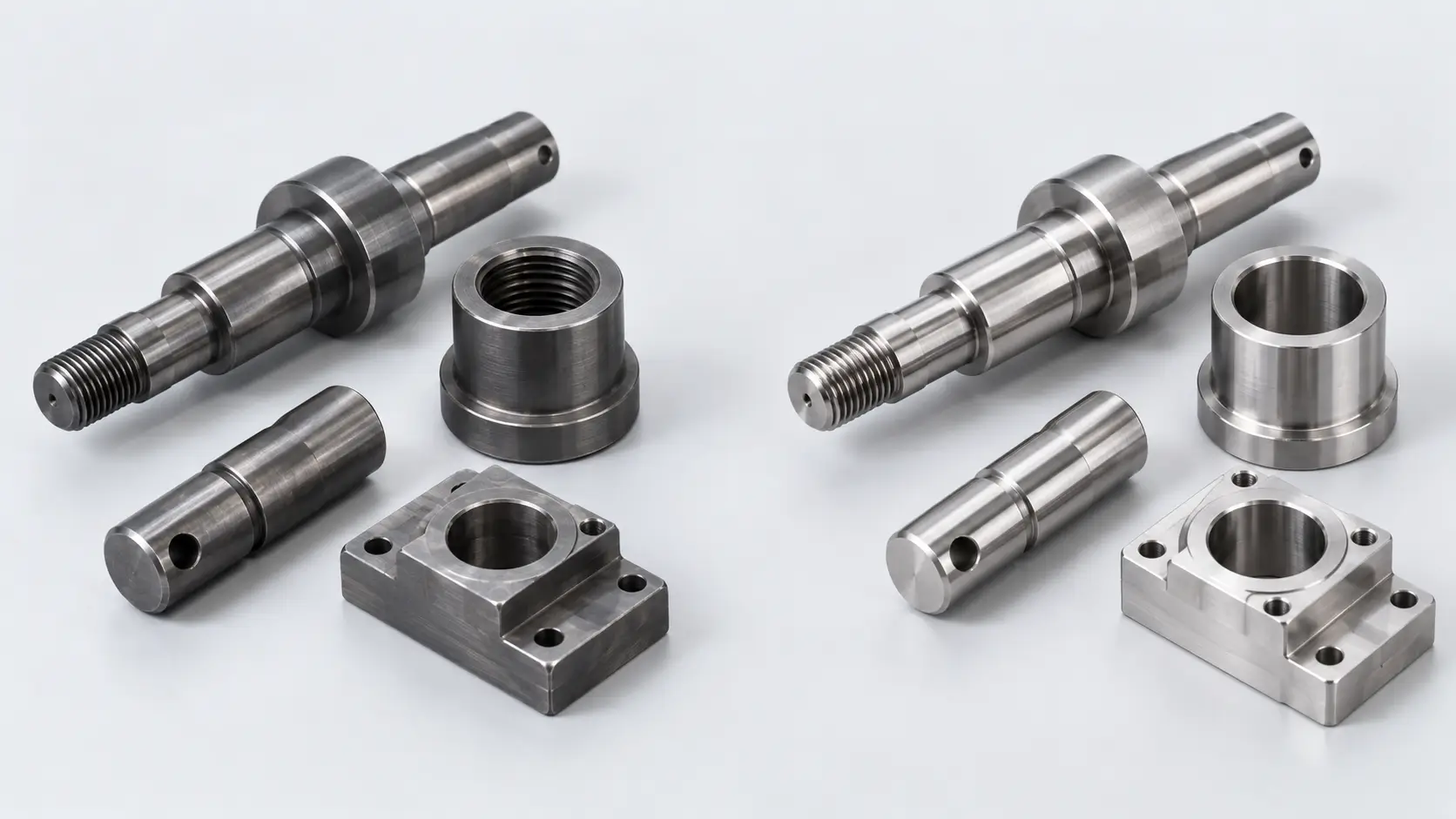
For engineering parts, the useful comparison is whether a specific grade and material condition can meet the mechanical and environmental requirements of the component at a practical finished-part cost. Carbon steel may be the better choice when strength, heat treatment, and cost dominate the design. Stainless steel becomes more valuable when corrosion resistance needs to come from the material itself.
What Is the Difference Between Carbon Steel and Stainless Steel?
The main difference between carbon steel and stainless steel is how the material resists corrosion.
Carbon steels are primarily iron-carbon alloys. Grades such as 1018, 1020, and 1045 can provide useful combinations of strength, toughness, machinability, and heat-treatment response, but they do not form the same corrosion-resistant passive surface as stainless steel. When exposed to moisture and oxygen without suitable protection, carbon steel can oxidize and develop rust.
Stainless steel contains enough chromium to form a thin chromium-rich passive layer on its surface. This film separates stainless steel from ordinary carbon steel because it provides inherent corrosion resistance rather than relying entirely on an applied coating.
That distinction affects more than the material itself.
| Factor | Carbon Steel | Stainless Steel |
|---|---|---|
| Corrosion resistance | Usually requires protection | Inherent, but grade-dependent |
| Raw material cost | Generally lower | Generally higher |
| Machinability | Often easier | Austenitic grades can be more difficult |
| Heat treatment | Widely used to modify properties | Depends on stainless family |
| Protective coating | Frequently required | Often unnecessary |
| Typical finishing | Zinc plating, black oxide, painting, powder coating | Passivation, polishing, bead blasting |
| Main advantage | Cost and mechanical-property flexibility | Corrosion resistance |
These are family-level differences rather than fixed properties. A drawing should still identify the actual grade because 1018, 1045, 304, 316, and precipitation-hardening stainless steels behave very differently.
Is Carbon Steel Stronger Than Stainless Steel?
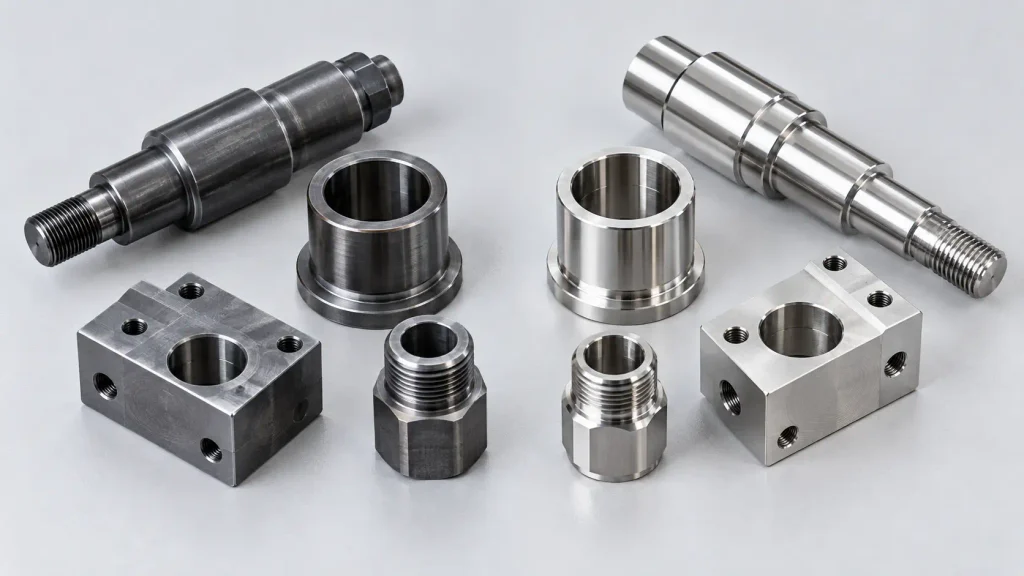
Carbon steel is not automatically stronger than stainless steel. Strength depends on the specific grade, material condition, heat treatment, and the mechanical property being compared.
A low-carbon 1018 steel, medium-carbon 1045 steel, annealed 304 stainless steel, and precipitation-hardening stainless steel cannot be ranked accurately from the words “carbon” and “stainless” alone. Yield strength, tensile strength, hardness, fatigue behavior, and wear resistance may lead to different material choices.
Carbon steel does provide considerable flexibility when strength and hardness need to be developed through heat treatment. For a shaft, pin, or wear component, a medium-carbon or alloy steel may offer a more suitable path than selecting an austenitic stainless grade simply because stainless appears to be a higher-performance material.
Stainless steel is not necessarily harder than carbon steel either. An annealed austenitic stainless steel can be considerably softer than a hardened carbon-steel component. Other stainless families can achieve much higher hardness.
For a functional drawing, it is more useful to specify the required grade, condition, hardness, or mechanical property than to rely on the material family as a proxy for strength.
How Does Corrosion Resistance Affect the Choice?
Corrosion resistance is usually the strongest reason for choosing stainless steel instead of carbon steel.
Carbon steel can perform reliably for long periods when the component remains dry, lubricated, enclosed, or protected by a suitable surface treatment. Machine shafts, fixtures, brackets, pins, structural components, and mechanical supports frequently use carbon steel because the service environment does not require corrosion resistance from the base material.
The decision changes when moisture, cleaning fluids, chemicals, salt, or other corrosive conditions regularly reach the component.
Stainless steel relies on its passive surface for corrosion resistance, which can eliminate the need for a separate protective coating. This is particularly useful on components with exposed functional surfaces or internal features that are difficult to coat uniformly.
Stainless steel is still not corrosion-proof. Grade selection remains important. Chlorides can promote pitting, while stagnant liquid trapped around joints, seals, threads, or narrow gaps can create conditions for crevice corrosion. A grade suitable for a clean indoor environment may not be appropriate for repeated salt or chemical exposure.
The operating environment should therefore be described in terms of what actually reaches the metal surface rather than using a broad rule such as “indoor” or “outdoor.”
A carbon-steel shaft inside a sealed and lubricated outdoor machine may face little corrosion risk. A stainless fitting located indoors but repeatedly exposed to chloride-containing cleaning solution can experience a much more aggressive environment.
How Do Carbon Steel and Stainless Steel Behave During CNC Machining?
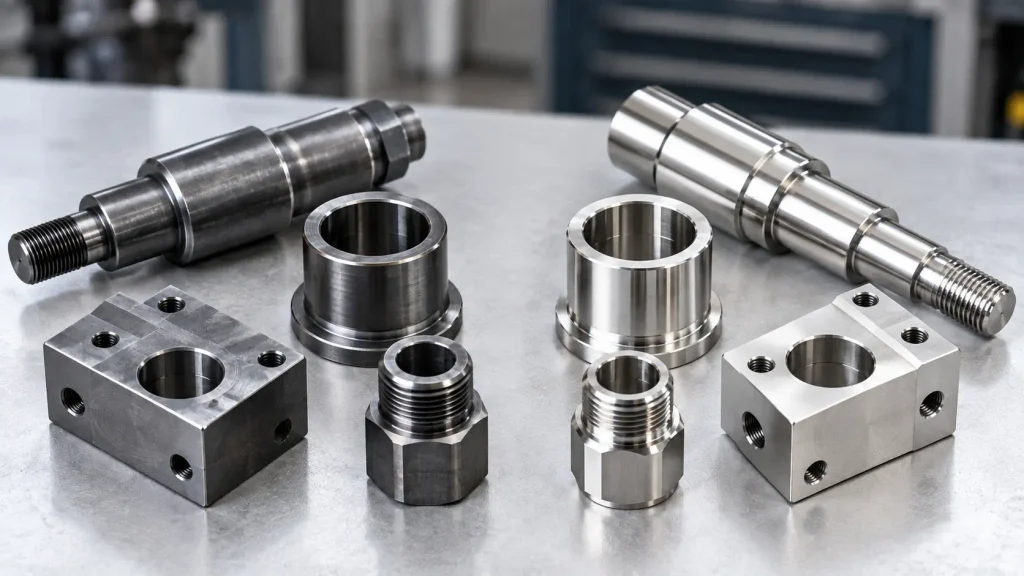
Carbon steel is often easier to machine than common austenitic stainless steel, but machinability still depends heavily on the actual grade and material condition.
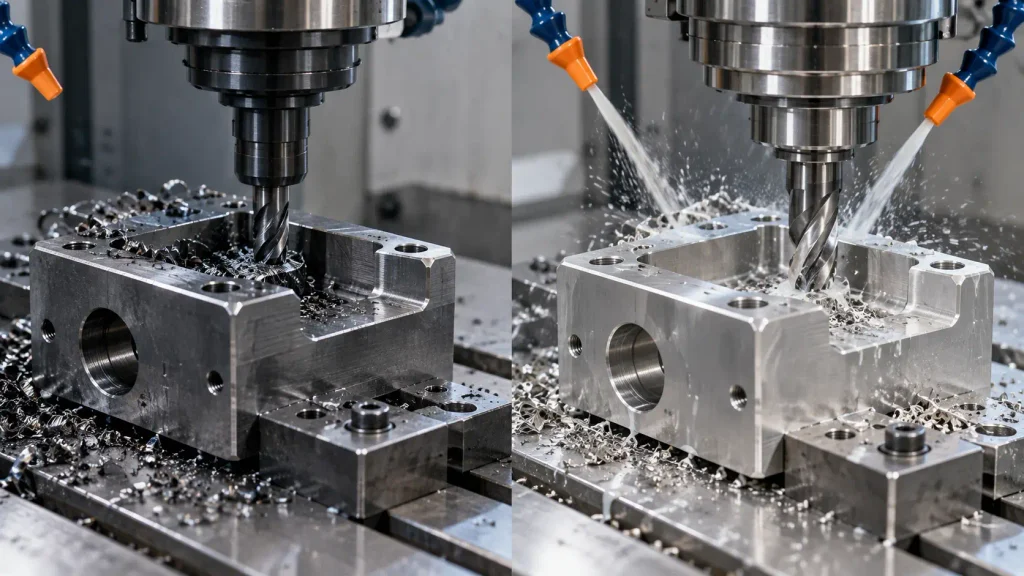
Austenitic grades such as 304 and 316 can work harden during machining. If the cutting edge rubs rather than maintaining a controlled cut, the surface ahead of the tool can become harder and make the following pass more difficult. Their thermal behavior and ductility can also increase cutting heat and complicate chip control.
Stable tooling, appropriate feeds, effective coolant delivery, controlled tool engagement, and consistent chip formation become particularly important when machining these materials.
Carbon steel frequently provides a wider machining window, but it should not be treated as one uniform material either. Machining annealed low-carbon steel is different from machining a higher-carbon grade, hardened component, or heat-treated alloy steel.
Geometry can also outweigh the nominal material difference.
A simple 304 shaft with accessible diameters may present less manufacturing difficulty than a thin-wall carbon-steel housing that requires multiple setups, heat treatment, and tight dimensional control afterward. Material choice has to be considered together with feature geometry, tolerance, workholding, and process sequence.
These differences are why CNC machining materials should be selected from the full manufacturing requirement rather than raw material properties alone.
How Does Surface Finishing Change the Material Decision?
Surface finishing can change the economics and manufacturability of stainless steel vs carbon steel considerably.
Carbon steel often requires an additional corrosion-protection process. Depending on the application, this may include zinc plating, nickel plating, black oxide, painting, powder coating, or another protective system.
Once a coating is added, the design has to account for the complete manufacturing route. Coating buildup on a fitted diameter, bore, thread, or locating surface can affect assembly. Some critical areas may require masking, while other dimensions may need to be controlled with the final coating thickness in mind.
This can make an apparently inexpensive carbon-steel component more complicated than the raw-material comparison suggests.
Stainless steel may eliminate the need for a dimensional protective coating. Machined stainless parts can instead receive processes such as passivation when removing free-iron contamination and maintaining a clean passive surface is important.
Passivation does not turn an unsuitable stainless grade into a highly corrosion-resistant one. The base alloy still determines the fundamental corrosion behavior.
The required surface finishing process should therefore be considered at the same time as material selection, especially when the part contains tight fits, threaded interfaces, masked surfaces, or features that are difficult to coat.
Which Costs Less for a Finished Machined Part?
Carbon steel generally costs less as raw stock, but it does not always produce the cheaper finished component.
The useful comparison is:
material + machining + heat treatment + finishing + inspection + corrosion protection
A carbon-steel part may require rough machining, heat treatment, finish machining, plating, masking, additional dimensional inspection, and corrosion-prevention packaging. Each operation introduces cost and another point where variation has to be controlled.
A stainless-steel part starts with more expensive material and may require more machining time, particularly when using grades such as 304 or 316. Tool wear, cutting conditions, and deburring may also add manufacturing effort.
The advantage is that the finished component may not need a separate corrosion-protection coating.
Consider a housing containing several internal passages. Carbon steel may initially appear to be the economical option, but reliably coating deep passages and internal intersections can be difficult. Stainless steel may cost more to machine while eliminating a finishing problem that affects long-term corrosion performance.
The opposite can happen with a simple machine bracket. If the entire assembly is already powder coated and operates in a mild environment, stainless steel may add material and machining cost without improving the function of the component.
Finished-part cost matters more than the price per kilogram of the raw material.
Is Carbon Steel Better Than Stainless Steel?
Carbon steel is better than stainless steel when its mechanical properties, manufacturing route, and corrosion protection satisfy the application at a lower total cost. Stainless steel is better when inherent corrosion resistance solves a real functional or maintenance problem.
For dry, lubricated, enclosed, or coated components, carbon steel is often the logical starting point. Shafts, pins, fixtures, machine brackets, mechanical supports, and other industrial parts can benefit from its material availability, heat-treatment flexibility, and generally favorable machining characteristics.
Carbon steel also makes sense when surface protection is already part of the product. If an entire machine assembly will be painted, plated, or powder coated, specifying stainless steel for every component may provide little additional value.
Stainless steel becomes more attractive when the component repeatedly encounters water, cleaning chemicals, process fluids, food-contact conditions, outdoor exposure, or other environments where maintaining a coating becomes difficult.
Internal geometry can strengthen the case for stainless steel. Ports, threads, cross-holes, deep cavities, and fluid passages may be difficult to protect consistently with an external coating process. Using a suitable stainless grade can simplify the corrosion-control strategy.
Neither material is universally better. The correct choice depends on which failure mode actually controls the component.
Why Grade and Condition Matter More Than the Material Family
One of the biggest weaknesses in a simple carbon steel vs stainless steel comparison is that it treats two large material families as though each one had a fixed set of properties.
Consider a rotating shaft.
If the shaft operates inside a sealed gearbox where lubrication protects the surface and wear or strength controls the design, a suitable carbon steel may offer a straightforward manufacturing route. Changing it to 304 stainless only for corrosion resistance could increase machining cost without addressing the important engineering requirement.
Now put a similar shaft in equipment that receives frequent washdown. Corrosion on a seal diameter, bearing seat, thread, or locating surface could directly affect function. Stainless steel may now justify the higher initial cost because the service environment has changed.
The part geometry can remain almost identical while the appropriate material changes completely.
The same reasoning applies to housings. A coated carbon-steel housing can work well when internal surfaces remain dry. If process fluid moves through drilled passages and cavities that are difficult to coat, stainless steel may become the more reliable solution.
This is why material selection should begin with the component’s failure mode and functional environment, not with a general ranking of carbon steel and stainless steel.
How Should the Material Be Specified on an RFQ?
A manufacturing RFQ should identify an actual material grade rather than simply specifying “carbon steel” or “stainless steel.”
Material condition can be equally important. Cold-drawn stock, annealed material, hardened steel, and heat-treated material can produce different mechanical properties and machining behavior even when the grade designation remains the same.
If hardness or strength controls the design, those requirements should be included on the drawing or material specification.
Finishing requirements should also be defined early. A carbon-steel component that will receive zinc plating, black oxide, or another dimensional finish may require different machining allowances or masking than an unfinished part. Stainless components may require passivation or a specified surface condition depending on the application.
Critical dimensions should indicate whether they apply before or after heat treatment and finishing where this distinction affects function.
For corrosion-sensitive components, information about the operating environment can also help prevent poor material choices. Exposure to salt, process chemicals, regular washdown, or retained fluids may influence whether carbon steel, 304 stainless, 316 stainless, or another material is appropriate.
For drawings where material, tolerance, heat treatment, and finishing interact, ZH Precision’s CNC machining services can include a manufacturability review before production to evaluate the complete process route.
Conclusion
The question of carbon steel vs stainless steel cannot be answered by saying one material is stronger, cheaper, or better.
Carbon steel is often the more economical option when corrosion can be controlled and the design depends on mechanical performance, heat-treatment flexibility, or manufacturing cost. Stainless steel becomes more valuable when corrosion resistance needs to come from the base material and when eliminating protective coatings simplifies the component.
The practical selection method is to define the service environment, required mechanical properties, grade and material condition, machining requirements, finishing route, and critical features before comparing cost.
That provides a more reliable engineering decision than comparing two broad material families by name alone.
FAQ
Not necessarily. Strength depends on the exact grade, material condition, heat treatment, and mechanical property being compared. Some heat-treated carbon steels are considerably stronger than common austenitic stainless grades, while other stainless families can also achieve high strength.
Not always. Hardness varies significantly between grades and conditions. Annealed 304 stainless steel, hardened 1045 carbon steel, and precipitation-hardening stainless steel can have very different hardness levels.
Carbon steel can rust when exposed to moisture and oxygen without adequate protection. Plating, painting, powder coating, oil, controlled environments, and other surface treatments can reduce corrosion risk.
Stainless steel is corrosion resistant rather than completely corrosion-proof. Chlorides, aggressive chemicals, crevices, contamination, unsuitable grades, and poor surface conditions can still cause corrosion.
Carbon steel can be better when cost, strength, heat treatment, or wear performance controls the design and corrosion can be managed. Stainless steel can be better when inherent corrosion resistance reduces coating, maintenance, or contamination risks.
Many common unhardened carbon steels are easier to machine than 304 or 316 stainless steel. The actual result depends on grade, hardness, geometry, tooling, and machining conditions.
Carbon steel generally has a lower raw-material price. The cheaper finished component depends on machining, heat treatment, finishing, coating, inspection, and the corrosion-control requirements of the application.