
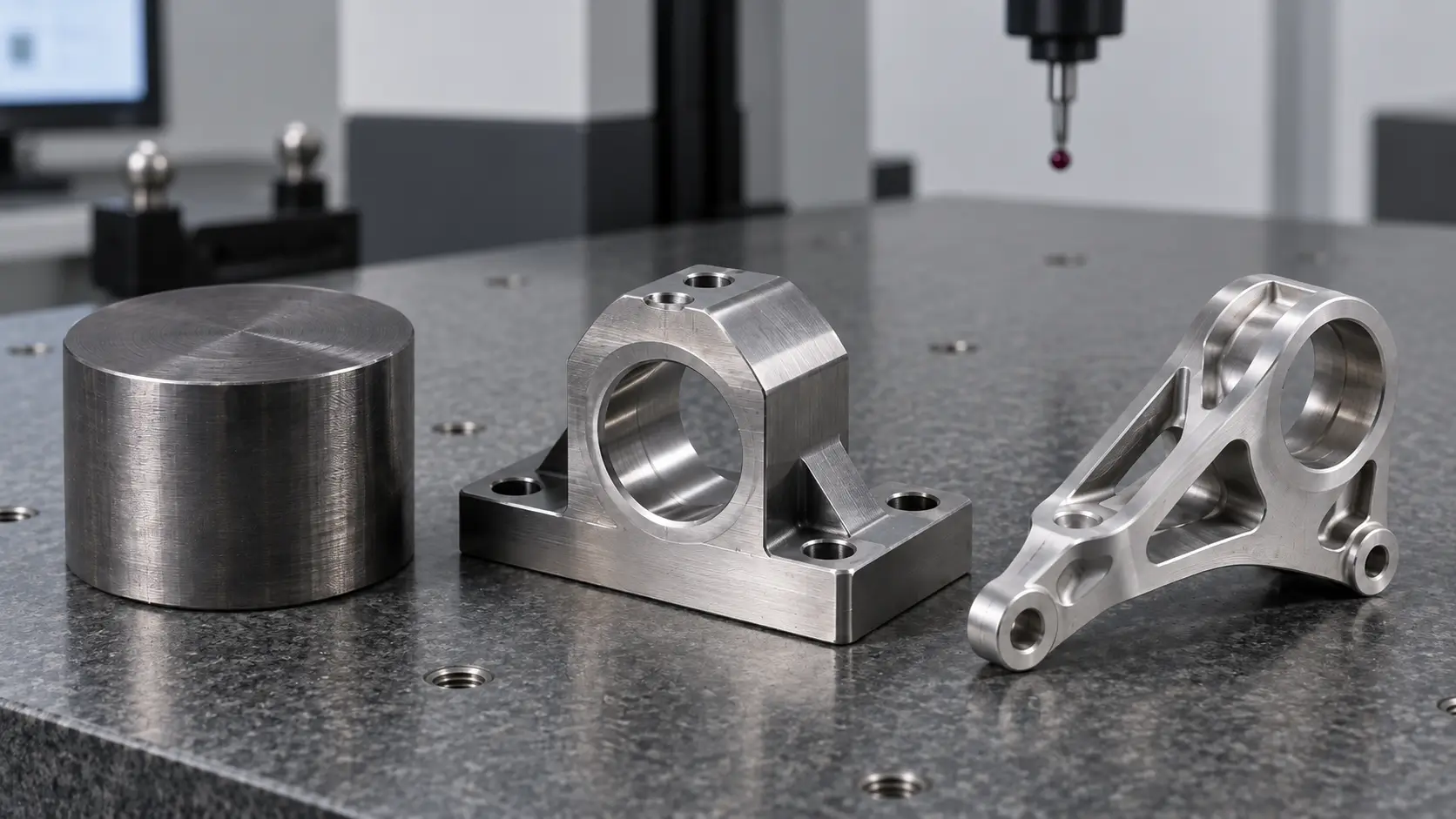
A metal can have very high tensile strength but still be too heavy, too brittle, or too difficult to manufacture for a particular part. The more useful engineering question is which type of strength actually controls the component in service.
What Is the Strongest Metal?
Tungsten is commonly regarded as one of the strongest pure metals. It combines high stiffness, excellent heat resistance, a density of about 19.3 g/cm³, and the highest melting point of any metal at approximately 3414°C.
The answer changes when alloys are included. Heat-treated maraging steels can exceed 2,000 MPa in tensile strength, titanium alloys provide high strength at much lower density, and nickel-based superalloys retain useful mechanical properties at temperatures where many structural metals lose strength.
| Requirement | Strong Candidate |
|---|---|
| Strong pure metal | Tungsten |
| Very high tensile and yield strength | Maraging steel |
| High strength-to-weight ratio | Titanium alloy |
| High-temperature strength | Nickel-based superalloy |
| High hardness and wear resistance | Hardened tool steel |
There is therefore no universal strongest metal until the required type of strength is defined.
Why “Strongest” Has No Single Engineering Meaning
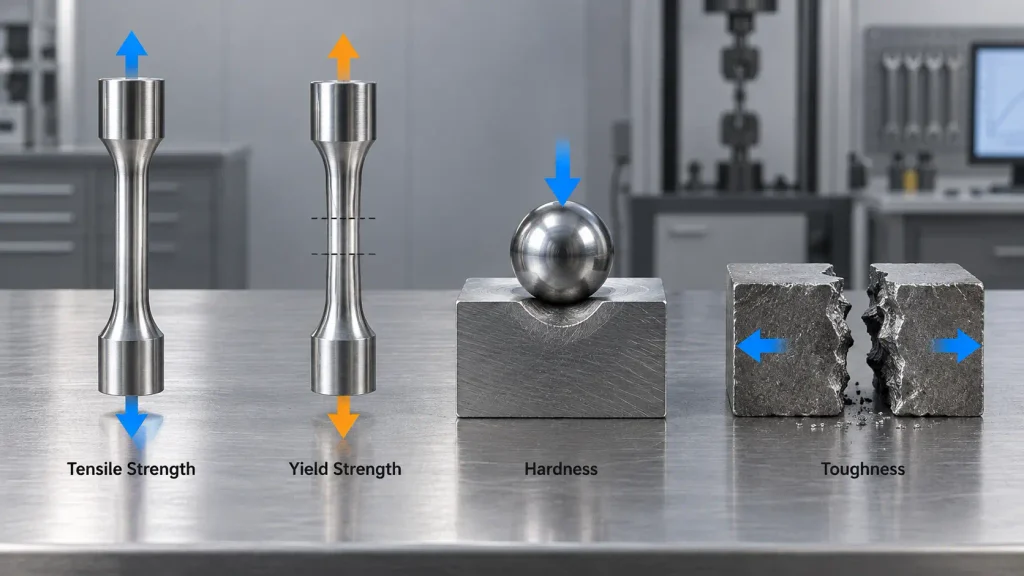
Strength is not one material property. A shaft that bends permanently has already failed even if it never reaches its ultimate tensile strength, so yield strength may matter more than the value measured at fracture.
Hardness and toughness create a similar distinction. A material can resist indentation and wear extremely well but still fracture under impact. Another material may be less hard but absorb much more energy before cracking.
| Property | What It Describes |
|---|---|
| Tensile Strength | Maximum tensile stress before fracture |
| Yield Strength | Stress at which permanent deformation begins |
| Hardness | Resistance to indentation and wear |
| Toughness | Ability to absorb energy before fracture |
| Specific Strength | Strength relative to density |
| High-Temperature Strength | Strength retained as temperature rises |
This is why strongest-metal rankings often become misleading when several different properties are treated as though they measured the same thing.
Tungsten vs High-Strength Steel
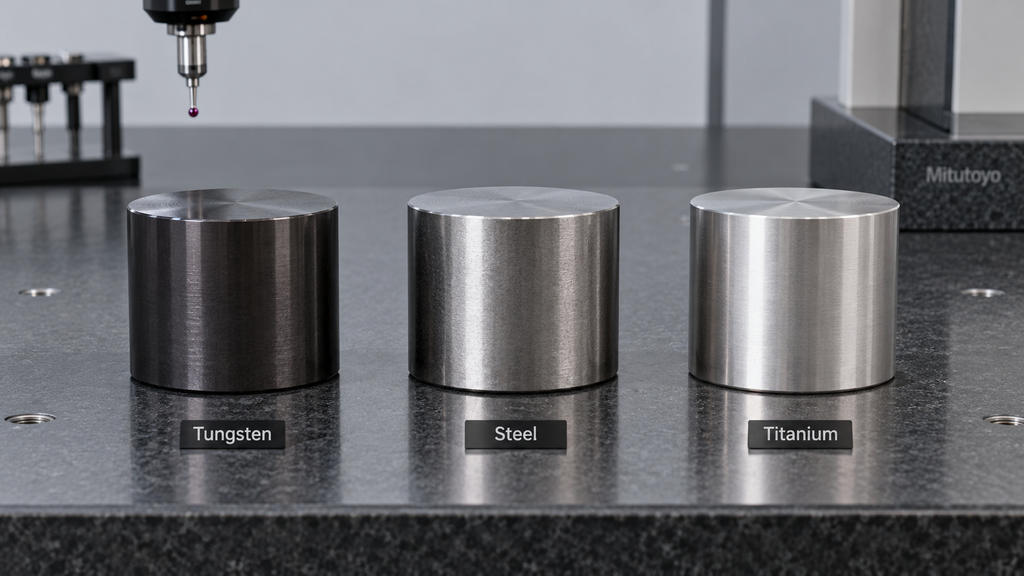
Tungsten is a strong answer when the comparison is limited to pure metals, but high-strength steels change the result once engineered alloys are included. Aged maraging steels, for example, can exceed 2,000 MPa in tensile strength, showing why the strongest pure metal and the strongest engineering alloy are different questions.
The two materials also solve different problems. Tungsten offers exceptional stiffness and temperature capability but is extremely dense. High-strength steels generally provide a more practical combination of strength, toughness, machinability, availability, and cost for structural parts.
The comparison therefore depends on the required property, not simply which material produces the larger number on a strength chart.
Where Titanium Actually Wins
Titanium does not usually exceed ultra-high-strength steel in absolute tensile strength. Its main advantage appears when strength is compared with density.
Ti-6Al-4V has a density of roughly 4.4 g/cm³, compared with about 7.8 g/cm³ for steel and 19.3 g/cm³ for tungsten. That lower density allows titanium alloys to provide high specific strength, which is valuable when reducing mass is part of the design requirement.
This is why titanium is common in aircraft structures, robotic assemblies, moving mechanisms, and other components where weight affects performance. It is more accurate to describe titanium as a high-strength, low-density material than simply as the strongest metal.
Strength Changes with Temperature and Material Condition
A strength value means very little without knowing the alloy and its condition. “Steel” may refer to mild steel, 4140, tool steel, or maraging steel, all of which can have very different tensile strength, yield strength, hardness, and toughness.
Heat treatment can change those properties again. Annealed, quenched and tempered, precipitation-hardened, or aged material should not be treated as mechanically identical even when the alloy designation is the same.
Temperature matters as well. A material that performs well at room temperature may lose substantial strength as temperature rises. Nickel-based superalloys such as INCONEL 718 are important not because they always have the highest room-temperature strength, but because they retain useful mechanical properties under elevated-temperature service.
The Strongest Metal Is Not Always the Best Material
More strength does not automatically produce a better component.
If a design requires a minimum yield strength of 650 MPa, selecting a 1,800 MPa alloy may provide little functional benefit once the required safety margin has already been achieved. The stronger material may instead increase raw material cost, cutting forces, tool wear, heat-treatment requirements, or distortion risk.
This becomes especially important in CNC machining. Hardened steels require different tooling from annealed stock, titanium concentrates heat near the cutting edge, and nickel-based alloys can generate high cutting forces and work-harden during machining.
Material selection should therefore provide enough strength for the actual failure mode without adding unnecessary manufacturing difficulty.
Strongest Metals for Different Requirements
The strongest material becomes easier to identify once the engineering requirement is clear.
| Engineering Requirement | Material Commonly Considered |
|---|---|
| Pure metal strength | Tungsten |
| Very high structural strength | Maraging steel |
| Strength with useful toughness | High-strength alloy steel |
| Strength-to-weight ratio | Titanium alloy |
| Elevated-temperature strength | Nickel-based superalloy |
| Hardness and wear resistance | Hardened tool steel |
A component exposed to static loading, impact, wear, high temperature, or strict weight limits may therefore require completely different materials even if every design is described as needing a “strong metal.”
Choosing a Strong Metal for a Manufactured Part
Material selection should begin with how the part is expected to fail. A shaft may be controlled by yielding or fatigue, a lightweight arm by mass and stiffness, a hot component by strength retention at temperature, and a wear surface by hardness.
The actual alloy should then be selected around those requirements together with corrosion resistance, part geometry, heat treatment, machinability, tolerance, availability, and cost. For manufactured components, specifying a grade such as 4140, Ti-6Al-4V, or INCONEL 718 is far more useful than simply calling for steel, titanium, or nickel.
The strongest available material is rarely the correct starting point. The better starting point is the load, environment, weight limit, and service condition the finished part must withstand.
Conclusion
Tungsten is a reasonable answer when the question is limited to strong pure metals, but it is not a universal winner once engineered alloys and real service conditions are considered.
Maraging steels can provide greater structural tensile and yield strength, titanium alloys offer high strength at low weight, and nickel-based superalloys retain strength at elevated temperature. The useful engineering question is not which metal has the highest number, but which material property controls failure in the actual part.
FAQ
Tungsten is commonly considered one of the strongest pure metals. If engineered alloys are included, some high-strength steels can achieve greater tensile and yield strength.
Tungsten is an exceptionally strong pure metal with high stiffness and extreme heat resistance. It is not the strongest material under every mechanical measure.
Tungsten strength varies with purity, processing method, product form, and temperature. Its engineering value comes from the combination of strength, stiffness, density, and high-temperature capability rather than one universal tensile-strength number.
It depends on the steel grade and the property being compared. Maraging and other ultra-high-strength steels can exceed tungsten in structural tensile or yield strength, while tungsten offers different advantages at extreme temperatures.
Not usually in absolute tensile or yield strength. Titanium alloys are valuable because they provide substantial strength at much lower density, giving them a high strength-to-weight ratio.
Titanium alloys are among the most important high-strength lightweight metals used in engineering. Ti-6Al-4V is widely used where strength, low weight, fatigue performance, and corrosion resistance need to be balanced.