
This distinction explains several observations that can otherwise seem contradictory. A magnet will not normally attach itself to an aluminum plate, yet a strong moving magnet can create noticeable drag near aluminum through induced electrical currents. Understanding that difference is useful when identifying materials, selecting aluminum alloys, designing equipment around magnets or sensors, and evaluating assemblies that contain both aluminum and magnetic components.
Is Aluminum Magnetic?
Pure aluminum is classified as a paramagnetic material. In a magnetic field, it develops a weak magnetization in the same general direction as the applied field, but the effect is far too small to make aluminum behave like iron or conventional carbon steel.
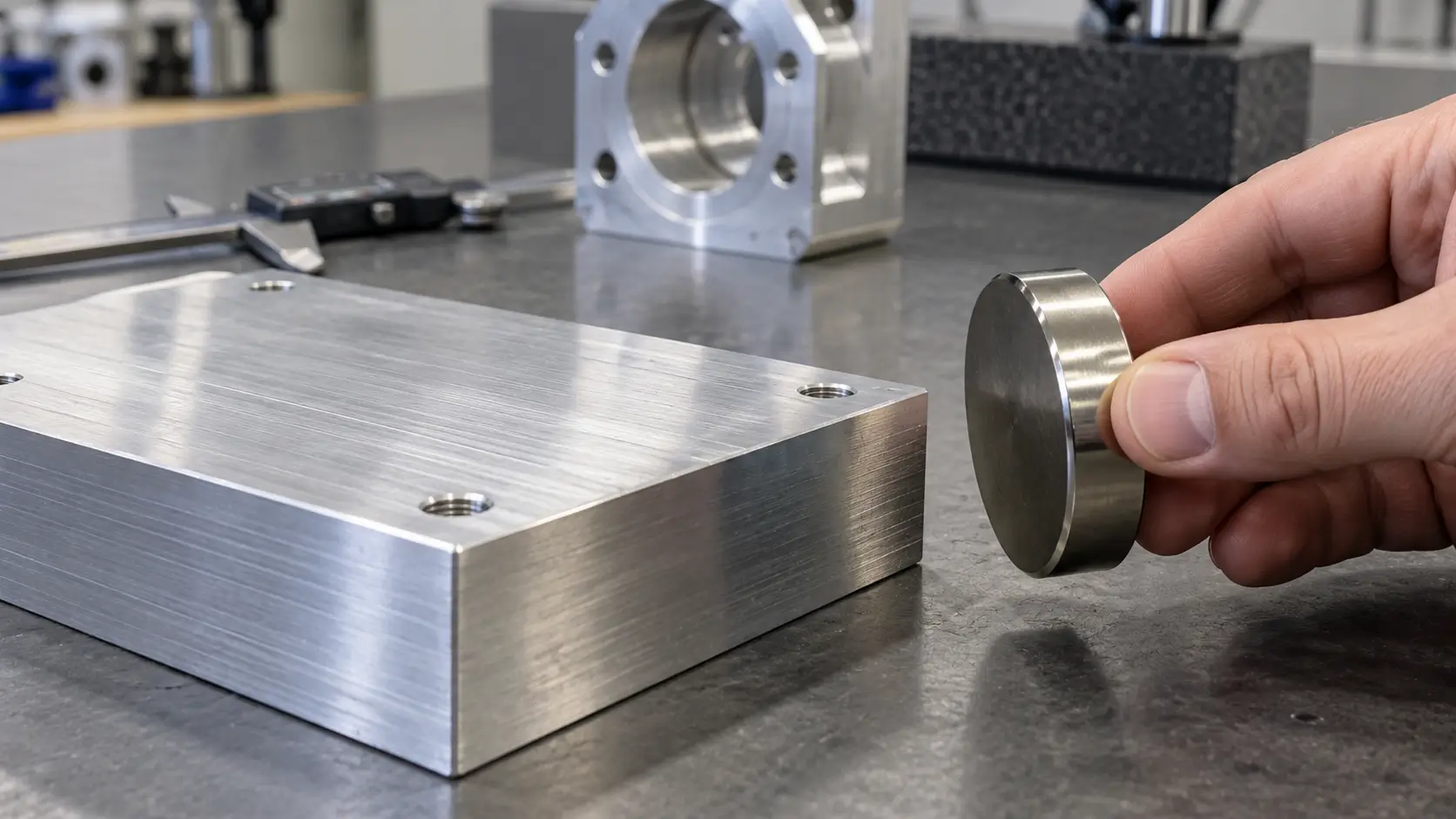
For practical engineering purposes, aluminum is therefore considered non-magnetic. If a standard workshop magnet is placed against a piece of 6061 aluminum plate, for example, there will normally be no meaningful attraction strong enough to hold the magnet in place.
This practical definition matters because the word “magnetic” is often used to describe very different material behaviors. Iron and many steels are ferromagnetic, which means their internal magnetic structure can align strongly with an external field and produce a substantial attraction. Aluminum does not have that type of magnetic behavior.
The difference is not that aluminum is completely invisible to magnetic fields. It is that its direct response to a static field is extremely weak compared with ferromagnetic metals.
Why Doesn’t a Magnet Stick to Aluminum?
A permanent magnet sticks strongly to carbon steel because the steel contains ferromagnetic regions that can align with the magnetic field. Once aligned, they create a much stronger attraction between the magnet and the material.
Aluminum does not have the same ferromagnetic domain behavior. Its response to a static magnetic field is weak, so the force produced between ordinary aluminum and a permanent magnet is usually too small to notice in everyday use.
This is why a simple magnet test can quickly distinguish many aluminum parts from ordinary carbon steel. A steel bracket may pull strongly toward the magnet, while an aluminum bracket of the same shape shows almost no visible attraction.
The same principle applies whether the aluminum is sheet, plate, extrusion, or a CNC-machined component. Geometry changes the amount of material present, but it does not turn aluminum into a ferromagnetic metal.
It is also important not to interpret “the magnet does not stick” as meaning there is no physical interaction at all. Static attraction and electromagnetic induction are different mechanisms, which becomes important when the magnet is moving.
Why Can a Moving Magnet Still Affect Aluminum?
One of the most interesting properties of aluminum is that a moving magnetic field can interact with it strongly enough to create a visible mechanical effect, even though the aluminum itself is not ferromagnetic.
Aluminum is a good electrical conductor. When the magnetic field passing through an aluminum part changes, electrical currents can be induced inside the metal. These circulating currents are known as eddy currents.
The eddy currents create their own magnetic field, which opposes the change that produced them. This is why a strong magnet moving across a thick aluminum plate can feel as though it is being slowed down even though the magnet does not actually stick to the surface.
A familiar demonstration uses a strong magnet dropped through an aluminum or copper tube. The magnet falls much more slowly than it would through a nonconductive tube. The changing magnetic field induces currents in the conductive wall, and the resulting electromagnetic force opposes the magnet’s motion.
This is an important distinction:
Aluminum does not need to be ferromagnetic for a changing magnetic field to produce a force in it.
The effect depends on electrical conductivity, magnetic field strength, movement, geometry, and the rate at which the magnetic field changes.
This principle is used intentionally in technologies such as eddy-current braking, induction systems, metal sorting, and some types of sensing equipment.
Can Aluminum Be Magnetized?
Aluminum cannot normally be magnetized in the same practical way as carbon steel or iron.
While an external magnetic field is present, aluminum develops a very weak paramagnetic response. Once the external field is removed, it does not retain the strong permanent magnetization associated with ferromagnetic materials.
This means placing an aluminum component next to a strong magnet will not normally turn it into a permanent magnet.
The distinction can be important when specifying components for equipment where residual magnetism is undesirable. A machined aluminum housing or structural component will not normally retain significant magnetization simply because it has operated near a magnetic field.
However, the complete assembly still needs to be considered. Steel screws, bearings, inserts, shafts, springs, or other ferromagnetic components installed in an aluminum part can produce a strong magnetic response even though the aluminum body itself does not.
Are Aluminum Alloys Magnetic?
The common aluminum alloys used in engineering and manufacturing are also generally treated as non-magnetic in normal applications.
Alloying aluminum with magnesium, silicon, copper, zinc, manganese, and other elements changes properties such as strength, hardness, corrosion resistance, formability, and machinability. In common wrought and cast aluminum grades, these additions do not normally create the strong ferromagnetic behavior found in carbon steel.
For example, 6061 aluminum remains practically non-magnetic and is widely used for machined components, frames, housings, fixtures, and structural parts. Its balance of machinability, strength, and corrosion resistance also makes it one of the most common materials used in aluminum CNC machining services. 5052 aluminum, despite its relatively high magnesium content, also remains non-magnetic in ordinary engineering use. High-strength alloys such as 7075 and 2024 behave similarly from a practical magnetic standpoint.
Cast aluminum alloys are also normally non-magnetic. If a die cast or sand cast aluminum component appears strongly attracted to a magnet, it is worth checking whether the response is actually coming from another material in the assembly.
Possible sources include steel inserts, threaded fasteners, bearings, pins, internal reinforcement, or contamination from another metal.
This is one reason magnetic response alone should not be used to identify an aluminum alloy grade.
Can You Identify Aluminum With a Magnet?
A magnet can be useful for quick material sorting, but it cannot positively prove that a metal is aluminum.
If a metal part is strongly attracted to a magnet, it is unlikely to be ordinary aluminum. That makes the test useful for separating aluminum from many common carbon steels.
The opposite conclusion is much less reliable. If the magnet does not stick, the material could be aluminum, but it could also be copper, brass, titanium, certain stainless steels, or another non-ferromagnetic alloy.
A simple comparison helps illustrate the limitation:
| Material | Typical Magnetic Behavior |
|---|---|
| Aluminum | Practically non-magnetic |
| Carbon steel | Strongly magnetic |
| Cast iron | Usually magnetic |
| Copper | Non-magnetic in practice |
| Brass | Generally non-magnetic |
| Titanium | Non-magnetic in practice |
| 304/316 stainless steel | Often weakly magnetic or non-magnetic, depending on condition |
Stainless steel is especially important because its magnetic behavior varies with alloy family and processing history. Austenitic stainless steels such as 304 and 316 are often weakly magnetic or effectively non-magnetic in their annealed condition, but cold working can increase their magnetic response.
For positive material identification, engineers should therefore rely on drawing control, material certificates, chemical analysis, XRF where appropriate, or other verification methods rather than a magnet alone.
When Does Aluminum’s Non-Magnetic Behavior Matter?
For many ordinary mechanical components, magnetic behavior has little influence on material selection. Strength, corrosion resistance, weight, machinability, cost, and surface treatment are usually more important.
There are applications, however, where aluminum’s lack of strong ferromagnetism becomes useful.
In electronic and electrical equipment, aluminum housings and structures can provide low weight, good thermal conductivity, and electrical conductivity without behaving like conventional magnetic steel. This can be useful when structural material is located near magnetic components, although electromagnetic compatibility must still be evaluated at the complete system level.
In sensor and instrumentation systems, the choice between a ferromagnetic and non-ferromagnetic structural material can influence local magnetic fields. Aluminum is therefore commonly considered for brackets, housings, frames, and other mechanical structures where strong magnetic interaction is undesirable.
In motors and machinery, aluminum can be used around rotating magnetic systems without producing the strong static attraction associated with steel. Its electrical conductivity can still generate eddy currents, however, so geometry and motion need to be considered if strong changing magnetic fields are present.
Aluminum also behaves differently in metal separation and recycling systems. A conventional magnet can remove ferrous metals such as steel, but aluminum will remain in the non-ferrous material stream. Eddy-current separators can then use rapidly changing magnetic fields to induce currents in conductive non-ferrous metals and physically separate materials such as aluminum.
The important engineering point is that “non-magnetic” does not mean “electromagnetically inactive.” Aluminum has weak static magnetic behavior but relatively high electrical conductivity, so its interaction with a changing magnetic field can still be important.
Does Surface Treatment Change Aluminum’s Magnetic Behavior?
Most common aluminum surface treatments do not change the fundamental magnetic behavior of the aluminum substrate.
Anodizing converts the aluminum surface into a controlled oxide layer. It changes corrosion resistance, wear resistance, appearance, and surface characteristics, but it does not make the underlying aluminum behave like ferromagnetic steel.
Powder coating, painting, bead blasting, and polishing also do not normally change the bulk magnetic properties of the aluminum.
Metallic coatings require more attention because the coating material itself may have different magnetic properties. A magnetic response can also come from steel inserts, screws, bushings, or other components beneath or attached to the aluminum.
This means a magnet reacting to a finished aluminum assembly does not automatically indicate that the aluminum itself is magnetic. The complete material stack needs to be considered.
Conclusion
Aluminum is technically a weakly paramagnetic metal, but in ordinary engineering use it is treated as non-magnetic because a conventional permanent magnet does not produce meaningful attraction to it. Common aluminum alloys such as 5052, 6061, 2024, and 7075 behave the same way for most practical applications.
A moving or changing magnetic field can still interact with aluminum because its electrical conductivity allows eddy currents to form. This explains why strong magnets can experience drag near aluminum even though they do not stick to it.
For engineers, the practical distinction matters when identifying materials, designing around sensors or magnets, selecting structural materials for electrical equipment, or evaluating assemblies that contain both aluminum and ferromagnetic components. A magnet is useful for quick screening, but it should not be treated as a reliable method for identifying aluminum or determining a specific aluminum alloy.
FAQ
6061 aluminum is considered non-magnetic in normal engineering use. Like pure aluminum, it is weakly paramagnetic, but the response is too small for an ordinary permanent magnet to stick noticeably to the material.
A normal permanent magnet will not usually stick to aluminum because aluminum is not ferromagnetic. Strong moving magnetic fields can still interact with aluminum through eddy currents, but this is different from magnetic attraction.
Aluminum does not normally retain strong permanent magnetization after an external magnetic field is removed. Its magnetic response is weak and exists mainly while the applied field is present.
The moving magnet creates a changing magnetic field that induces eddy currents in the conductive aluminum tube. Those currents generate an opposing magnetic field that slows the magnet’s movement.
A magnet can help rule out strongly magnetic materials such as carbon steel, but it cannot confirm that a metal is aluminum. Copper, brass, titanium, and some stainless steels may also show little or no attraction to an ordinary magnet.