
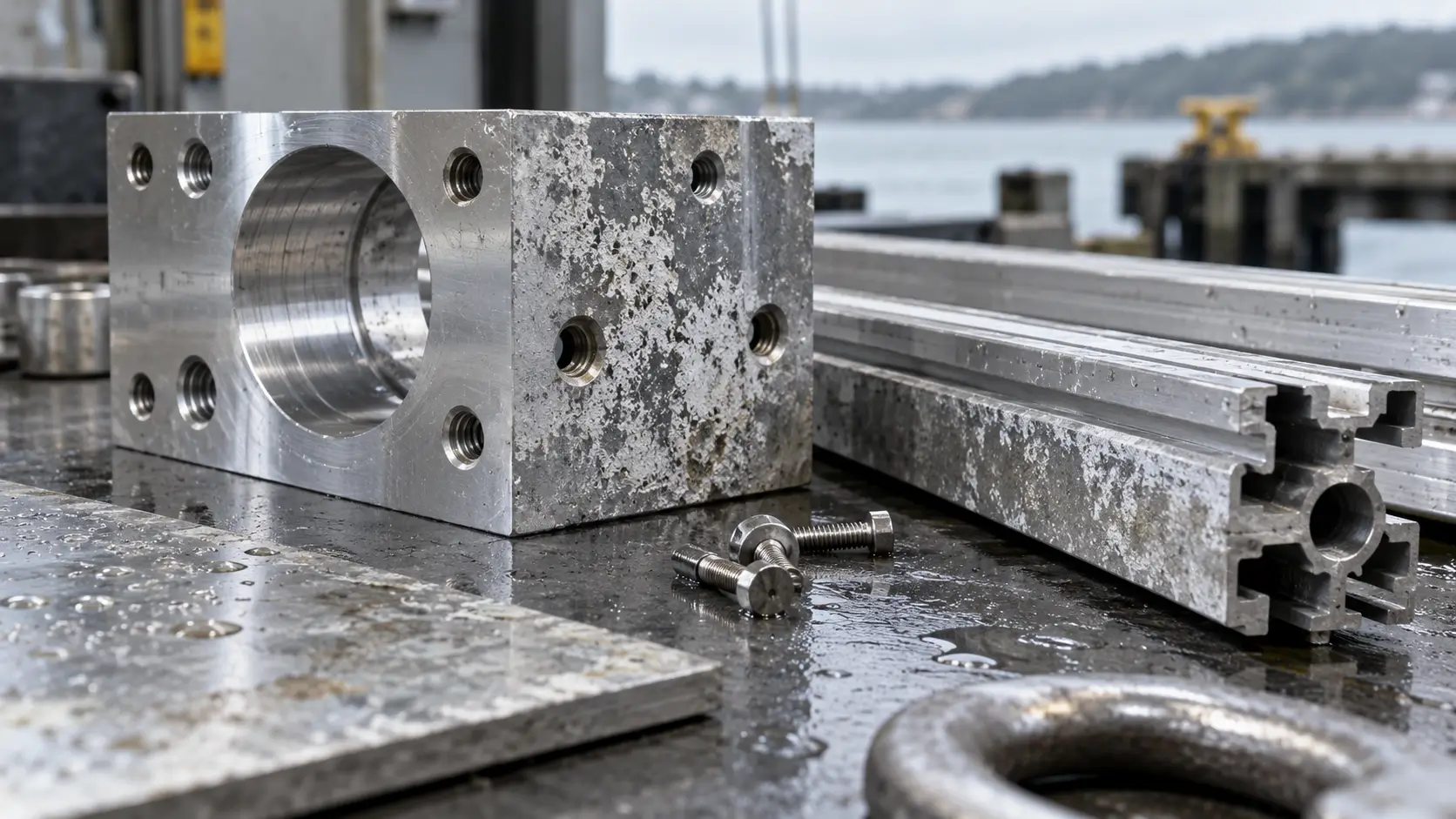
This distinction matters because aluminum is widely chosen for its corrosion resistance, but that does not mean every aluminum part will remain unchanged in every environment. The practical question is not simply whether aluminum oxidizes. It is whether the oxide layer remains protective or whether moisture, chlorides, dissimilar metals, alloy composition, or part geometry allow corrosion to continue beneath or through that protection.
Does Aluminum Rust?
Aluminum does not rust because rust specifically involves the oxidation of iron. Since aluminum is not an iron-based metal, it cannot form the iron oxides and hydroxides normally described as rust.
That does not make aluminum immune to chemical attack. Fresh aluminum reacts readily with oxygen, and oxidation begins almost immediately when a clean aluminum surface is exposed to air. The important difference is what happens next.
The oxide that forms on aluminum is thin, adherent, and relatively stable. Instead of continuously flaking away and exposing fresh metal as rust can do on unprotected carbon steel, the aluminum oxide layer normally remains attached to the surface and slows further reaction with the environment.
This passive surface film is the main reason aluminum and many aluminum alloys provide good corrosion resistance in ordinary atmospheric conditions. ASM describes aluminum’s natural corrosion resistance as closely tied to passivation and notes that alloy composition, microstructure, processing history, and environment all affect how well that protection performs.
Why Aluminum Corrodes Differently From Steel
The difference between steel rust and aluminum oxidation is less about whether oxidation occurs and more about whether the corrosion product protects the underlying metal.
When unprotected carbon steel corrodes, rust can become porous, cracked, or loosely attached. Moisture and oxygen can continue reaching the underlying steel, allowing corrosion to progress.
Aluminum behaves differently. When the bare surface reacts with oxygen, it rapidly develops an aluminum oxide film. That film forms a barrier between the base metal and the surrounding environment. If the film is lightly damaged in a suitable environment, exposed aluminum can oxidize again and re-establish the passive surface.
This is why a machined aluminum component can lose some of its freshly cut metallic brightness after exposure to air without necessarily experiencing damaging corrosion. A slight change in surface appearance does not automatically mean the component is losing meaningful material.
The limitation is that this passive film is not equally stable in every environment. Aluminum’s corrosion resistance depends on whether that protective layer can remain intact or reform after local damage. Hydro similarly distinguishes aluminum oxidation from iron rust and identifies breakdown of the oxide film as the point where more damaging forms of corrosion can develop.
When Does Aluminum’s Protective Oxide Layer Break Down?
Aluminum performs well in many normal environments, but several conditions can disrupt or locally weaken its protective surface.
Chlorides are one of the most important risks. Saltwater, road salt, salt spray, and coastal atmospheres contain chloride ions that can promote localized breakdown of the passive film. Instead of the entire surface corroding evenly, small areas may become active and develop pits. This is why pitting corrosion is a major concern for aluminum exposed to chloride-containing environments.
Trapped moisture can create a different problem. Water held inside joints, narrow gaps, beneath gaskets, or around fasteners can create a local environment that differs from the exposed surface. If oxygen availability and chemistry inside the gap change enough, the passive layer can become less stable and crevice corrosion may develop.
Contact with another metal can also change the corrosion mechanism. If aluminum is electrically connected to a more noble metal while both are exposed to an electrolyte such as saltwater, galvanic corrosion can accelerate attack on the aluminum. Stainless steel fasteners in an aluminum assembly, for example, do not automatically create a failure, but the combination of electrical contact, moisture, exposed area, and environmental chemistry needs to be considered.
Strongly acidic or alkaline environments can also attack aluminum or dissolve its protective surface film. This is why corrosion performance should be evaluated against the actual operating environment rather than assuming aluminum is universally corrosion resistant.
What Does Aluminum Corrosion Look Like?
Aluminum corrosion does not usually resemble the reddish-brown rust associated with steel.
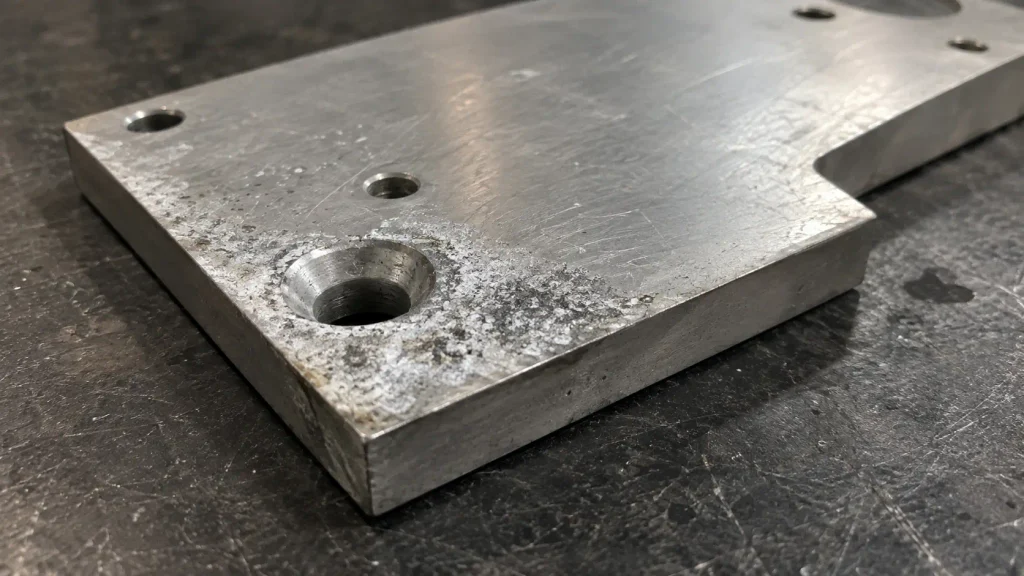
Early surface oxidation may simply make aluminum appear duller or slightly gray. In more aggressive environments, corrosion products may appear white, chalky, or powdery. Localized corrosion can produce small pits that penetrate into the material even when most of the surrounding surface still looks relatively clean. Hydro notes that aluminum corrosion commonly appears as a dull gray surface or white powdery material rather than conventional rust.
That distinction matters when evaluating a real component.
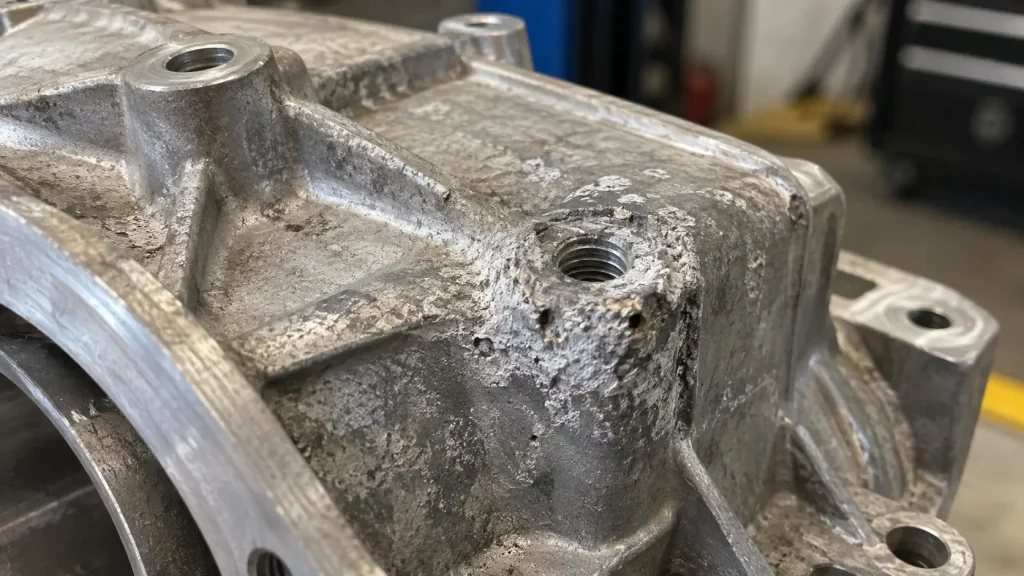
A uniform change in appearance may be largely cosmetic. A deep pit near a sealing surface, however, can become a leak path. Corrosion around a threaded hole may affect fastening. Local attack near a bearing seat, thin wall, electrical contact, or highly loaded feature can matter much more than a larger area of harmless-looking discoloration.
The area covered by corrosion therefore does not tell the whole story. Location, depth, and function are often more important than appearance alone.
Corrosion concentrated around a fastener or joint should also raise a different question from uniform surface oxidation. It may indicate trapped moisture, a crevice, or galvanic interaction rather than simply exposure of bare aluminum to air.
Does Aluminum Corrode in Water or Outdoors?
Aluminum can perform very well outdoors and in many freshwater environments because its natural oxide film remains protective under suitable conditions.
Rain or ordinary atmospheric humidity does not automatically cause rapid material loss. Aluminum is widely used in transportation, buildings, machinery, and outdoor structures partly because normal atmospheric exposure can be tolerated without the continuous rusting behavior associated with unprotected carbon steel.
Water exposure becomes more complicated when additional factors are present. Stagnant water trapped in a narrow joint is different from a surface that drains and dries. Freshwater is different from chloride-rich seawater. An isolated aluminum component is different from aluminum electrically connected to stainless steel or copper while wet.
Saltwater and coastal environments deserve particular attention because chlorides can promote localized pitting. Aluminum is widely used in marine applications, but alloy selection and component design become more important as the environment becomes more aggressive. Hydro, for example, specifically treats marine applications as an area where alloy and corrosion considerations have to be designed together.
The useful engineering question is therefore not:
Will water make aluminum rust?
It is:
What is in the water, can the part dry, where can moisture become trapped, and what other materials are electrically connected to the aluminum?
Do Different Aluminum Alloys Corrode Differently?
Yes. “Aluminum” describes a large family of alloys rather than one material with one corrosion behavior.
Alloying elements are added to change strength, hardness, formability, machinability, heat-treatment response, and other properties. Those changes also affect corrosion behavior because different phases and microstructures can create different local electrochemical conditions.
Many 5xxx-series aluminum alloys are known for strong corrosion resistance and are commonly considered for marine and exposed applications. 6xxx-series alloys such as 6061 and 6063 generally provide a useful balance of corrosion resistance, mechanical properties, manufacturability, and finishing response.
High-strength 2xxx and 7xxx alloys require more careful evaluation in aggressive environments. Their compositions and heat-treated microstructures provide excellent mechanical performance, but certain grades and tempers can be more susceptible to localized or intergranular forms of corrosion than general-purpose 5xxx and 6xxx alloys.
That does not make one series universally better than another. A 7075 component may be the correct choice when strength controls the design, while a 5052 or 5083 part may make more sense when corrosion resistance and forming behavior dominate.
For machined components, material selection also affects manufacturing strategy. Alloys such as 6061 and 7075 are common in aluminum CNC machining services, but corrosion environment, required strength, dimensional stability, finish, and machining behavior should be evaluated together rather than choosing an alloy based on one property alone.
When Should Aluminum Corrosion Be an Engineering Concern?
Not every visible change on an aluminum surface requires the same response.
Light dulling or uniform surface oxidation is often much less concerning than deep localized attack. If the component remains dimensionally intact and the affected area is non-functional, a cosmetic surface change may have little effect on service performance.
Closer review is appropriate when corrosion appears as deep or growing pits, concentrates around joints or fasteners, repeatedly returns after cleaning, or occurs near critical geometry such as sealing faces, thin walls, threads, bearing interfaces, electrical contact surfaces, or heavily loaded features.
The operating environment also matters. A cosmetic blemish on an indoor equipment cover is a different engineering problem from corrosion on a marine housing, outdoor sensor enclosure, pressure-containing casting, or structural component.
For this reason, corrosion assessment should connect the visible condition back to function. The useful questions are:
Is material actually being removed? Is the damage localized? Is it near a critical feature? Is the environment likely to keep driving the same mechanism?
Those questions usually provide more useful information than simply asking whether the part “looks corroded.”
When Does Aluminum Need Additional Corrosion Protection?
The natural oxide film is sufficient for many aluminum components, so additional surface protection is not automatically required.
More aggressive service conditions may justify anodizing, conversion coating, powder coating, painting, or another protective system. The correct choice depends on whether the priority is corrosion resistance, wear resistance, appearance, electrical behavior, dimensional control, or a combination of requirements.
Design can be just as important as coating. Providing drainage, avoiding narrow moisture traps, managing contact between dissimilar metals, and selecting an alloy suited to the environment can reduce corrosion risk before any finish is applied.
Additional protection should therefore be treated as part of the material and component design rather than as a correction applied after corrosion problems appear.
When a finished aluminum component requires both environmental protection and dimensional control, surface finishing services should also be reviewed against features such as threaded holes, sealing surfaces, electrical contacts, and tight fits because a coating can change more than appearance.
If the corrosion requirement is difficult to evaluate from the drawing and service environment alone, ZH Precision can review the aluminum alloy, exposed interfaces, and finishing requirements before production so that material and surface protection decisions are made together.
Conclusion
Aluminum does not rust like steel, but it can corrode. Its strong reputation for corrosion resistance comes from the thin passive oxide layer that naturally forms on the surface and normally slows further attack.
The engineering question is therefore not whether aluminum oxidizes. It always does when exposed to oxygen. The important question is whether that oxidation remains protective.
Chlorides, trapped moisture, aggressive chemical conditions, galvanic contact, alloy selection, and component geometry can all change the answer. A dull surface or light oxidation may be mainly cosmetic, while deep pitting or corrosion around critical interfaces can affect the function and life of a part.
Understanding the difference helps engineers decide when aluminum’s natural protection is sufficient and when alloy selection, design changes, or additional surface protection should be considered.
FAQ
Aluminum does not form iron rust in water, but it can corrode. In many freshwater environments its oxide layer provides effective protection, while salts, stagnant moisture, unfavorable chemistry, or contact with other metals can increase corrosion risk.
Outdoor aluminum generally develops a protective oxide film rather than conventional rust. Its long-term performance depends on humidity, pollutants, salt exposure, drainage, alloy selection, and whether moisture remains trapped against the surface.
Aluminum does not technically rust, but saltwater can cause significant corrosion. Chloride ions can locally break down the protective oxide film and promote pitting, which is why marine alloy selection and protective design are important.
Aluminum corrosion may appear as dull gray discoloration, white powdery deposits, rough areas, or localized pits. The severity should be judged by depth and location rather than appearance alone.
It depends on the extent and location of the damage. Light surface oxidation may have little functional effect, while deep pitting near sealing surfaces, threads, thin walls, or structural features may require closer inspection or replacement.