
The symbol itself is easy to recognize because it closely follows the element name. The meaning becomes less obvious once terms such as 6061, 7075, and 6061-T6 appear in material specifications. These are all related to aluminum, but they do not describe the same thing.
What Is the Chemical Symbol for Aluminum?
The chemical symbol for aluminum is Al. It is written with an uppercase A followed by a lowercase l.
Chemical element symbols use standardized capitalization, so Al is the correct form. AL, al, and AI should not be used as substitutes for the aluminum element symbol.
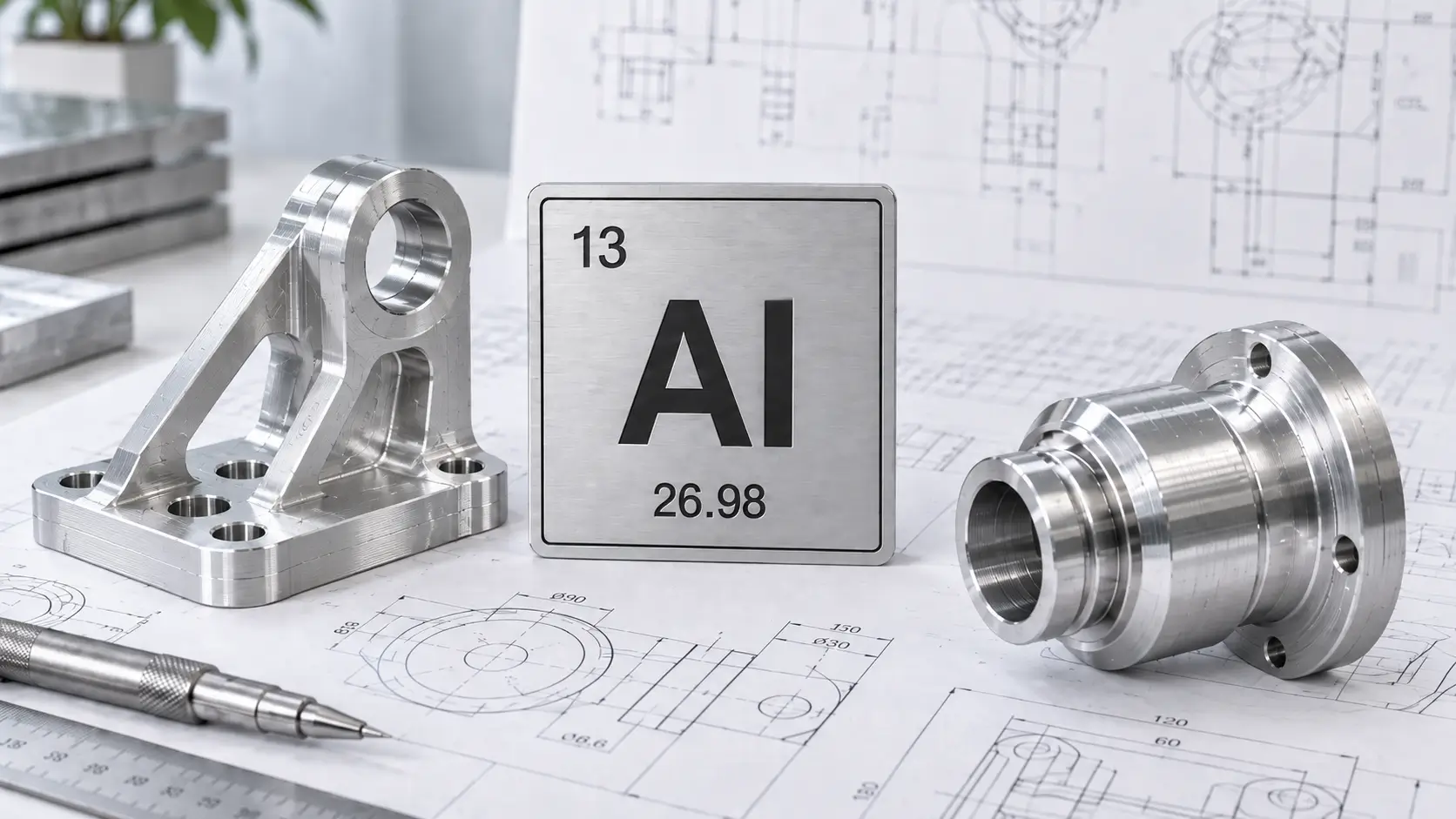
Aluminum has atomic number 13. This means that every aluminum atom contains 13 protons in its nucleus. Its relative atomic mass is approximately 26.98.
Terms such as aluminum symbol, aluminum chemical symbol, aluminum element symbol, atomic symbol of aluminum, and chemical symbol for aluminum all refer to the same two-letter notation: Al.
Aluminum on the Periodic Table
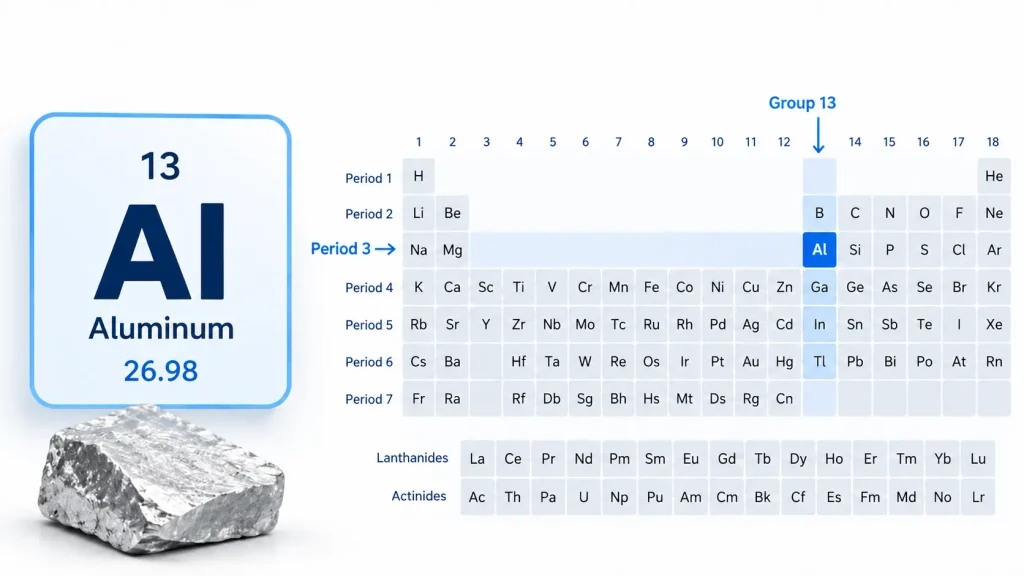
Aluminum appears in Group 13 and Period 3 of the periodic table.
| Property | Aluminum |
|---|---|
| Chemical symbol | Al |
| Atomic number | 13 |
| Relative atomic mass | 26.982 |
| Group | 13 |
| Period | 3 |
| Block | p-block |
| State at 20°C | Solid |
Al sits between magnesium and silicon in Period 3. Its position in Group 13 places it in the same column as boron, gallium, indium, and thallium.
The symbol and atomic number serve different purposes. Al identifies the element, while 13 identifies it by the number of protons in the nucleus.
This is why searches such as Al periodic table, aluminum periodic table, aluminum symbol periodic table, and periodic table symbol for aluminum usually lead to the same basic information.
Why Is the Symbol Al?
The symbol Al is closely related to the name of the element. This makes it more intuitive than symbols such as Fe for iron or Na for sodium, whose symbols come from older names.
The history of the name goes back to alum, an aluminum-containing substance known long before metallic aluminum could be produced. Humphry Davy discussed the metal in the early nineteenth century and used the name aluminum. Hans Christian Ørsted produced an impure form of the metal in 1825, and Friedrich Wöhler improved the isolation process shortly afterward.
Over time, aluminum and aluminium developed as different English spellings of the same element. The chemical symbol did not change with the spelling, so Al remained the universal notation.
Aluminum vs Aluminium: Does the Symbol Change?
No. Aluminum and aluminium refer to the same chemical element, and both use the symbol Al.
Aluminum is the spelling commonly used in the United States, while aluminium is widely used in British and international scientific usage.
The spelling difference therefore has no effect on the chemical notation.
A document may say:
Aluminum 6061
or:
Aluminium 6061
but the element symbol remains Al in both cases.
Is Al the Same as 6061, 2024, or 7075 Aluminum?
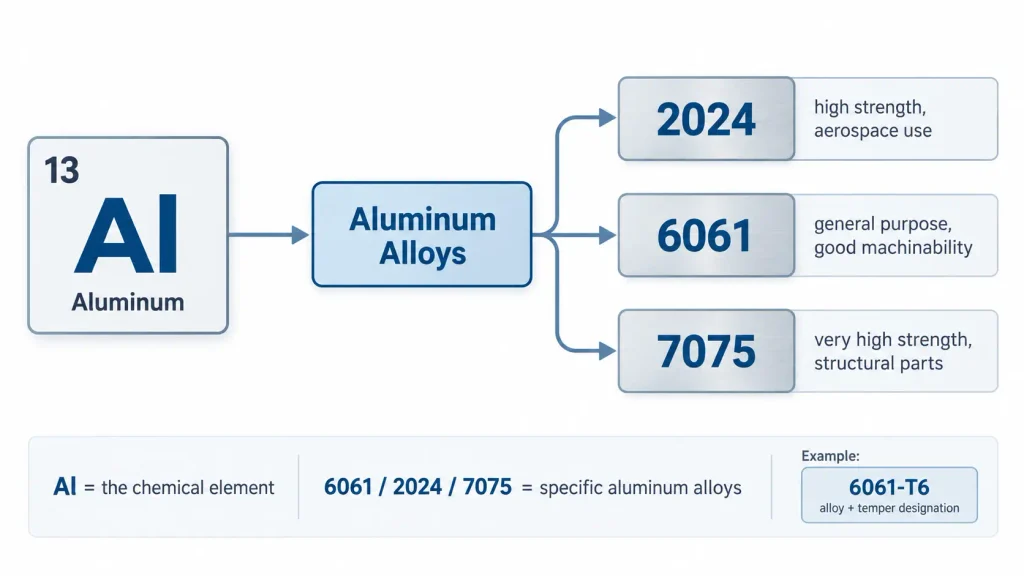
No. Al is the chemical symbol for the element aluminum. Numbers such as 2024, 6061, and 7075 are aluminum alloy designations.
Engineering aluminum materials are usually alloys rather than chemically pure aluminum. Other elements are added in controlled amounts to create materials with different combinations of strength, corrosion behavior, formability, and manufacturing characteristics.
For example, 2024 belongs to the 2xxx series, 6061 belongs to the 6xxx series, and 7075 belongs to the 7xxx series.
The difference can be summarized simply:
Al identifies the chemical element.
6061 identifies a specific aluminum alloy.
7075 identifies a different aluminum alloy.
6061-T6 identifies an alloy together with a particular temper condition.
These designations are related, but they are not interchangeable.
What Does T6 Mean in 6061-T6?
In 6061-T6, 6061 identifies the alloy and T6 identifies the temper.
The temper tells the engineer something about the material condition created after processing. For heat-treatable aluminum alloys, T6 generally indicates a solution heat-treated and artificially aged condition.
This is why 6061 and 6061-T6 do not communicate exactly the same amount of information.
6061 identifies the alloy.
6061-T6 identifies both the alloy and a defined processed condition.
The distinction is not particularly important when identifying aluminum on a periodic table, but it becomes much more important when the material is being selected for an engineered component.
Is Al Enough on an Engineering Drawing?
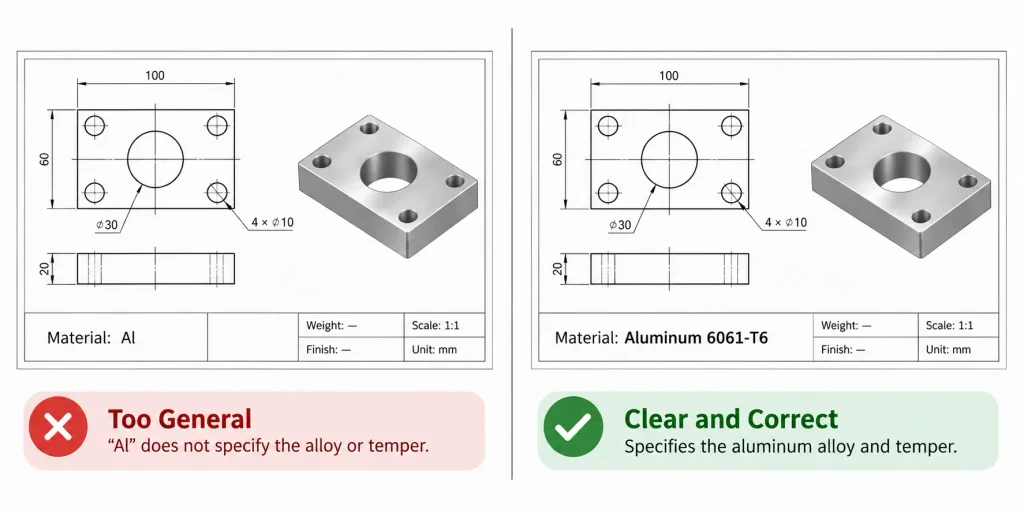
On a periodic table, Al is enough to identify aluminum. On an engineering drawing, it is usually too general to define the material for a finished part.
Consider two material notes:
Material: Al
and:
Material: Aluminum 6061-T6
The first note identifies the base element but leaves the actual alloy uncertain. The second identifies a specific alloy and temper, giving the manufacturer much clearer information about the material that should be used.
This matters because different aluminum alloys are not simply different names for the same metal. Their compositions and material conditions can affect strength, machining behavior, corrosion performance, surface finishing, and consistency between production runs.
A manufacturing drawing normally benefits from identifying the required material more precisely than simply writing aluminum or Al.
For an aluminum CNC-machined component, a material note such as Aluminum 6061-T6 or Aluminum 7075-T6 gives the supplier far more useful information than Al alone.
Common Aluminum Symbols and Designations
Aluminum-related notation can look similar even though it describes very different information.
| Notation | Meaning |
|---|---|
| Al | Chemical symbol for aluminum |
| 13 | Atomic number of aluminum |
| Al³⁺ | Aluminum ion |
| Al₂O₃ | Aluminum oxide |
| 2024 | Aluminum alloy designation |
| 6061 | Aluminum alloy designation |
| 6061-T6 | 6061 aluminum with T6 temper |
| 7075-T6 | 7075 aluminum with T6 temper |
The difference becomes clearer when the notation is viewed in context.
Al belongs to chemistry and the periodic table.
6061 belongs to an aluminum alloy designation system.
6061-T6 goes one step further by identifying both the alloy and its material condition.
This progression explains why the simple aluminum symbol is useful for identifying the element but is usually not enough to specify the material for an engineered part.
Conclusion
The aluminum symbol is Al, and its atomic number is 13. The same symbol is used whether the element is written as aluminum or aluminium.
Al identifies the chemical element, while designations such as 2024, 6061, and 7075 identify specific aluminum alloys. Adding a temper, as in 6061-T6, provides another level of material information.
For a periodic table, Al is the complete answer. For an engineering drawing or machined component, it is usually only the starting point.
FAQ
The chemical symbol for aluminum is Al.
The atomic number of aluminum is 13.
The correct chemical symbol is Al, with an uppercase A and lowercase l.
The symbol for aluminium is also Al. Aluminum and aluminium are two spellings of the same element.
No. Al is the chemical symbol for aluminum, while 6061 is a specific aluminum alloy designation.
T6 is a temper designation. In 6061-T6, it indicates that the alloy has been solution heat-treated and artificially aged.