
For engineers, understanding CNC machining means more than knowing that a machine follows programmed toolpaths. The practical questions are what kinds of parts the process is good at producing, what makes one design easier or harder to machine, what accuracy can realistically be expected, and when CNC machining is a better manufacturing choice than another process.
What Is CNC Machining?
CNC stands for Computer Numerical Control. A CNC machine follows programmed instructions that control tool movement, workpiece movement, spindle speed, feed rate, tool changes, and other machining operations.
Most CNC machining starts with solid material such as plate, bar, billet, extrusion, forging, or casting. Cutting tools remove unwanted material until the required geometry remains. This makes CNC machining fundamentally different from additive manufacturing, where a component is built by adding material layer by layer.
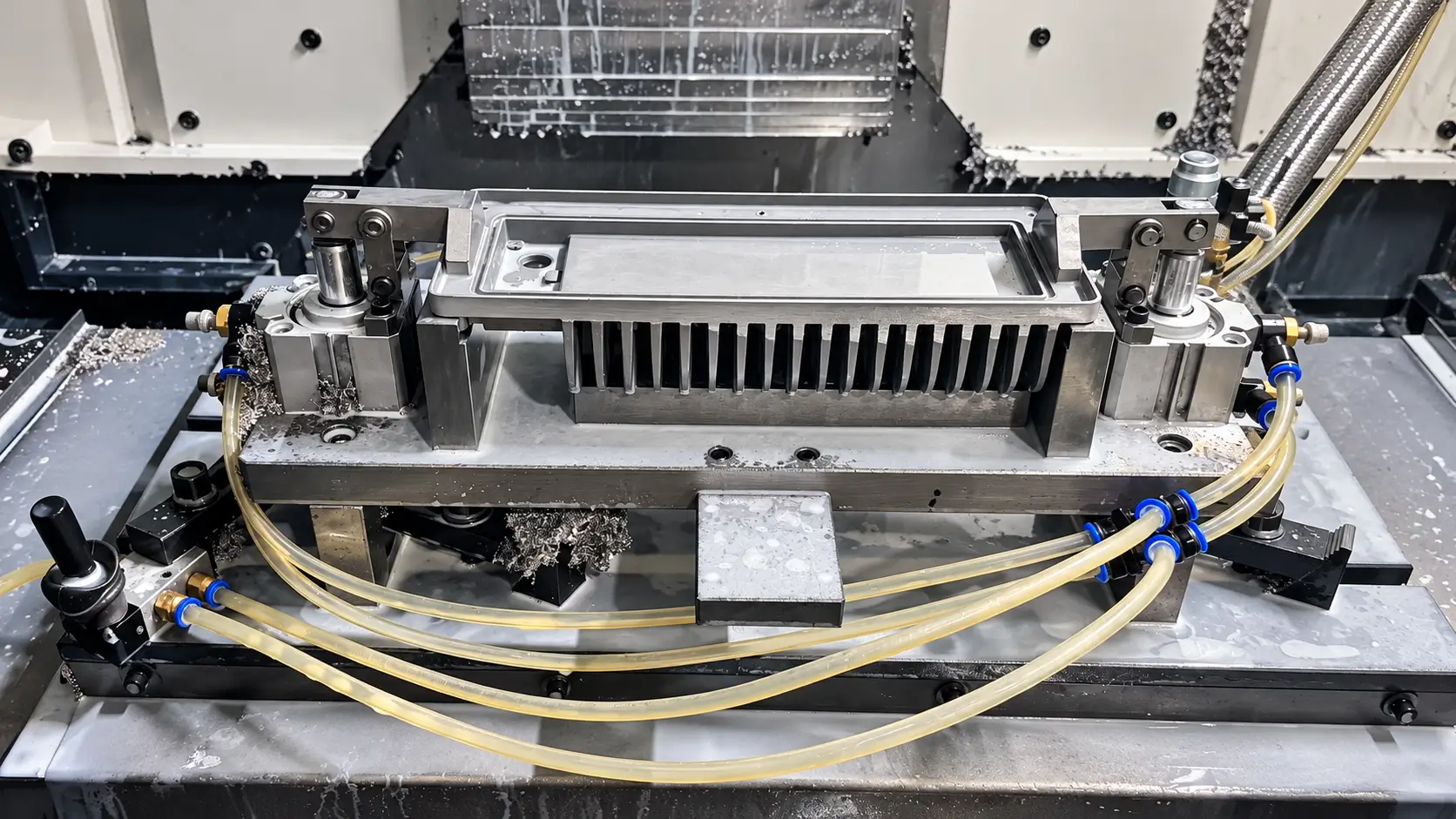
The program defines where the machine should move, but it does not determine part quality on its own. Workholding, tool access, cutting forces, material behavior, setup strategy, dimensional requirements, and inspection all influence the finished result.
A CAD model can describe the shape of a component perfectly while still leaving important manufacturing questions unanswered. The machining process has to convert that geometry into a practical sequence of datums, fixtures, tools, cutting operations, and inspections.
How Does CNC Machining Work?
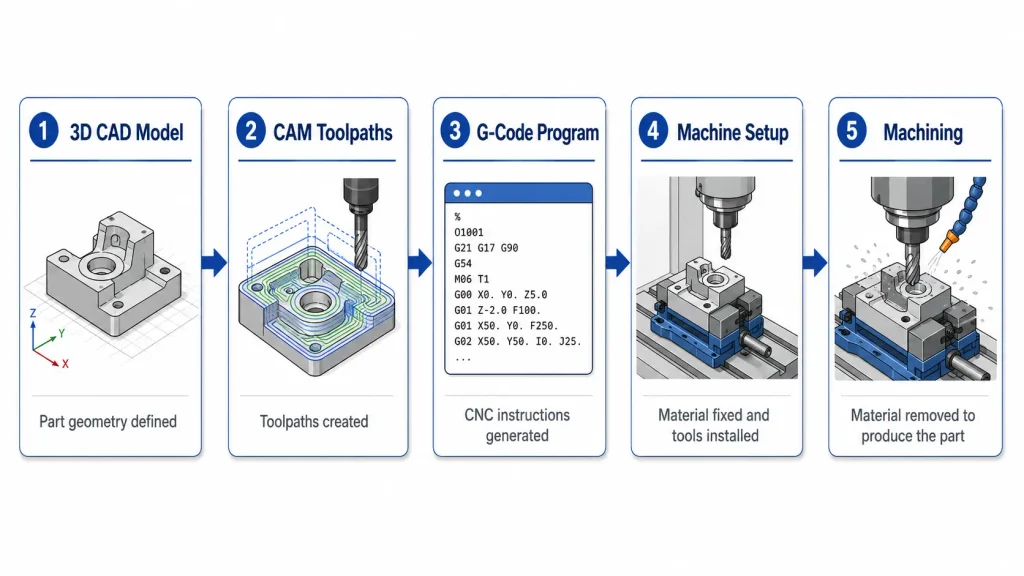
The process normally begins with a 3D CAD model and, when required, a controlled 2D engineering drawing. The model defines nominal geometry, while the drawing communicates requirements that may not be clear from geometry alone, including tolerances, fits, GD&T, threads, surface roughness, and inspection requirements.
Before CAM programming begins, the part is reviewed for manufacturability. The machining team determines how the raw material will be held, which surfaces should establish the machining references, what tools can reach the required geometry, and whether the component can be completed in one setup or must be repositioned.
CAM software is then used to generate toolpaths. Roughing operations remove most of the material efficiently, while finishing operations bring important features to their final dimensions and surface condition. Critical dimensions may also be checked during machining so that tool wear or dimensional movement can be corrected before the entire batch is completed.
A typical CNC machining process moves through design review, programming, workholding and setup, rough and finish machining, in-process inspection, any required surface treatment, and final inspection. The engineering difficulty often comes from keeping the part stable through these stages rather than simply generating machine movement.
What Are the Main Types of CNC Machining?
The main CNC processes differ in how the cutting tool and workpiece move relative to one another. Geometry usually determines which process is most efficient.
CNC Milling
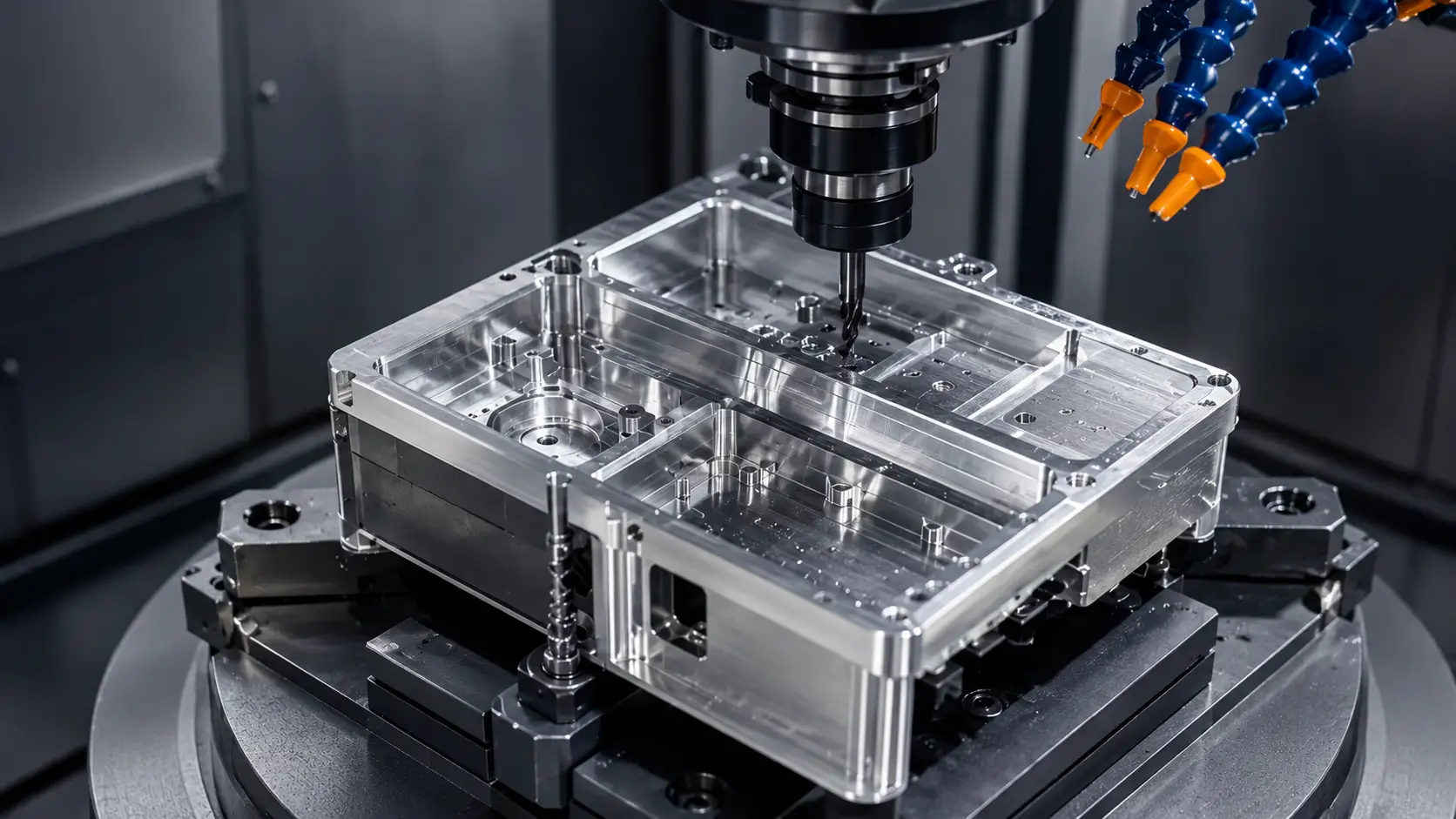
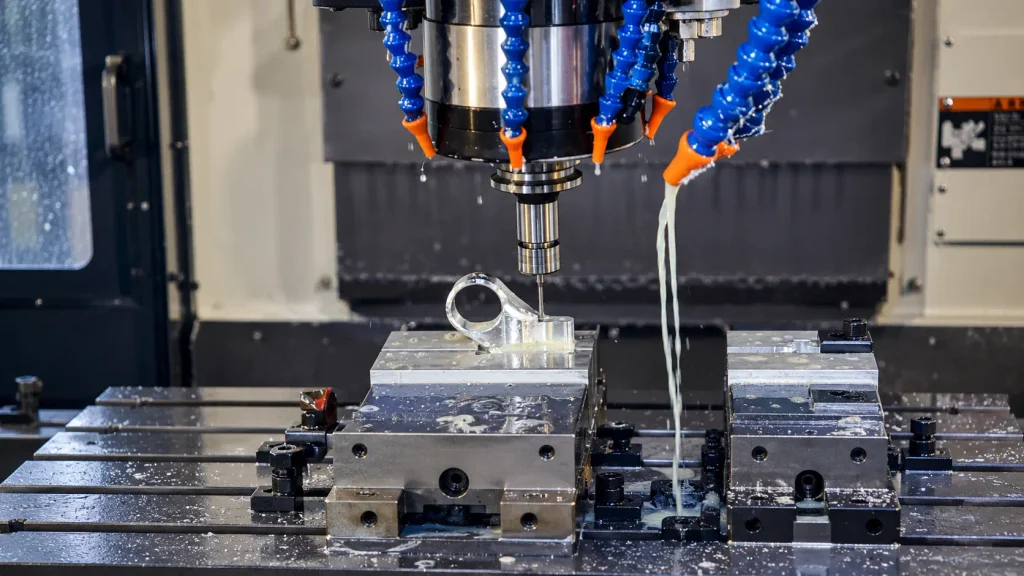
CNC milling uses rotating cutting tools to remove material from a workpiece held in a fixture. It is commonly used for housings, brackets, plates, pockets, slots, hole patterns, mounting faces, and other prismatic geometry.
Three-axis milling controls movement along the X, Y, and Z axes. A fourth rotary axis makes additional sides of the workpiece accessible without completely repositioning it. Five-axis machining provides more freedom to approach angled surfaces, compound geometry, and features that would otherwise require additional setups.
More axes do not automatically make a part easier or more accurate to produce. A simple component that can be machined rigidly in one or two 3-axis setups may not benefit from being moved to a 5-axis machine.
CNC Turning
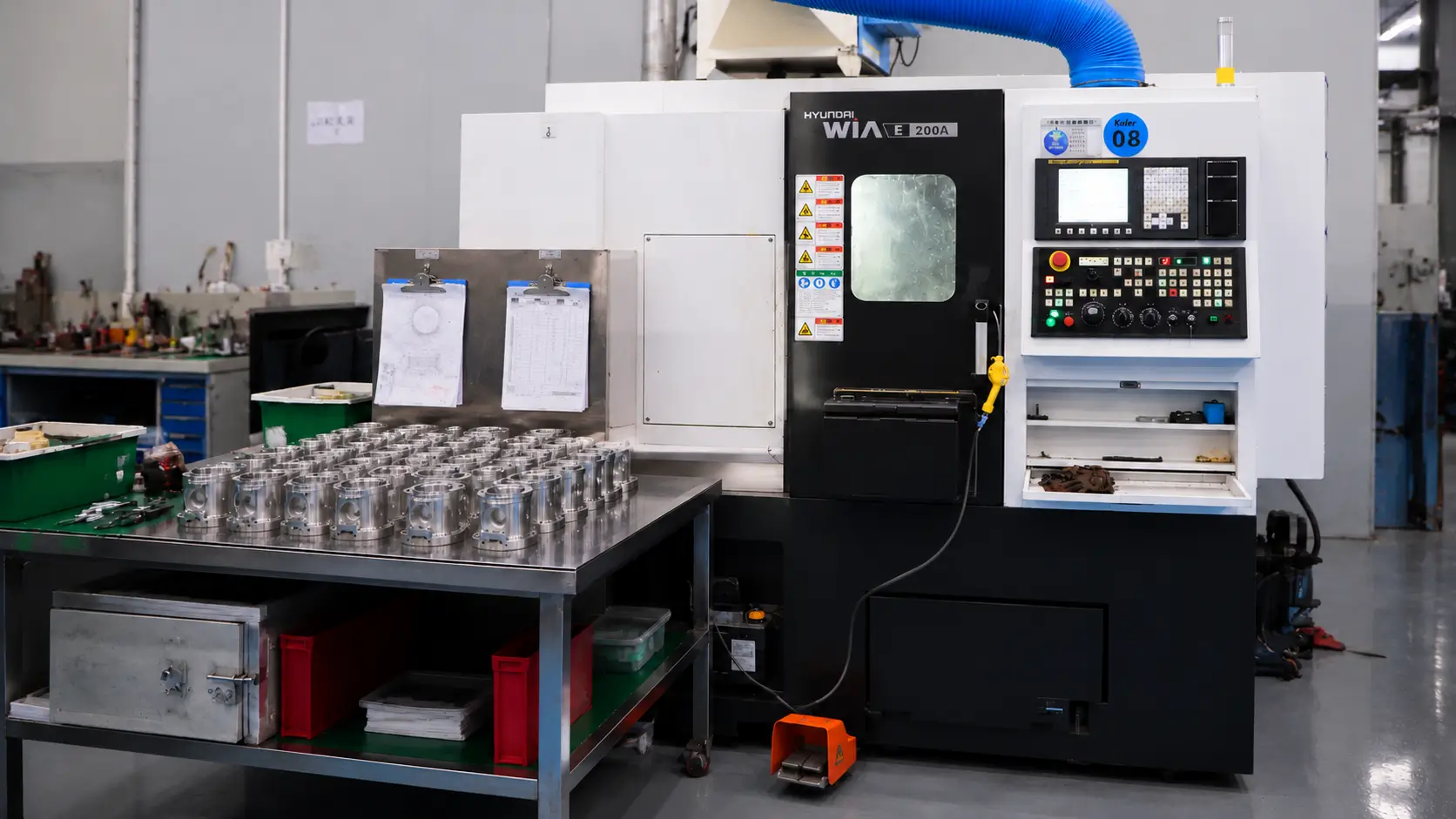
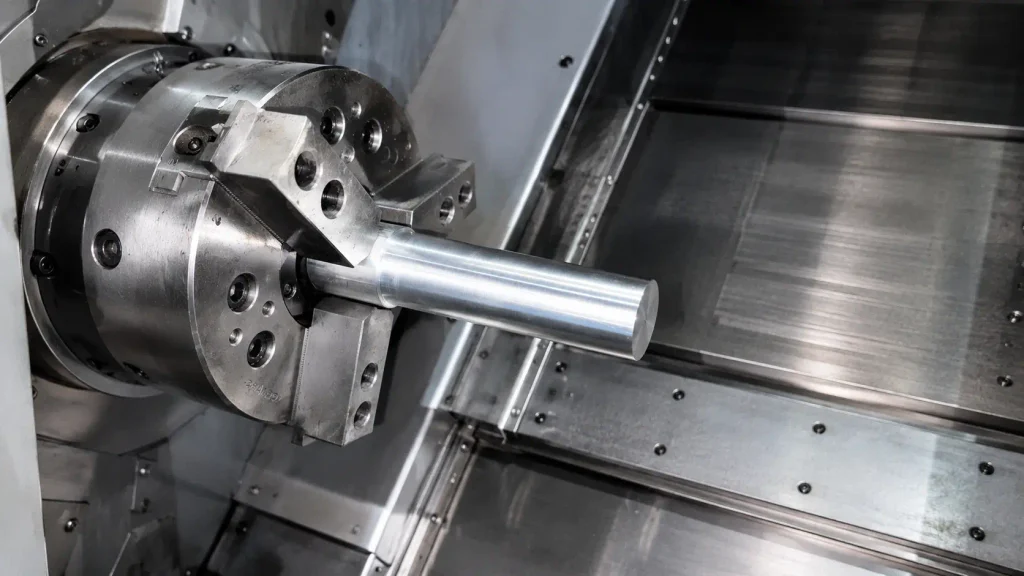
CNC turning rotates the workpiece while cutting tools remove material. It is particularly efficient for shafts, pins, bushings, sleeves, connectors, threaded components, and other parts dominated by rotational geometry.
Diameters, shoulders, grooves, bores, faces, and threads can often be produced around a common axis, which makes turning efficient when most of the functional geometry is concentric.
Mill-Turn Machining
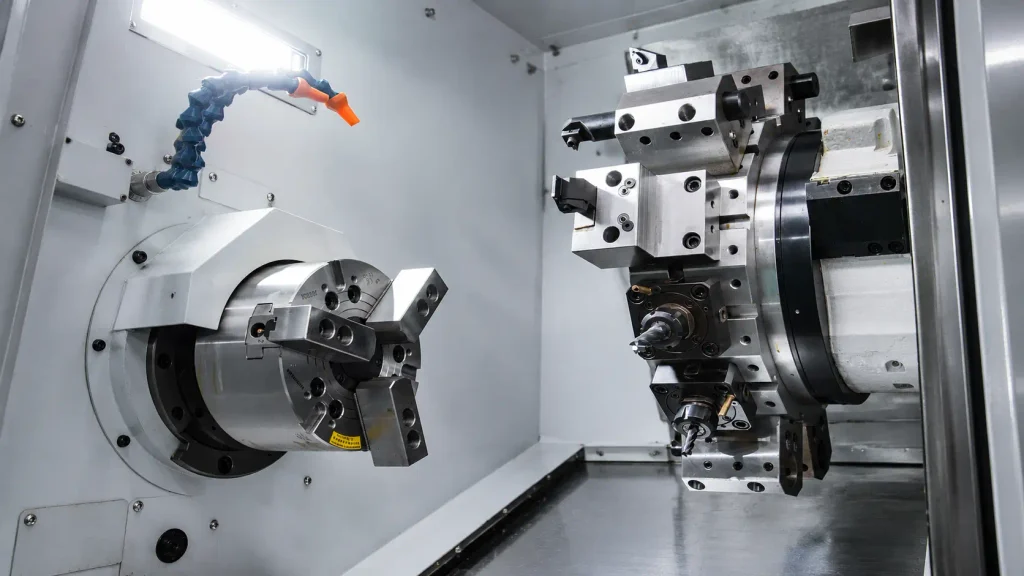
Mill-turn equipment combines turning and milling operations in the same machine. It is useful when a component has a rotational body together with cross holes, flats, slots, off-axis features, or other milled details.
The practical difference between CNC milling vs CNC turning is mainly geometric. Milling is generally better suited to prismatic and multi-face features, while turning is more efficient when the part is primarily rotational.
| CNC Process | Commonly Suited To |
|---|---|
| CNC Milling | Housings, brackets, plates, pockets, multi-face parts |
| CNC Turning | Shafts, pins, bushings, sleeves, rotational parts |
| 5-Axis Machining | Angled surfaces, complex access, multi-face geometry |
| Mill-Turn | Parts combining rotational and milled features |
What Materials Can Be CNC Machined?
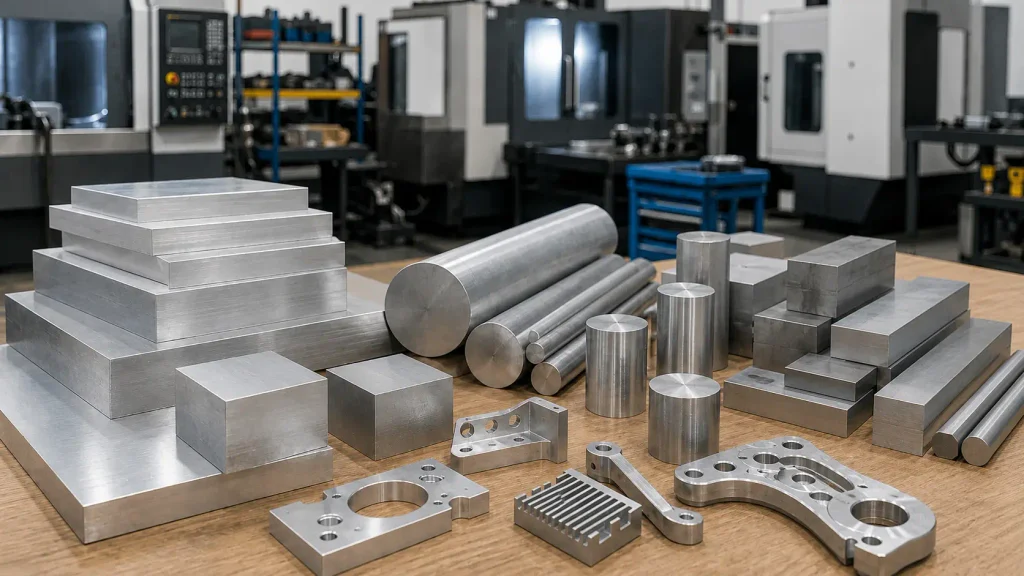
CNC machining can process a wide range of metals and engineering plastics. Material selection affects both the finished part and the machining process, including cutting force, heat generation, tool wear, chip formation, dimensional stability, surface condition, and cost.
Aluminum is widely used because many grades combine low density with good machinability. Stainless steel offers strength and corrosion resistance but generally requires more careful control of cutting heat and tool condition. Carbon and alloy steels are common where strength, wear resistance, or structural performance matter, while titanium is selected when high strength-to-weight ratio or corrosion resistance justifies a more demanding machining process.
Copper and brass are frequently used for electrical, thermal, fluid-handling, and mechanical applications. Engineering plastics may be selected for low weight, insulation, chemical resistance, or low friction, although some plastics are more sensitive to heat and deformation during machining.
Common CNC machining materials should be selected according to both functional requirements and manufacturing behavior. A material with excellent mechanical properties may still increase machining time, tooling cost, or dimensional risk if its machining characteristics are ignored.
What Kinds of Parts Are Well Suited to CNC Machining?
CNC machining is particularly useful for parts that need to be produced directly from engineering materials without dedicated molds or dies.
Typical examples include housings, brackets, shafts, bushings, manifolds, fixtures, actuator components, mounting plates, structural components, and mechanical interfaces. These parts often contain a combination of holes, pockets, bores, threads, mating faces, turned diameters, and locally controlled features.
The process works especially well when different features on the same part require different levels of control. An aluminum housing may contain general exterior geometry together with a bearing bore, locating pattern, and sealing face that need tighter dimensional or geometric control. The machining plan can concentrate more attention on those functional features without forcing the same requirements onto every surface.
Part suitability depends more on geometry, material, tolerance, quantity, and function than on the industry where the component will eventually be used.
What Accuracy and Tolerances Can CNC Machining Achieve?
CNC machining can produce closely controlled dimensions, but there is no single tolerance that applies to every machined feature.
Achievable accuracy depends on geometry, material, tool access, cutter stiffness, workholding, machine condition, temperature, setup count, and inspection method. Two features carrying the same tolerance can have very different manufacturing difficulty.
A short turned diameter on a rigid shaft may be relatively straightforward to control. The same numerical tolerance on a deep internal bore may be more difficult because tool reach increases, chip evacuation becomes harder, and measurement access may be limited.
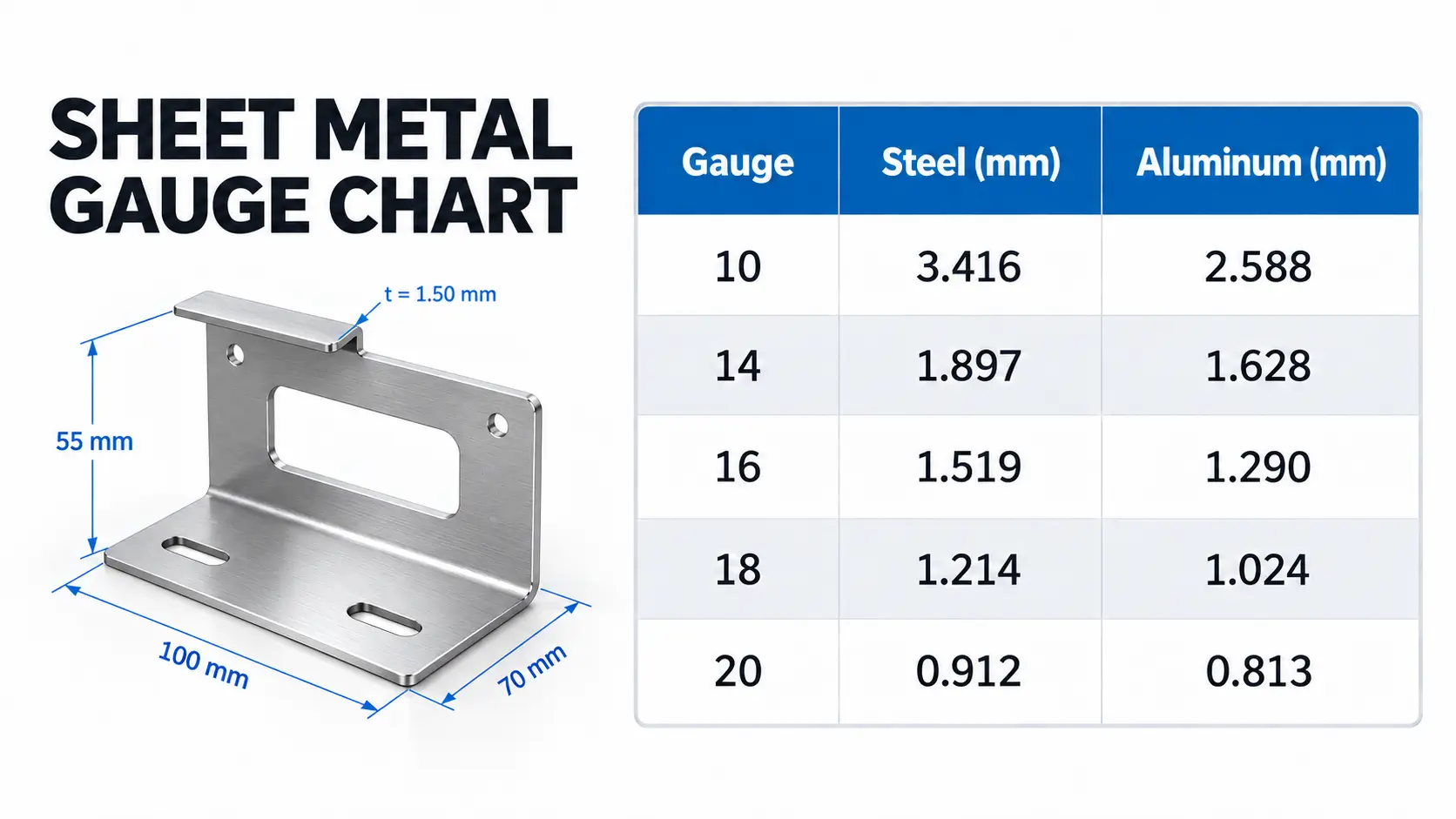
Thin-wall parts create a different problem. Cutting force and clamping pressure can temporarily deform the component, and the geometry may move again after the part is released from the fixture.
For general planning, many CNC dimensions can be controlled around ±0.05 mm, while selected critical features may be evaluated for requirements around ±0.01 mm where the geometry, process, and inspection method support it. These values should not be treated as universal tolerances for an entire component.
CNC machining tolerances should be assigned according to feature function. A bearing bore, locating hole, shaft fit, sealing face, or mating datum may justify close control, while a clearance pocket or non-functional exterior dimension usually does not need the same tolerance.
When Is CNC Machining a Good Manufacturing Choice?
CNC machining is a strong option when functional parts need to be produced directly from engineering-grade materials without the cost and lead time of dedicated molds or dies.
This makes it particularly useful during product development. A prototype can be machined from the same or similar material intended for the final product, allowing engineers to evaluate fit, assembly, mechanical behavior, and critical interfaces with a physically representative part.
Design revisions are also relatively easy to accommodate. A change to a hole position, pocket depth, mounting interface, or overall geometry may require a revised model, program, or setup rather than completely new production tooling.
CNC machining also fits low-volume and repeat production when quantities do not justify high tooling investment or when the design may continue to evolve. Components containing bearing seats, threads, precision bores, sealing faces, locating features, and other mechanical interfaces can be machined and inspected directly against drawing requirements.
The process is most attractive when material choice, design flexibility, and dimensional control matter more than obtaining the lowest possible unit cost at very high volume.
What Are the Limitations of CNC Machining?
The limitations of CNC machining come mainly from the physical cutting process.
Tool access is one of the most important. The cutting edge, tool shank, and holder must reach the feature without colliding with surrounding geometry. Deep pockets, narrow cavities, undercuts, and enclosed features may require longer or specialized tools.
Long tool reach reduces stiffness. A cutter extending deep into a component is more likely to deflect or vibrate under cutting force, which can affect wall position, dimensional accuracy, machining time, and surface condition.
Internal corners are another common limitation. A rotating end mill always has a physical radius, so perfectly sharp internal corners cannot normally be produced directly by standard milling. Smaller corner radii require smaller cutters, and smaller cutters may need slower cutting conditions.
Material removal can also become inefficient when the finished component represents only a small fraction of the starting billet. Removing most of a large block increases raw material use, machining time, and chip volume.
Production quantity eventually changes the economics as well. CNC machining avoids large upfront tooling costs, but every part still requires machine time. Once a design is stable and quantities become sufficiently high, a near-net-shape process may offer a lower unit cost.
These limits do not make CNC machining unsuitable. They help determine whether the geometry is efficient to machine and whether another manufacturing route should be considered.
CNC Machining vs 3D Printing
CNC machining removes material from solid stock, while 3D printing builds a component layer by layer. That basic difference affects material options, geometry, dimensional control, surface condition, and production strategy.
| Consideration | CNC Machining | 3D Printing |
|---|---|---|
| Process | Subtractive | Additive |
| Starting material | Solid stock | Powder, filament, resin, or other feedstock |
| Tool access | Required | Less restrictive for many geometries |
| Internal geometry | Limited by tool access | Greater geometric freedom |
| Conventional engineering materials | Strong availability | Depends on printing technology |
| Machined fits and interfaces | Strong advantage | May require secondary machining |
| Dedicated mold | Not required | Not required |
CNC machining is often preferred when a prototype or finished component needs conventional engineering material properties, controlled fits, machined interfaces, or a predictable surface condition.
3D printing becomes more attractive when geometric freedom, lightweight internal structures, or shapes that are difficult to reach with cutting tools are more important.
The better process depends on what the part needs to demonstrate or achieve, not on which technology is newer.
CNC Machining vs Die Casting
CNC machining and die casting can both produce functional metal components, but their cost structures are very different.
CNC machining requires relatively little dedicated production tooling. Low quantities can be started quickly, and design revisions can often be introduced without rebuilding expensive tooling. The trade-off is that every component still consumes machine time.
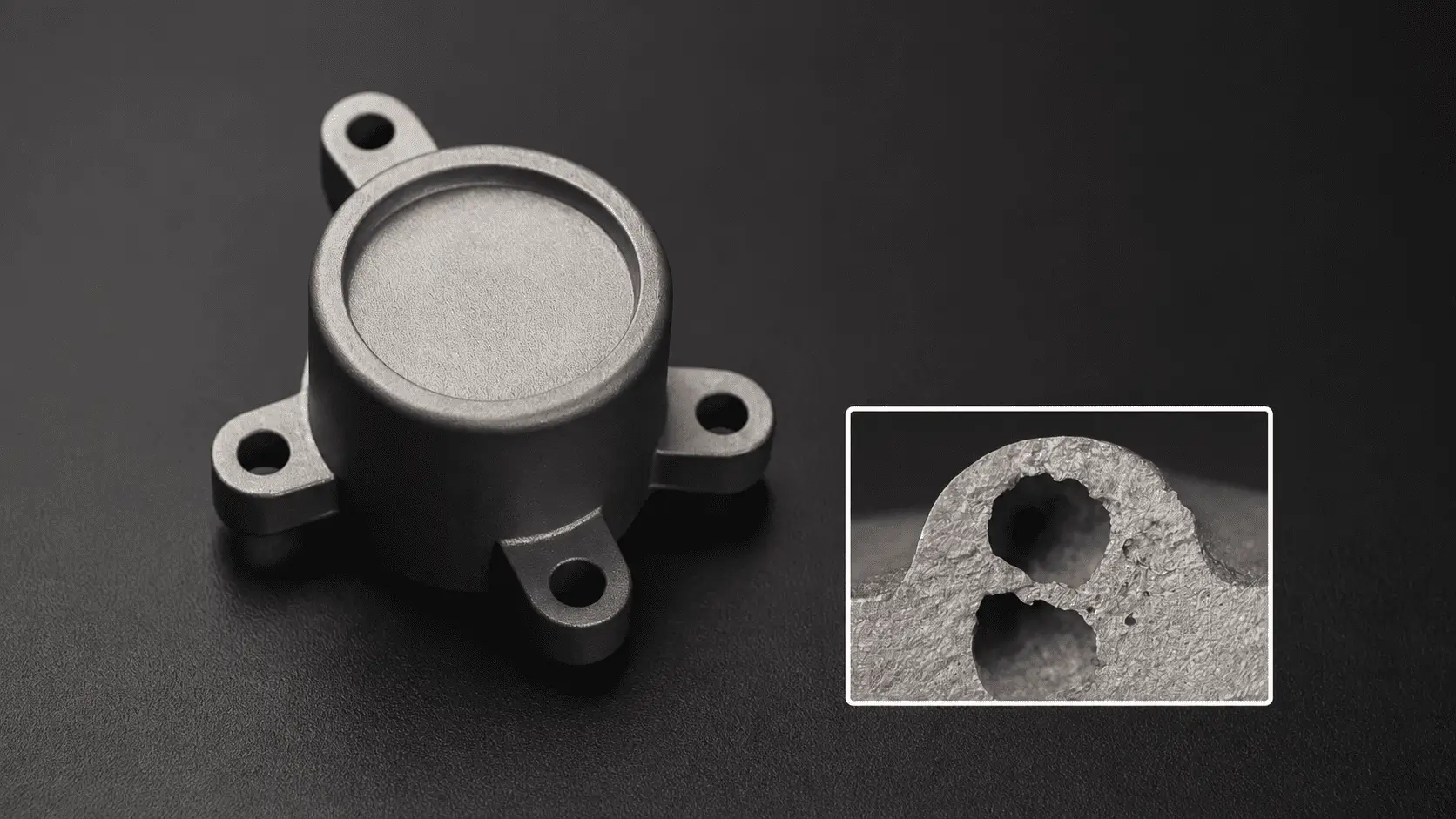
Die casting requires a mold and much greater initial investment. Once the design is stable and production quantity is high enough, the casting process can produce near-net-shape components much more efficiently.
| Consideration | CNC Machining | Die Casting |
|---|---|---|
| Initial tooling | Low | High |
| Design revisions | Relatively easy | May require tooling changes |
| Prototype and low volume | Well suited | Often difficult to justify |
| High-volume unit cost | Usually higher | Can become much lower |
| Material options | Broad | Limited to suitable casting alloys |
| Precision local features | Machined directly | Often require secondary machining |
| Material removal | Can be substantial | Near-net-shape process |
The decision is not always CNC machining or die casting. Many cast parts are subsequently machined at bearing bores, sealing surfaces, threaded holes, locating datums, and other critical interfaces. Casting creates the basic shape efficiently, while machining provides local dimensional control.
How Should Engineers Evaluate a CNC Machining Project?
A useful CNC machining review should begin with part function rather than machine type.
The first step is identifying which features actually control assembly or mechanical performance. Bearing fits, locating interfaces, sealing surfaces, shaft diameters, and mating datums may need closer control, while nearby clearance features may tolerate much more variation.
Geometry should then be reviewed for tool access and rigidity. Deep cavities, thin walls, long-reach features, small internal radii, and undercuts can change tooling, machining time, and setup strategy even when the CAD model appears simple.
Setup planning matters because every repositioning operation introduces another reference condition. Features that must remain accurately related are generally easier to control when they can be machined from a stable common datum rather than repeatedly transferred between setups.
The drawing should communicate requirements that nominal CAD geometry cannot define reliably. Fits, critical tolerances, GD&T, threads, surface roughness, finishing, and inspection requirements should be identified where they affect part function.
For parts with critical tolerances or complex feature relationships, capable CNC machining services should include drawing review and process planning before production rather than simply reproducing nominal CAD geometry.
A good CNC design is not merely one that can be cut. Its functional requirements should be convertible into a stable machining and inspection process without unnecessary manufacturing constraints.
Conclusion
CNC machining is a computer-controlled subtractive manufacturing process that creates parts by removing material from solid stock. Milling, turning, five-axis machining, and mill-turn equipment allow the process to cover a broad range of geometries and engineering materials.
Its main strength is flexibility. Functional parts can be produced without dedicated molds or dies, design changes can be introduced relatively easily, and critical dimensions can be controlled where assembly or mechanical function requires them.
Its limitations come from the cutting process itself. Tools must reach the geometry, workpieces must remain stable under cutting and clamping forces, material has to be removed from the starting stock, and very high production quantities may eventually favor another process.
For engineers, the useful question is not simply whether a component can be CNC machined. The better question is whether its geometry, material, tolerances, quantity, and functional requirements make CNC machining the most practical manufacturing route.
FAQ
CNC stands for Computer Numerical Control. It refers to machine tools whose movements and machining operations are controlled by programmed numerical instructions.
No. CNC machining is the broader manufacturing category. Milling is one CNC machining process, while turning, drilling, boring, five-axis machining, and mill-turn machining are other examples.
No. CNC machining is the broader manufacturing category. CNC milling is one machining process, while turning, drilling, boring, five-axis machining, and mill-turn machining are other examples.
CNC machining can process many metals and engineering plastics, including aluminum, stainless steel, carbon and alloy steels, titanium, copper, brass, and various engineering plastics. Machining behavior varies significantly between materials.
There is no single accuracy value for every CNC-machined part. Achievable tolerance depends on feature geometry, material, workholding, tool stiffness, setup strategy, temperature, and inspection method.
Yes. CNC machining is useful for functional prototypes because parts can be produced directly from engineering materials without dedicated production tooling. It is also suitable for validation builds, low-volume projects, and repeat production.
time. At sufficiently high and stable quantities, processes such as die casting may become more economical if the design and material are suitable.
A 3D CAD model, material, quantity, and finish are usually enough for an initial review. A 2D drawing becomes important when the part includes critical tolerances, GD&T, fits, threads, surface roughness, or specific inspection requirements.